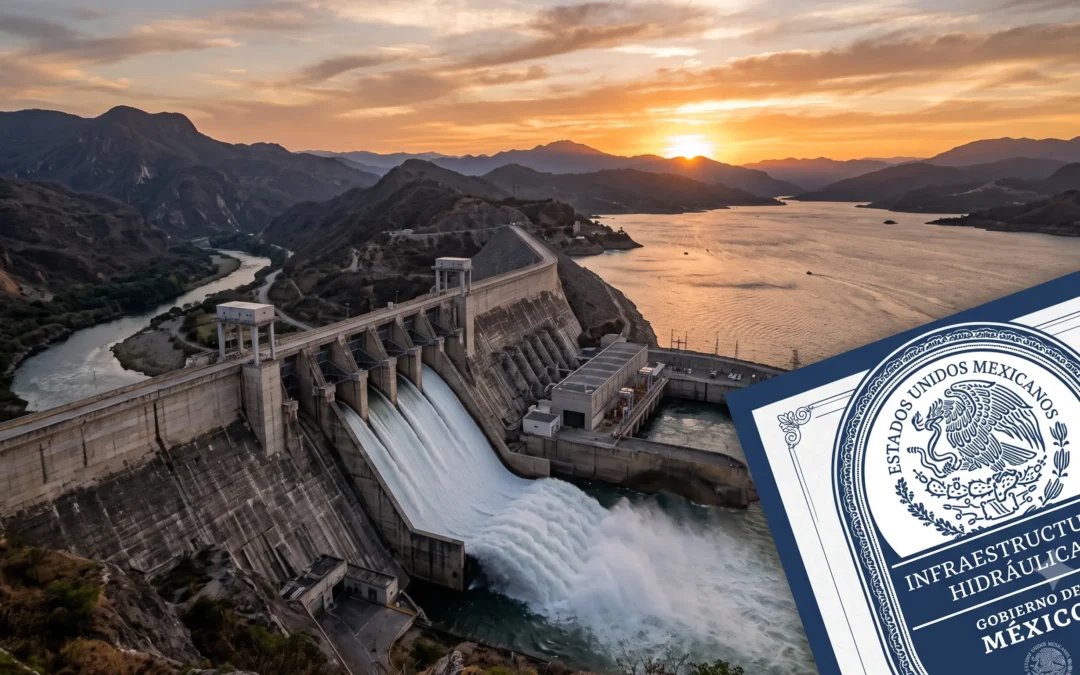
The regularization of national water concessions formally began on July 16, 2026, one day after the publication of the corresponding agreement in the Official Gazette of the Federation. Signed by the Director General of the National Water Commission, Efraín Morales López, the instrument opens a twelve-month window for individuals, ejidos (communal landholdings), municipalities, and irrigation districts to bring their expired water rights up to date between 2009 and July 2026. However, this opportunity comes with concrete risks: those who do not act within the deadline could face the expiration of unused water volumes. Therefore, understanding the true scope of the agreement is essential for any company with operations that depend on water resources in Mexico.
What does the water concession regularization agreement establish?
The instrument published on July 15, 2026, implements temporary administrative simplification measures. It applies to concession and allocation titles whose validity expired between January 1, 2009, and the agreement's entry into force. The condition is that the interested party had not requested an extension, or had submitted it after the deadline. The measures cover domestic, urban public, agricultural, livestock, and aquaculture uses. Agro-industrial use is expressly excluded, in accordance with Article 2, Section 17, of the Regulations of the National Water Law.
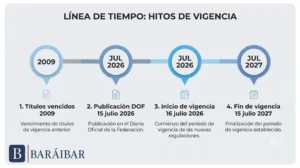
Twelve months of validity: from July 16, 2026 to July 15, 2027.
Regarding the beneficiaries, the agreement distinguishes three profiles. Irrigation districts, irrigation units, and ejidos (communal landholdings) can regularize their water usage without volume limits. Similarly, state and municipal governments that directly provide water services are exempt from volume limits. Individuals, however, have a limit of one million cubic meters per year. It is worth noting that this scheme aligns with the 2024-2030 National Water Plan, whose fourth pillar seeks comprehensive and transparent water management.
The program's legal basis is anchored in Article 24 of the National Water Law, which regulates concession extensions, and in the law's regulations. For its part, the authority justifies the measure as a direct response to what it has termed the "black market" for water rights, that is, the informal transfer of rights without the knowledge or control of the National Water Commission (Conagua).
🔗 EXTERNAL LINK: See the full agreement in the Official Gazette of the Federation (DOF) → https://dof.gob.mx/nota_detalle.php?codigo=5793639&fecha=15/07/2026
Requirements to access the regularization of water concessions
Thirteen requirements are necessary to qualify for the program, and none are optional. Among the most important are having a property in operation for the last two years, having a meter installed, and being up-to-date on payments for the last five fiscal years. Additionally, the applicant must not have any pending administrative sanction proceedings related to the property title they intend to regularize.
This documentary requirement is not accidental. Consequently, the Federal Government seeks to regulate the concession system and reduce the informal market for permits to extract groundwater. Centralized control falls to Conagua through the National Public Water Registry, which will compile information on ownership, authorized volumes, and actual water use reported by each concession holder.
Minimum recommended documentation
- Certified copy of the original concession or assignment title
- Proof of payment of fees for the last five fiscal years
- Photographic and technical evidence of the capture work in operation
- Certificate of no outstanding debt with the National Water Commission
- Report of extracted volumes, when a meter is installed.
In practice, several errors delay the process: submitting the title without proof of payment for the last five years, or failing to report that the water intake structure has changed location without formal registration with Conagua (the National Water Commission). For example, if the authority detects inconsistencies between the reported volume and the actual usage observed in the field, the process can be suspended until the discrepancy is clarified. Therefore, it is advisable to gather all the necessary documentation from the beginning, rather than waiting for a later request.
⚖️ Do you have questions about this topic? The lawyers at Baráibar & Asociados in Mexico City can guide you. Schedule your consultation today.
Risk of expiration if the regularization of water concessions is not addressed in time
Anyone who chooses to ignore this administrative window faces a quantifiable risk. The agreement instructs Conagua to verify, for two years after its entry into force, the actual use of the allocated water volumes. For its part, the authority will conduct reconciliation processes to adjust the authorized volume to the volume actually used, taking into account national water security and the marginalization index of the populations involved.
For businesses, this means that unused water rights could be subject to expiration. Therefore, it is crucial to maintain robust documentation regarding water usage, metering, and timely payment of fees. If the entire allocated volume is not used, companies can also initiate procedure CONAGUA-01-019 to interrupt the expiration of the rights corresponding to the unused volumes.
Let's consider the case of a medium-sized agro-industrial plant that was granted a specific water allocation a decade ago, but which today consumes only a fraction of that amount. Under the new system, that difference could be returned to the national water supply without any compensation. Therefore, conducting an internal audit of actual consumption becomes a preventative measure, not just an administrative one.
🔗 INTERNAL LINK: Learn how to defend yourself against acts of administrative authority → https://baraibar.com.mx/reforma-lfpca-2026/
Impact of the regularization of water concessions on industrial and infrastructure sectors
Although this first phase is aimed at non-industrial uses, its effects extend to sectors with higher water consumption. The December 2025 reform to the National Water Law replaced traditional mechanisms for transferring water rights with reassignment schemes subject to the direct intervention of the National Water Commission (Conagua). It also incorporated a national water reserve fund to reincorporate unused volumes and limited the validity of the water guarantee to a maximum of five years.
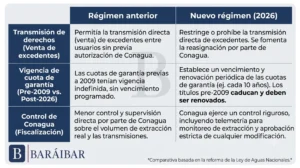
The new scheme centralizes the reassignment of water rights in Conagua.
These measures have direct relevance for water-intensive manufacturing, mining, energy, and data center projects. Any water rights management for new developments must be processed directly with Conagua, with no option to acquire water volumes through private transfer of water rights with a change of use.
A concrete example illustrates the change. Before the reform, a manufacturing company could acquire additional water volumes by purchasing a water rights from another concessionaire, with a simple subsequent notification to Conagua (the National Water Commission). Today, however, that same operation requires demonstrating to the authority that the corresponding basin has actual water availability, which can considerably lengthen the planning time for a new industrial project.
Sectors with greater exposure to the new regime
- Manufacturing and data centers: They require constant volumes and depend entirely on the direct allocation of Conagua.
- Mining: It faces greater scrutiny under the new water crimes regime incorporated in the December 2025 reform.
- Real estate development: You should verify the actual availability of water before committing to new projects.
- Agribusiness: Although excluded from this first stage, it must anticipate future phases of sectoral regularization.
Therefore, legal and corporate compliance departments must incorporate this new regime into their water risk assessment before initiating any project that requires a new concession.
Implications for irrigation districts, communal lands, and agricultural operations
Irrigation districts, irrigation units, and ejidos are among the main beneficiaries of the agreement, as they can regularize their water titles without volume limits. However, this advantage does not exempt these entities from complying with the thirteen general requirements, including proof of an operational project for the past two years.
In practice, many irrigation districts operate infrastructure built decades ago, with documentation scattered across various agencies. Therefore, the first recommended step is to reconstruct the technical file for each permit before contacting Conagua directly. Otherwise, the lack of an organized file can prolong the process beyond what is expected.
Furthermore, the volume reconciliation stipulated in the agreement will take into account food security and the marginalization index of the beneficiary populations. Consequently, municipalities that directly provide drinking water services should take advantage of the absence of volume limits to regularize all of their supply sources, thus avoiding future disputes with the National Water Commission.
📋 Don't face this process alone. At Baráibar & Asociados, we have specialists in Administrative and Corporate Law ready to defend your interests in Mexico City.
Legal context: from the National Water Law to the General Water Law
For nearly three decades, the 1992 National Water Law regulated the granting of concessions under a primarily administrative approach, with little emphasis on tracing actual water use. However, this approach changed with the December 2025 reform, which substantially modified the National Water Law itself and gave rise to the new General Water Law.
The General Water Law, published on December 11, 2025, is based on a different premise: water is no longer understood as a mere commodity but is expressly recognized as a human right. This paradigm shift translates into concrete mechanisms, such as the national water reserve fund and the limitation of the guaranteed quota to five years.
In this context, the agreement to regularize water concessions serves as the first operational instrument of this new policy. It does not modify the existing legal framework, but it does put it into practice by offering a concrete administrative process for clearing the registry of expired permits. It is also worth noting that this transition coincides with a strengthening of the sanctions regime, aimed at penalizing unauthorized water extraction and the misuse of hydraulic infrastructure.
For businesses, understanding this regulatory evolution is not an academic exercise. How Conagua interprets and applies the water concession regularization agreement in the coming months will set the tone for the program's subsequent stages. Therefore, it is advisable to closely monitor the operational criteria that the authority publishes, rather than assuming that the text of the agreement contains all the relevant information for the process.
🔗 EXTERNAL LINK: Consult the current text of the General Water Law → https://www.diputados.gob.mx/LeyesBiblio/pdf/LGAg.pdf
How to prepare for the new water policy in Mexico
The regularization of water concessions should be understood as part of a broader policy of traceability and state control over water resources. For companies, this means proactively reviewing the status of each concession title and assessing the advisability of joining the program before its expiration on July 15, 2027.
Recommended steps before applying for regularization
- Internally audit all current or expired concession and allocation titles.
- Verify the installation and calibration of extraction meters.
- Gather proof of payment of fees for the last five fiscal years.
- Confirm that there are no open sanctioning procedures before Conagua.
- Submit the application with specialized legal support before the twelve-month period expires.
It is also advisable to review any pending concession, extension, or modification procedures, as the agreement allows for the registration of favorable resolutions issued since April 1, 2019, in the National Public Water Registry. Otherwise, the risk of losing unused volumes will increase as Conagua progresses with its verification processes.
🔗 INTERNAL LINK: Review the implications of the 2025 Amparo Law for companies in Mexico City → https://baraibar.com.mx/reforma-ley-de-amparo-2025-empresas-cdmx-2/
⚖️ Protect your company's water resources with expert legal advice from Baráibar & Asociados.
Conclusion
The regularization of water concessions represents a limited-time opportunity, not a mere administrative formality. Those with permits that expired between 2009 and July 2026 must act within the twelve-month validity period of the agreement to avoid the expiration of unused water volumes. Furthermore, the new water traceability regime requires companies in all sectors to strengthen their documentation submitted to Conagua (the National Water Commission). Finally, having specialized legal support makes all the difference between taking advantage of the regularization window and facing costly expiration proceedings in the future.
Frequently asked questions about the regularization of water concessions
Who can access the regularization of water concessions in 2026?
Irrigation districts, irrigation units, ejidos, federal entities, municipalities and individuals with titles that expired between 2009 and July 2026 can access it, in accordance with the agreement published in the DOF on July 15, 2026 and article 24 of the National Water Law.
What happens if I don't regularize my concession within the deadline?
The unused volume may be subject to a declaration of forfeiture. Conagua will verify actual usage during the two years following the entry into force of the agreement, in accordance with the powers granted to it by the current National Water Law.
Does the agreement apply to industrial use concessions?
Not directly, since the agreement expressly excludes agro-industrial use volumes, in accordance with article 2, section 17, of the Regulations of the National Water Law, although the general traceability regime does affect industrial sectors.
How long does the regularization agreement remain valid?
It is valid for 365 calendar days starting on July 16, 2026, so the term ends on July 15, 2027, as established in the agreement itself published in the Official Gazette of the Federation.
What documents do I need to start the process with Conagua?
Among other documents, a certified copy of the title, proof of payment of fees for the last five fiscal years, evidence of the work in operation and proof of no debt are required, in accordance with the thirteen requirements set out in the agreement.
Can I avoid expiration if I don't use my entire allocated volume?
Yes, it is possible to initiate the CONAGUA-01-019 procedure to interrupt the expiration of rights related to unused volumes, provided that a justified cause is proven before the corresponding authority.
Legal references: Official Gazette of the Federation (July 15, 2026); National Water Law and its Regulations; General Water Law (DOF, December 11, 2025); National Water Plan 2024-2030.
This article is for informational purposes only and does not constitute formal legal advice or establish an attorney-client relationship.