
by paulina@baraibar.com.mx | Aug 24, 2026 | Corporate Law, Labor Law
Housing benefits offered as alternatives to Infonavit can no longer simply replace the legal obligation to contribute to the institute. This was determined by the full Supreme Court of Justice of the Nation on August 3, 2026, in its ruling on Amparo Appeal 633/2026. The case arose from a claim by a retired Pemex employee who demanded recognition of his unpaid contributions. Therefore, this ruling mandates a thorough review of any internal housing program offered by a company as a substitute for legal contributions. Consequently, legal and human resources directors must take action before the issue escalates to litigation.
What did the Supreme Court of Justice of the Nation (SCJN) decide regarding alternative housing benefits to Infonavit?
The full Court confirmed that the benchmark for evaluating any alternative housing system is the Infonavit Law, along with Article 136 of the Federal Labor Law. It is not sufficient, therefore, for a company's internal regulations to provide benefits such as rental assistance or support for acquiring a home. Furthermore, the courts must expressly compare these extra-legal benefits against the legal framework that protects the right to housing. Only in this way can it be determined whether the scheme offers benefits equal to or greater than those required by law. Otherwise, the company remains obligated to make the corresponding contributions to the National Workers' Housing Fund Institute (Infonavit).
It is worth noting that this ruling stems from a labor matter, but its scope extends beyond the energy sector. Any Mexican company with its own housing benefit schemes that operate as alternatives to Infonavit now faces the same standard of review. Furthermore, the ruling confirms that an internal work regulation, by itself, does not replace the constitutional obligation established in Article 123, Section A, Paragraph XII.
Background: The Case of a Retired Pemex Worker
A former Pemex employee filed a labor lawsuit claiming various benefits that were not provided during his employment. Among these, he demanded recognition and payment of the contributions omitted from his Infonavit (National Workers' Housing Fund Institute). In the first instance, the labor authority ordered the company to register him with the IMSS (Mexican Social Security Institute) and make the corresponding contributions. However, a collegiate court overturned that ruling, considering that Pemex's Regulations for Management Personnel provided for their own housing system.
Articles 47 and 76 of this regulation provide for benefits such as housing allowances and financial support for home purchases. For this reason, the collegiate court determined that Pemex was exempt from contributing to Infonavit. However, the worker appealed this decision to the Supreme Court. Ultimately, the full court overturned the lower court's ruling and returned the case to the collegiate court for a new decision, this time in accordance with the parameters established by the Supreme Court.
Do you have questions about this? The lawyers at Baráibar & Asociados in Mexico City can guide you. Schedule your consultation today.
Why are Internal Regulations Not Enough to Replace Infonavit?
The Legal Parameter: Infonavit Law and Article 136 of the LFT
The Court was clear: no internal regulations can supersede the legal social security system. On the contrary, any alternative scheme must be measured against the Infonavit Law and Article 136 of the Federal Labor Law, which establishes the employer's obligation to contribute to the housing fund. Therefore, housing benefits that are alternatives to Infonavit are only valid when they offer a benefit equal to or greater than the legally mandated one. Likewise, the company must demonstrate this equivalence with objective and verifiable data, not with a mere contractual declaration.
The Mandatory Comparison Between Extralegal and Legal Benefits
Collegiate courts can no longer simply verify the existence of internal regulations regarding housing benefits. Instead, they must conduct an explicit comparative analysis between the two systems. For example, if the rental assistance offered by a company is less than the amount it would contribute to Infonavit, the alternative scheme does not meet the constitutional standard. In that case, the company must regularize its contributions and could face tax penalties, surcharges, and interest adjustments.
Other Criteria of the SCJN in the Same Session of August 3, 2026
The ruling on alternative housing to Infonavit was not the only one issued. That same day, the full court resolved three other matters of importance to businesses and individuals. First, it confirmed that declarations of Protected Natural Areas are a valid form of property ownership, without triggering the right to a prior hearing under Article 14 of the Constitution. Second, it upheld the constitutionality of the desk audits provided for in the Social Security Law, considering them an act of intrusion in accordance with Article 16 of the Constitution.
Additionally, the Plenary established binding precedent requiring collegiate courts to assume full jurisdiction when ruling on suspensions in direct amparo proceedings, when the omission of the responsible authority is deemed justified. Taken together, these rulings demonstrate a particularly active session regarding economic, social, and procedural rights, with a direct impact on the relationship between companies, authorities, and workers.
Impact on State-Owned Enterprises and the Energy Sector
The origin of this legal precedent in a case against Pemex is not accidental. For decades, various state-owned enterprises and parastatal entities have had internal regulations offering housing benefits alternative to Infonavit (the Mexican National Housing Fund) to their management personnel. For example, the Federal Electricity Commission (CFE) and other entities in the energy sector maintain similar schemes, inherited from historical collective bargaining agreements. Consequently, these entities now face the same requirement for documented comparison with the legal framework.
Similarly, private companies operating under specialized outsourcing schemes or that inherited personnel management regulations from other public entities must review their situation. Therefore, it is not enough to argue that a scheme “has always worked this way”; the Court now requires technical and comparative support, updated according to the realities of the real estate market in each region of the country.
What does this criterion mean for companies with their own housing schemes?
Numerous Mexican companies, particularly in the energy, industrial, and service sectors, offer housing benefits as alternatives to Infonavit as part of their compensation packages. However, very few have formally documented the equivalence between these benefits and the legal system. For this reason, the Supreme Court's ruling represents an urgent call for self-evaluation. Failure to do so leaves the company vulnerable to a claim for retroactive payment of unpaid contributions by an employee at any point during the employment relationship or even after retirement.
Furthermore, the issue is not limited to the workplace. There is also a significant tax risk, as Infonavit can determine credits for omitted contributions, with interest and penalties that accrue over time. For their part, affected workers retain the option of pursuing legal action to demand recognition of their rights, as occurred in the case resolved by the full court.
Statute of Limitations and Time Limits for Claiming Omitted Contributions
It is important to remember that labor actions related to social security benefits are subject to statutes of limitations. As a general rule, the Federal Labor Law establishes a one-year period to demand compliance with benefits arising from the employment relationship, counted from the date the obligation became due. However, regarding contributions to Infonavit (the Mexican National Housing Fund), various judicial rulings have modified this period, especially when the omission is continuous throughout the entire employment relationship.
For this reason, a company should not assume that the passage of time automatically protects it from claims like the one resolved by the Plenary. Instead, it is advisable to address the contingency proactively, before an active or retired employee decides to assert their rights in labor courts.
Risks of Non-Compliance Regarding Alternative Housing to Infonavit
Among the main risks a company faces without documented comparisons are the following: tax credits for omitted contributions, accumulated updates and surcharges, individual or collective labor lawsuits, and reputational damage with investors and authorities. Similarly, a poorly designed scheme can generate contingent liabilities that affect audit processes, mergers, or acquisitions.
On the other hand, companies operating under collective bargaining agreements should review whether their housing clauses comply with the standard set by the Court. In many cases, these clauses were drafted years ago, without updating their amounts to reflect inflation or the actual cost of housing in Mexico. This outdated information increases the risk that the benefit will be less than the legally mandated amount. Similarly, in mergers and acquisitions, contingent liabilities for omitted contributions often emerge as significant findings during labor due diligence, which can affect the final transaction price. Therefore, mergers and acquisitions teams should incorporate this criterion as a standard part of their checklist before closing any deal.
Don't face this process alone. At Baráibar & Asociados, we have specialists in Labor and Corporate Law ready to defend your interests in Mexico City.
Labor Compliance Recommendations for 2026
First, every company offering housing benefits other than those provided by Infonavit should commission a comparative audit of its internal regulations against the Infonavit Law. Next, it is advisable to document in writing the technical analysis that supports the equivalence of benefits, using updated figures and objective criteria. Likewise, it is prudent to review collective bargaining agreements and individual labor contracts to verify that the housing clauses reflect current and reasonable amounts.
Similarly, it is advisable to establish an internal mechanism for periodic review, preferably annual, to update the amounts of alternative benefits as housing costs evolve. Finally, it is recommended to train the human resources department on this new jurisprudential standard so that any future benefits are designed in accordance with the parameters validated by the Court. Otherwise, the company will remain vulnerable to litigation like the case that prompted this ruling.
What Should a Housing Benefits Comparison Report Contain?
A technical comparison report should include several specific elements. First, a detailed list of the housing benefits currently in effect under the company's internal regulations, with exact amounts and payment schedules. Second, a calculation of the corresponding contribution under the Infonavit Law for the same group of workers, considering their base salary for social security contributions. Third, a comparative table showing, month by month, the difference between the two schemes.
The report must also identify workers covered by the alternative scheme, distinguishing between management, unionized, and retired personnel. Labor lawyers recommend updating this document every fiscal year, given that minimum wages and contribution caps change periodically. A regulation that has been in effect for several years likely no longer reflects current housing market conditions.
Companies with operations in multiple states face an additional challenge: housing costs vary significantly across regions. A uniform national benefit might be sufficient in some cities but insufficient in others, particularly in metropolitan areas with high real estate demand. Documenting this regional variation strengthens the company's defense against any subsequent review, whether administrative or judicial.
How to proceed if your company offers housing benefits other than Infonavit?
If your company has its own housing program, the first step is to gather all the necessary documentation for the benefit: amounts, frequency, covered population, and eligibility requirements. Next, it's advisable to compare this information with the requirements of the Infonavit Law for the same group of workers. If a discrepancy is identified, the company can choose to adjust the program, supplement it, or switch to regular contributions.
Furthermore, this review should be carried out with specialized legal support, as it involves labor, social security and, sometimes, tax regulations.
EXTERNAL LINK: Infonavit Law
EXTERNAL LINK: Federal Labor Law, Article 136
EXTERNAL LINK: SCJN Press Release No. 108/2026
Additionally, it is useful to review how other recent Court rulings have modified the relationship between companies and authorities.
INTERNAL LINK: Amparo Law 2025: Strategic Guide for Companies in Mexico City
INTERNAL LINK: Labor certification for agricultural exports + environmental grounds
Protect your company with expert legal advice from Baráibar & Asociados before a housing contingency turns into litigation.
Conclusion
The Supreme Court's ruling marks a turning point for alternative housing benefits to Infonavit in Mexico. From now on, no internal regulation alone will be sufficient to exempt a company from its legally mandated contributions. On the contrary, each scheme must demonstrate, with objective data, that it offers benefits equivalent to or greater than those required by law. Companies that act proactively will reduce their exposure to litigation, tax liabilities, and labor disputes. Conversely, those that ignore this ruling could face claims similar to the one that prompted the Supreme Court's intervention.
Frequently Asked Questions (FAQs)
What did the Supreme Court decide regarding alternative housing benefits to Infonavit?
The Plenary determined that these benefits must be expressly compared against the Infonavit Law and Article 136 of the Federal Labor Law, in accordance with Amparo in Review 633/2026 resolved on August 3, 2026.
Can a company be exempt from contributing to Infonavit if it offers housing on its own?
Only if it demonstrates, with objective data, that its scheme offers benefits equal to or greater than those legally mandated. Otherwise, it remains obligated to make contributions in accordance with the Infonavit Law and Article 123 of the Constitution.
Which companies should review their housing benefits as alternatives to Infonavit?
Any company with internal regulations, collective agreements or its own schemes that replace legal contributions, especially in energy, industrial and service sectors with high staff turnover.
What risks does a company face without this documented comparison?
Tax credits for omitted contributions, surcharges, updates, labor claims and contingent liabilities that may affect audits or merger processes, according to the criteria set by the Plenary.
What happened to the specific case that the Court resolved?
The Plenary revoked the ruling of the collegiate court and returned the matter for a new resolution to be issued, applying the comparative parameter between the Pemex regulations and the Infonavit Law.
Where can I find the full Supreme Court ruling?
The criterion is found in Press Release No. 108/2026 of the SCJN and in the file of the Amparo in Review 633/2026, resolved in the Plenary session of August 3, 2026.
Legal References
- Press Release SCJN No. 108/2026, August 3, 2026.
- Amparo en Revisión 633/2026, Pleno de la SCJN.
- Law of the National Housing Fund Institute for Workers.
- Federal Labor Law, articles 136 and 516.
- Political Constitution of the United Mexican States, article 123, section A, subsection XII.
This article is for informational purposes only and does not constitute formal legal advice or establish an attorney-client relationship.

by paulina@baraibar.com.mx | Aug 7, 2026 | Labor Law
The reduction of the workweek is now a legal reality in Mexico, although its full implementation will take several years. Since March 2026, Article 123 of the Constitution has stipulated that the maximum workweek will gradually decrease from 48 to 40 hours by 2030. Therefore, every company operating in the country must adjust its schedules, payroll, and contracts as the official timeline progresses. This guide explains the origin of the reform, its exact timeline, and the practical obligations employers face in Mexico City and throughout the rest of the country.
1. What is the reduction of working hours and how was it approved?
The reduction of the workweek is a constitutional reform that modifies sections IV and XI of Article 123, paragraph A, to lower the weekly work limit from 48 to 40 hours. The Senate approved the bill on March 3, 2026, and the Official Gazette of the Federation published the decree that same day, making its constitutional component immediately effective.
However, the constitutional reform alone does not immediately change everyday labor relations. For this reason, Congress also approved changes to the Federal Labor Law, which were published in the Official Gazette of the Federation on May 1, 2026. Consequently, there are now two regulatory levels: the constitutional mandate, which sets the ultimate goal, and secondary legislation, which defines the specific mechanisms for transitioning to the new work schedule.
According to the Senate's approved ruling, the reform garnered broad political support, with 104 votes in favor in the April 2026 vote. Subsequently, the Chamber of Deputies ratified the bill on April 22, without substantial changes to the original draft. This legislative consensus largely explains the speed with which both the constitutional decree and its secondary legislation were published, in a period of just two months.
Compared to other recent labor reforms, this initiative enjoyed simultaneous support from both labor unions and business associations, although the latter expressed reservations about the pace of implementation. Therefore, the final text incorporated a phased five-year timeline, rather than immediate implementation, precisely to allow productive sectors time to adapt.
2. Implementation schedule 2026-2030
The reduction schedule is gradual and mandatory for all employers in the country. During 2026, the workweek will remain at 48 hours, as it currently operates. Starting in 2027, the limit will decrease to 46 hours; in 2028, to 44 hours; in 2029, to 42 hours; and finally, in 2030, the target of 40 hours per week will be reached.
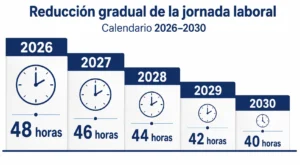
It is important to note that the reform expressly prohibits reducing workers' salaries or benefits as a result of reduced hours. In other words, companies must maintain the same full salary even if actual working time decreases. Furthermore, the reform does not differentiate based on company size or economic sector, meaning that both SMEs and multinational corporations must comply with the same schedule.
For example, a company that currently pays an employee a fixed monthly salary for 48 hours per week will have to pay the same salary for 46 actual hours of work by 2027. In practical terms, this equates to an increase in the cost per hour worked, even if the total payroll remains nominally unchanged. Consequently, finance and human resources departments will need to coordinate their budget projections, taking this cumulative effect into account over the next four years.
| Do you have questions about this topic? The lawyers at Baráibar & Asociados in Mexico City can guide you. Schedule your consultation today. |
3. Key changes to the Federal Labor Law following the reduction of the working day
The reform to the Federal Labor Law, published on May 1, 2026, adapts the secondary legal framework to the new constitutional work schedule. This regulatory adjustment modifies provisions regarding overtime, rest periods, and the weekly distribution of working time, in order to provide legal certainty to both employers and employees during the transition period toward 2030.
Overtime and weekly limits
Before the reform, the law allowed a maximum of nine overtime hours per week. Now, that limit increases to twelve hours per week, although these cannot exceed four hours per day distributed over a maximum of four days. Therefore, companies will need to redesign their shift schedules and overtime pay systems, especially in sectors such as manufacturing, logistics, and retail, where extended workdays are common.
This involves reviewing attendance control systems to accurately differentiate between regular and overtime hours as the weekly limit changes each year. Otherwise, miscalculating overtime can lead to incomplete payments and, potentially, labor lawsuits for wage discrepancies.
Mandatory day off and full pay
Furthermore, the reform reinforces the obligation to grant at least one paid day off for every six days worked. It also clarifies that the gradual reduction of working hours should not result in disguised salary cuts or the elimination of previously granted benefits. For its part, the Ministry of Labor and Social Welfare will issue additional operational guidelines as each stage of the 2027-2030 timeline progresses.
It is worth noting that these guidelines could include specific criteria for mixed work schedules, shift work, and work-from-home arrangements—modalities that current law does not always regulate precisely. Consequently, the Ministry of Labor and Social Welfare (STPS) is expected to publish supplementary rules before the first effective reduction takes place in January 2027.
4. Economic and operational impact on companies
The economic impact of this reform varies considerably by sector. Labor-intensive industries, such as manufacturing, construction, and retail, will face greater pressure to maintain production levels with fewer available hours per worker. For example, a plant that currently operates with 48-hour shifts will need to consider additional hiring, technological upgrades, or process redesign by 2027.
Several business associations have requested differentiated transition periods by sector, arguing that a uniform reduction could disproportionately affect industries with lower profit margins. To date, however, the constitutional timetable does not include sectoral exceptions, so any differentiated adjustments would depend on additional reforms to secondary legislation.
On the other hand, sectors with already flexible work schedules, such as some areas of professional services and technology, could absorb the change with less operational friction. However, all companies will need to update their internal attendance policies, timekeeping systems, and payroll structures, since the calculation of overtime and breaks will change as each phase of the official calendar progresses.
Furthermore, it's important to anticipate the effect on productivity per hour worked. Companies that already measure performance indicators by results, rather than by physical hours spent at the workplace, will likely absorb the transition with less financial impact than those organizations still anchored to traditional timekeeping systems.
5. Sectors with the highest risk of non-compliance
Certain sectors face a particular risk of non-compliance during the transition. For example, the export manufacturing sector, with its 48-hour rotating shift schedules, will need to rethink its operational organization starting in 2027. Similarly, the retail sector, which operates with extended hours on weekends, will have to review the distribution of mandatory rest periods to avoid penalties.
Similarly, the construction sector, where working hours are typically tied to project deadlines, will face difficulties in reconciling reduced hours with contractual timelines agreed upon with clients. Therefore, it is recommended that these industries begin an internal assessment now, rather than waiting until each deadline in the 2027-2030 calendar approaches.
The call center and customer service sector, which operates with staggered 24-hour shift schedules, will also face additional challenges in distributing mandatory breaks without disrupting service. Finally, the agricultural sector, subject to harvest seasons with intensive workdays, will need to negotiate accumulated work schedules in advance that comply with the new weekly limit.
In all these cases, the recommendation is the same: document each operational adjustment with legal backing, instead of improvising informal solutions that later prove difficult to defend in the event of a labor inspection or a lawsuit from a worker.
| Don't face this process alone. At Baráibar & Asociados, we have specialists in Labor Law ready to defend your interests in Mexico City. |
6. What should companies do to prepare?
First, it's advisable to conduct an audit of current schedules to identify areas and positions most affected by the reform. This audit should include a detailed breakdown by department, shift, and contract type, so the company has accurate data before negotiating any adjustments with unions or employee representatives. Additionally, it's recommended to model the financial impact of each stage of the schedule, considering potential hiring or investments in automation.
A third step involves mapping positions with rotating shift schedules or frequent overtime, as these will concentrate the majority of the legal and financial risk during the transition. Internal legal departments, for their part, should establish their own regulatory review schedule now, aligned with each effective date of the official 2027-2030 calendar.
Contractual and payroll adjustments
It is also prudent to review collective and individual employment contracts to ensure they accurately reflect the new limits on working hours and overtime. Similarly, payroll and attendance systems must be updated before 2027 to avoid errors in calculating earnings and overtime pay. Finally, it is advisable to train middle managers on the new regulations, as they typically manage the schedules of operational staff directly.
These middle managers, in their daily work, are the ones who authorize overtime, approve breaks, and resolve attendance issues. Consequently, inadequate training at this hierarchical level often results in operational non-compliance, even when corporate policies are correctly written on paper.
7. Legal risks of non-compliance
Failure to comply with the new work schedule may result in lawsuits before the Conciliation and Arbitration Board or the corresponding labor courts, in addition to administrative sanctions imposed by the Ministry of Labor and Social Welfare. For example, exceeding the permitted overtime limits or failing to grant the mandatory day of rest may generate significant employer liability.
Similarly, reducing salaries or benefits under the pretext of decreased working hours constitutes a direct violation of the constitutional reform. Consequently, companies that implement salary adjustments without legal justification risk costly labor disputes and reputational damage. For their part, unions and workers' representatives have already announced that they will closely monitor compliance with each phase of the official timeline.
🔗 INTERNAL LINK: Labor certification for agricultural exports → https://baraibar.com.mx/certificacion-laboral-para-agroexportacion-causales-ambientales/
🔗 INTERNAL LINK: 2025 Amparo Law Reform for Businesses in Mexico City → https://baraibar.com.mx/reforma-ley-de-amparo-2025-empresas-cdmx-2/
🔗 EXTERNAL LINK: Official Gazette of the Federation (DOF) Decree, constitutional reform to Article 123 → https://www.dof.gob.mx/nota_detalle.php?codigo=5781417&fecha=03032026
🔗 EXTERNAL LINK: Official Gazette of the Federation (DOF) Decree, amendment to the Federal Labor Law → https://www.dof.gob.mx/nota_detalle.php?codigo=5786537&fecha=01052026
| » Protect your company's operations with expert legal advice from Baráibar & Asociados in the face of this new work calendar. |
Conclusion
This reduction in the workday will gradually transform the relationship between companies and workers until 2030. Although 2026 still operates under the 48-hour workweek, the regulatory clock is already ticking for every employer in Mexico. Therefore, anticipating this through internal audits, payroll adjustments, and training is more cost-effective than facing penalties or labor disputes later on.
Companies that begin their transition plan from 2026 onward, rather than waiting until the last quarter of 2027, will have more time to negotiate with unions, redesign processes, and train their teams without operational pressure. At Baráibar & Asociados, we support companies through every phase of this regulatory transition process, from the initial assessment to the final contract update.
Frequently asked questions about reducing working hours
When does the reduction in working hours come into effect? The schedule is gradual: 48 hours in 2026, 46 in 2027, 44 in 2028, 42 in 2029 and 40 hours per week from 2030 onwards, according to the decree published in the DOF on March 3, 2026.
Does a reduction in hours imply a lower salary? No. The constitutional reform expressly prohibits reducing workers' salaries or benefits as a consequence of the gradual reduction of the weekly working hours.
How many overtime hours can be worked now? The limit increased from nine to twelve hours per week, distributed in a maximum of four hours per day for up to four days, according to the reform to the Federal Labor Law published on May 1, 2026.
Which companies must comply with this reform? All companies operating in Mexican territory, regardless of size or economic sector, must comply with the constitutional schedule for reducing working hours until 2030.
What if a company doesn't meet the deadline? You may face labor lawsuits, administrative sanctions from the Ministry of Labor and Social Welfare, and employer liability for violations of working hours and overtime limits.
Should I update my employment contracts now? It is recommended. Reviewing collective and individual contracts, as well as payroll systems, before 2027 avoids calculation errors and reduces legal risks during the transition.
Legal references
- Official Gazette of the Federation, Decree of constitutional reform to article 123, section A, March 3, 2026.
- Official Gazette of the Federation, Decree reforming the Federal Labor Law, May 1, 2026.
- Political Constitution of the United Mexican States, article 123, section A, subsections IV and XI.
- Federal Labor Law, provisions on working hours, breaks and overtime.
This article is for informational purposes only and does not constitute formal legal advice or establish an attorney-client relationship.

by paulina@baraibar.com.mx | Mar 20, 2026 | Labor Law
The 40-hour work week reform in Mexico It's now a reality. On May 1, 2026, President Claudia Sheinbaum enacted the decree amending the Federal Labor Law and initiating the transition to a 40-hour workweek. This reform is undoubtedly the change with the greatest immediate impact on businesses in recent years.
If your company operates in Mexico City or any other state in the country, you need to understand what's changing, when it's changing, and what the legal consequences of non-compliance may be. This guide analyzes each key aspect: the phased-in schedule, new obligations for employers, mandatory electronic registration, and applicable fines.
What does the Labor Reform Published on May 1, 2026 Establish?
The decree published in the Official Gazette of the Federation (DOF) on May 1, 2026, amends, adds to, and repeals various provisions of the Federal Labor Law. Specifically, it modifies Articles 59, 61, 66, 68, 69, and 71, and adds section XXXIV to Article 132, as well as section IV Bis to Article 994.
The main objective is to regulate the constitutional reform to article 123 that was published on March 3, 2026. With that constitutional change, Mexico established the maximum work week of 40 hours as a fundamental right.
The LFT decree specifies the following:
- The maximum ordinary daytime working hours will be 8 hours; the night shift, of 7 hours; and the mixed one, of 7.5 hours.
- The sum of ordinary and overtime hours may not exceed 12 hours a day.
- For every six days of work, the employer must grant at least a day of rest with full salary.
- Reductions in salaries, wages, or benefits as a result of this reform are prohibited.
In short, the law has already changed. What is being phased in is the maximum weekly working hours, not the effective date of the law itself.
Official Gradual Reduction Schedule: From 48 to 40 Hours between 2026 and 2030
One of the most important aspects of business planning is the phased reduction schedule. The decree is clear:
| Year |
Maximum weekly working hours |
| 2026 (until Dec.) |
48 hours (adjustment period) |
| 2027 |
46 hours |
| 2028 |
44 hours |
| 2029 |
42 hours |
| 2030 |
40 hours |
The effective reduction begins January 1, 2027The period from May 1 to December 31, 2026, is an adaptation phase. During this time, the Ministry of Labor and Social Welfare (STPS) will collect, process, and evaluate data to monitor the implementation of the change.
This means that companies have until December 31, 2026 to prepare: update contracts, internal regulations, human resources policies and implement electronic registration systems.
New Obligations for Employers: What Every Employer Must Comply
The reform doesn't just reduce working hours. It also imposes specific and verifiable obligations on all employers. The most relevant are listed below:
1. Electronic Work Record (Article 132, Section XXXIV)
From January 1, 2027, all employers must implement an electronic attendance control system that accurately records the entry time, rest periods, and exit time of each worker.
This record has full legal validity as evidence in court, provided it has been agreed upon between the employer and the employee. In other words, if there is a labor dispute regarding overtime, the digital time clock will be the primary evidence.
The STPS will soon issue the general provisions on the acceptable formats and methods for this registration.
2. Updating Contracts and Internal Regulations
Individual and collective contracts that establish working hours exceeding the new limit must be modified before December 31, 2026. The same applies to internal work regulations and human resources policies.
This is a mandatory compliance action, not optional. Failure to update contracts exposes companies to labor lawsuits.
3. Express Prohibition of Reducing Wages
The decree is unequivocal: no employer may reduce an employee's salary, wages, or benefits as a justification or consequence of a reduction in working hours. Any attempt to do so will be considered a serious violation of labor rights. The affected employee may demand retroactive payments and even compensation.
4. Limit on Overtime Hours
With the reform, the limit on weekly overtime hours will be gradually increased until it reaches a maximum of 12 hours By 2030, all overtime will be paid at double the regular rate, regardless of the amount worked. The previous system, where the first 9 hours were paid at double the rate and subsequent hours at triple the rate, will be eliminated.
⚖️ Do you need to adapt your company's employment contracts before December 31, 2026? At Baráibar & Asociados, we help you comply with the reform without risk. Contact us today in Mexico City.
Fines and Penalties: How Much Can Non-Compliance Cost Your Company?
Article 994, section IV Bis, of the Federal Labor Law establishes economic penalties for failure to comply with the obligation of electronic work hour registration. The fines range from 250 to 5,000 Units of Measurement and Update (UMA).
In 2026 values, that equates to between $29,327.50 and $586,550 Mexican pesos for infringement.
It is important to note that these penalties are calculated per affected worker. A company with 50 employees in non-compliance could face a potential penalty of several million pesos.
In addition to the economic aspect, failure to comply with working hours limits can lead to:
- Immediate inspections from the Ministry of Labor.
- Individual labor demands for unpaid overtime.
- Nullity of contractual clauses that contravene the new law.
- Joint and several liability for substitute patterns in business groups.
📋 Don't wait for an inspection. At Baráibar & Asociados, our Labor Law specialists in Mexico City conduct preventative audits to protect your company before 2027 begins.
Impact on Night Shifts, Mixed Shifts and Rest Days
The reform also specifies the rules applicable to special working days and mandatory rest days:
Special days: The day shift has a maximum of 8 hours; the night shift, 7 hours; and the mixed shift, 7.5 hours. These provisions were already in the Federal Labor Law, but are now being aligned with the new weekly limit.
Weekly rest: For every six days worked, the employee is entitled to one day of rest with full pay. The debate on whether the reform automatically implies two days of rest per week is not definitively resolved in the decree, but it is an issue that will have to be addressed in collective bargaining agreements and internal policies.
Sunday premium: People who work on Sundays are entitled to an additional premium of at least 25% on the ordinary salary of regular working days.
Minors: The reform expressly prohibits underage workers from working overtime. This is a special protective provision that employers must implement immediately.
Electronic Registration: Which Technology Complies with the Law?
Section XXXIV of Article 132 establishes that registration must be electronic, but does not specify the type of technology. The STPS (Ministry of Labor and Social Welfare) will define the technical requirements soon. However, the most common systems that already comply with the spirit of the standard are:
- Biometric readers (fingerprint, facial recognition).
- Mobile applications with geolocation, for remote or field work.
- Smart card systems or chip-enabled credentials.
- Attendance management platforms integrated into the payroll system.
The key point is that the registration must be agreed between the worker and the employer, and the employer has the obligation to keep it and show it to the authority when required.
For the purposes of labor litigation, this electronic record will constitute conclusive proof of the actual duration of the workday. This benefits both workers, who can prove unpaid overtime, and employers, who can demonstrate compliance.
What about collective bargaining agreements and unions?
The reform has a direct impact on collective bargaining agreements (CBAs). Those that establish working hours exceeding the new limit will need to be reviewed and modified. In sectors with a strong union presence, such as manufacturing, transportation, commerce, and services, this will entail collective bargaining renegotiations.
The Federal Labor Law (LFT) establishes that working conditions cannot be diminished. Therefore, if a collective bargaining agreement (CBA) established benefits exceeding those mandated by law (more days off, better-paid overtime), those conditions remain in place. The reform sets a minimum standard, not a maximum.
For companies, the collective bargaining window between May and December 2026 is strategic. Early legal advice can make the difference between an orderly transition and a costly collective dispute.
✒️ Anticipate the labor disputes that the reform may bring. Baráibar & Asociados has the experience in Labor Law to protect your company's contracts in Mexico City before the effective reduction of working hours begins in 2027.
Conclusion: The reform is now in effect. Your company must act now.
The reduction of the workweek from 48 to 40 hours is the most significant legal change for Mexican companies in the last decade. The decree has already been published. The law has already changed. What is being implemented gradually is the cap on working hours, but the preparation requirements are immediate.
Companies that take action before December 31, 2026, will have updated contracts, implemented record-keeping systems, and streamlined payroll processes. Those that wait will face fines, lawsuits, and the cost of a chaotic transition under pressure.
The time to act is now.
Frequently Asked Questions about the 40-Hour Labor Reform in Mexico
From when does the reduced working hours effectively apply? The effective reduction in working hours begins on January 1, 2027, with a limit of 46 hours per week. The period from May 1 to December 31, 2026, is an adaptation phase, as stipulated in the decree published in the Official Gazette of the Federation (DOF) on May 1, 2026 (Federal Labor Law, first transitional article).
Can the employer reduce the salary because fewer hours are now being worked? No. The decree expressly amends Articles 59 and 61 of the Federal Labor Law to prohibit any reduction in wages, salaries, or benefits resulting from a reduction in working hours. Doing so constitutes a serious violation of workers' labor rights.
What happens if my company does not implement electronic attendance registration? As of January 1, 2027, the lack of electronic registration is sanctioned with fines of between 250 and 5,000 UMA per infraction, equivalent to between $29,327 and $586,550 pesos in 2026, according to the new article 994, section IV Bis, of the LFT.
Are the current contracts still valid or do they need to be modified? Contracts stipulating workdays exceeding the new legal limit must be modified before December 31, 2026. Failure to do so creates legal risk, as clauses that contravene the Federal Labor Law are null and void, according to Article 33 of the Federal Labor Law.
Are overtime hours still paid the same as before? Not entirely. With the reform, all overtime hours will be paid at double the regular rate, without exception. The weekly overtime limit will be gradually adjusted until it reaches 12 hours by 2030, as stipulated in the amended Article 68 of the Federal Labor Law.
Does the reform also apply to domestic workers and agricultural workers? The Federal Labor Law (LFT) establishes special regulations for domestic and agricultural workers. However, the general principle of reduced working hours and the prohibition of wage reductions applies to all employment relationships. For specific sectors, it is advisable to review each case individually with a specialist.
Legal References
This article is for informational purposes only and does not constitute formal legal advice or establish an attorney-client relationship.
👉 Schedule a legal consultation at Baráibar & Asociados.
by paulina@baraibar.com.mx | Mar 14, 2026 | Labor Law
The prescripción en responsabilidad civil dejó de ser una discusión “de trámite” cuando el daño deriva de muerte o lesiones. Desde el March 6, 2026, un criterio publicado en el Semanario Judicial fijó una línea clara: en responsabilidad extracontractual objetiva por riesgo creado, si la pretensión resarcitoria se vincula con vida o integridad, debe preferirse el plazo de 10 años y no el bienio. La razón no es retórica: jerarquía del bien jurídico, acceso efectivo a la justicia and justa indemnización.
Para empresas con operación en transporte, logística, construcción, manufactura, salud, eventos, inmuebles o energía, esto impacta riesgo legal, reservas, evidencia, seguros y estrategia procesal. También redefine cómo se litiga (y se defiende) en CDMX cuando hay componentes interestatales o criterios constitucionales trasladables.
1) Qué cambió en 2026: el bienio ya no es “automático” si hay vida o integridad
El criterio publicado el viernes 6 de marzo de 2026 sostiene, en síntesis:
- En Sonora, para reclamar indemnización por responsabilidad extracontractual objetiva por riesgo creado, existen reglas bienales (arts. 2108 y 2114) y una regla decenal (art. 1330).
- Cuando el daño deriva de muerte o lesión a la integridad, se debe desplazar el bienio y aplicar el plazo de 10 años por ser bienes de máxima jerarquía; la regla abreviada se considera insuficiente porque es previsible que la atención inicial se concentre en la situación vital y sus consecuencias.
Dato técnico que importa para litigio: es tesis aislada de Tribunal Colegiado (V.2o.C.T.1 C (12a.)) y aparece en la Gaceta/Semanario con referencia al propio sistema de publicación semanal.
Implicación estratégica: si tu defensa se apoya “por defecto” en prescripción bienal en asuntos con lesiones graves o fallecimiento, ese argumento ya no es de baja fricción. Exige análisis constitucional y de proporcionalidad del plazo, no sólo lectura literal.
2) Fundamento constitucional y doctrina SCJN: acceso a justicia y proporcionalidad del plazo
El criterio de 2026 no nace aislado. Se apoya en una línea de la Suprema Corte (Primera Sala) que distingue entre:
- reclamaciones por afectaciones patrimoniales, donde un plazo breve puede ser proporcional; y
- reclamaciones por vida e integridad, donde debe operar un plazo genérico más amplio para no vaciar el acceso a justicia.
Por qué “vida e integridad” cambia la lectura de la prescripción
En ADR 3012/2021, la Corte desarrolla explícitamente que el plazo de dos años sólo sería proporcional en daños patrimoniales; y que tratándose de lesiones a vida e integridad, procede la regla genérica de 10 años, conectándolo con acceso a justicia, y tomando como referente el art. 1159 del Código Civil Federal (regla general decenal).
Esto es clave para CDMX incluso cuando el caso no sea Sonora: la argumentación es constitucional, no localista. En la práctica, abre la puerta a que jueces y salas evalúen si aplicar un bienio en lesiones graves es una restricción desproporcionada.
3) Riesgo creado y responsabilidad objetiva: cuándo entra en juego el criterio
En lo operativo, “riesgo creado” suele aparecer cuando la actividad o el medio empleado es capaz de generar daño por su naturaleza (vehículos, maquinaria, sustancias, instalaciones, energía, obras, etc.). El punto no es sólo probar culpa, sino conectar:
- actividad riesgosa,
- daño,
- nexo causal,
- y parámetros de reparación.
Dónde pega el cambio: en el tiempo disponible para reclamar. Si hay muerte o lesión, el “cierre” bienal ya no es el refugio fácil para el demandado ni el talón de Aquiles para la víctima.
El error común que cuesta el caso
El error típico en demandas (y contestaciones) es tratar la prescripción como fórmula, sin separar:
- daño patrimonial puro (p. ej., pérdida de ingresos, daños materiales sin lesiones), vs.
- daño a integridad / muerte (lesión física y moral, secuelas, pérdida de vida).
La tesis de 2026 obliga a tipificar jurídicamente el núcleo del daño: si la pretensión resarcitoria se apoya en afectaciones a vida o integridad, el plazo defendible tiende a ser más amplio.
4) Cómo se aterriza en Sonora: artículos 1330 vs 2108/2114 y el desplazamiento del bienio
La tesis explica la arquitectura normativa del Código Civil para el Estado de Sonora:
- artículos 2108 y 2114: regla especial bienal aplicada por instancias ordinarias;
- artículo 1330: regla decenal (10 años) como horizonte más amplio;
- y menciona también un bienio para ilícitos no delictivos (art. 1332, fr. V).
La tesis es contundente en el “test” constitucional: el bienio es constitucional sólo si se reserva a afectaciones meramente patrimoniales; en muerte o integridad, debe operar el decenal.
Base normativa local del 10 años: el propio Sonora contiene la regla decenal en su capítulo de prescripción negativa.
5) Impacto real para empresas en CDMX: contratos, evidencia, seguros y gobierno corporativo
Aunque la tesis es sobre Sonora, el efecto práctico en empresas con sede en CDMX es inmediato por cuatro razones:
- Operación multiestado: siniestros en carreteras, transporte federal, turismo, logística o obras.
- Foro y ley aplicable: disputas donde se discute jurisdicción, domicilio del demandado, lugar del hecho, o elección de foro.
- Amparo como “segunda vía”: aun si el juez local aplica bienio, el debate puede migrar a control constitucional, donde pesa la doctrina de acceso a justicia.
- Reservas y seguros: un horizonte decenal cambia el cálculo de exposición, reservas contables y estrategia de conciliación.
Qué riesgo existe (y nadie presupuestó bien)
- Retención de evidencia insuficiente: si tu política interna destruye bitácoras, CCTV, GPS, mantenimientos o reportes a los 24–36 meses, te expones a litigios a 6–9 años sin soporte documental.
- Pólizas mal alineadas: coberturas, avisos de siniestro, y cooperación en defensa deben revisarse a la luz de escenarios de reclamo más largos.
- Protocolos de incident response débiles: la forma en que documentas el siniestro en la primera semana define tu defensa años después.
Prevención ejecutiva: reconfigura tu “legal hold” y compliance de seguridad para preservar evidencia crítica por periodos compatibles con reclamos de largo plazo cuando hay lesiones graves o muerte.
6) Estrategia procesal: cómo litigar (o defender) la prescripción tras marzo de 2026
Aquí está el giro: el pleito ya no es “¿dos o diez?” por capricho, sino qué derecho lesionado manda y si el plazo breve pasa un examen de proporcionalidad.
Para quien reclama (actor)
- Enfoca el caso desde el inicio en vida/integridad (lesiones, secuelas, afectación moral), no como apéndice del daño patrimonial.
- Construye la narrativa probatoria: atención médica, dictámenes, rehabilitación, secuelas, impacto familiar.
- Anticipa la excepción de prescripción: sostén la aplicación del plazo amplio con base constitucional y en la doctrina SCJN de acceso a justicia.
Para quien defiende (demandado/aseguradora/empresa)
- Evalúa si realmente estás en un supuesto de daño patrimonial puro. Si hay integridad, la prescripción bienal será frágil.
- Cambia el eje: en vez de apostar todo al tiempo, trabaja causalidad, interrupción, concurrencia de culpas, cuantificación, y cumplimiento de deberes de mitigación.
- Cuida el “frente constitucional”: una defensa agresiva basada en bienio ante lesiones graves puede ser el camino más corto al amparo.
¿Te preocupa si tu caso cae en el plazo de 2 o 10 años y cómo se argumenta tras el criterio de marzo de 2026? En Baráibar & Asociados (CDMX) podemos aterrizar una estrategia procesal y preventiva a tu situación. Agenda tu consulta hoy.
7) Qué hacer hoy: checklist corporativo de prevención de responsabilidad civil objetiva
Si tu empresa opera con actividades o equipos de riesgo, este es el checklist mínimo:
- Mapa de riesgos y siniestros (por operación y estado).
- Política de conservación de evidencia (CCTV, telemetría, bitácoras, mantenimiento, capacitación, incident reports).
- Protocolo de atención a víctimas (médico, acompañamiento, comunicación, documentación).
- Revisión de pólizas (RC, RC profesional, transporte, productos, D&O cuando aplique).
- Cláusulas contractuales (subcontratistas, transportistas, arrendamientos de equipo, indemnidades, control de seguridad).
- Simulacros y auditorías: no por PR, sino por trazabilidad probatoria.
La ganancia es doble: reduces probabilidad de daño y, si ocurre, reduces la probabilidad de perder el litigio por mala documentación.
CTA 2 (después de la quinta sección, obligatorio)
Don't face this process alone. Baráibar & Asociados We have specialists in responsabilidad civil y litigio estratégico ready to defend your interests in Mexico City.
Preguntas frecuentes (FAQ) — búsquedas reales en México
1) ¿Cuántos años tengo para demandar indemnización si hubo muerte por accidente (riesgo creado)?
Cuando la reclamación se basa en afectaciones a la vida o integridad, los tribunales han sostenido que debe preferirse un plazo más amplio, como el decenal (10 años) frente al bienio, por acceso a justicia y jerarquía del bien jurídico. Sustento: criterio del 6/03/2026 y doctrina SCJN.
2) ¿La prescripción de 2 años aplica si hubo lesiones graves, aunque no haya fallecimiento?
No necesariamente. La línea constitucional distingue entre daños patrimoniales y daños a integridad física y moral. Para lesiones a integridad, se ha sostenido que el plazo breve puede ser desproporcionado y debe aplicarse el genérico más amplio. Sustento: ADR 3012/2021 y criterios vinculados.
3) ¿La tesis de marzo de 2026 aplica en CDMX aunque sea de Sonora?
Es una tesis aislada local (Sonora), pero su razonamiento se apoya en doctrina constitucional de acceso a justicia and justa indemnización. En CDMX puede operar como criterio persuasivo, especialmente en litigios con componente constitucional o vía amparo. Sustento: Gaceta 03/2026 y precedentes SCJN.
4) ¿Qué artículo establece el plazo general de 10 años en materia civil federal?
The artículo 1159 del Código Civil Federal prevé, como regla general, un plazo de 10 años para que se extinga el derecho de exigir una obligación cuando pudo hacerse exigible. Este artículo suele usarse como referencia del “plazo genérico” frente a reglas especiales más cortas.
5) ¿Qué debo probar en responsabilidad objetiva por riesgo creado?
Normalmente se discute la existencia de la actividad riesgosa o el medio empleado, el daño y el nexo causal. La ventaja del actor es que no centra todo en culpa; la defensa suele concentrarse en causalidad, exclusiones, caso fortuito o conducta de la víctima. La prescripción depende del bien jurídico afectado.
6) ¿Cómo se cuenta el plazo de prescripción en estos casos?
El punto de inicio del cómputo puede depender del marco local y del tipo de acción; además, hay litigios donde se debate conocimiento del daño, consolidación de secuelas o definitividad en vías relacionadas. Por eso conviene diagnosticar desde el expediente y la norma aplicable. Sustento doctrinal: línea SCJN sobre prescripción en daños.
Asegura tu posición jurídica desde hoy con acompañamiento experto: Baráibar & Asociados te ayuda a diseñar una defensa sólida o una reclamación bien fundada, con enfoque estratégico y probatorio.
Conclusion
La tesis publicada el March 6, 2026 cambia el terreno: en responsabilidad civil objetiva por riesgo creado, si el daño toca vida o integridad, el sistema judicial está dispuesto a abrir el horizonte a 10 años y desplazar el bienio por razones constitucionales.
Para empresas en CDMX, la lectura correcta no es “nos aplica/no nos aplica”, sino: ¿qué tan preparada está tu organización para sostener un caso dentro de un horizonte largo? Evidencia, protocolos, pólizas y estrategia de litigio deben alinearse a este estándar, porque el costo real aparece cuando el asunto llega tarde… y ya no tienes cómo probar.
Referencias (oficiales y criterios)
- Gaceta del Semanario Judicial de la Federación, Marzo 2026 (incluye tesis publicada el 6/03/2026) + SCJN + PDF oficial.
- Suprema Corte de Justicia de la Nación — Amparo Directo en Revisión 3012/2021 (PDF), listado/documento oficial SCJN.
- Suprema Corte de Justicia de la Nación — Amparo Directo en Revisión 7255/2018 (PDF), listado/documento oficial SCJN.
- Código Civil Federal (Cámara de Diputados) — última reforma visible en el documento (PDF).
- Código Civil para el Estado de Sonora (Congreso del Estado / publicación en línea).
Disclaimer: “This article is for informational purposes only and does not constitute legal advice or an attorney-client relationship.”

by paulina@baraibar.com.mx | Feb 4, 2026 | Labor Law
Substantive equality reforms 2026: Women's rights and labor obligations (Official Gazette of the Federation, January 15)
The substantive equality reforms 2026 (DOF 15 de enero) no son “discurso”: reconfiguran estándares exigibles en el centro de trabajo y elevan el riesgo legal por violencia, discriminación y brechas salariales. Para empresas en CDMX, el punto crítico es probatorio y de cumplimiento: políticas, capacitación, investigación interna y documentación, porque el incumplimiento se vuelve defendible por la persona trabajadora y fiscalizable por la autoridad. El objetivo aquí es operativo: qué cambió, por qué importa y cómo blindar a la organización.
Qué se publicó el 15 de enero: un paquete transversal con impacto laboral real
The 15 de enero de 2026 se publicó un decreto que reformó, adicionó y derogó disposiciones en múltiples leyes federales, entre ellas:
- Ley General para la Igualdad (cambia incluso su denominación a Ley General para la Igualdad Sustantiva entre Mujeres y Hombres).
- Ley General de Acceso de las Mujeres a una Vida Libre de Violencias (también ajusta su denominación).
- Ley del Seguro Social.
- Ley Federal del Trabajo (LFT).
Para el sector privado, el “núcleo duro” está en LFT: se incorpora, con texto expreso, la obligación de un entorno laboral libre de discriminación y violencias hacia las mujeres, y además se impone un deber empresarial de capacitación para prevenir y eliminar violencias.
Reformas de igualdad sustantiva 2026 en la LFT: lo que cambió y por qué sube el riesgo
El decreto modificó los artículos 2, 3 y 56 de la LFT y adicionó párrafos al artículo 16.
Cambios clave (lectura ejecutiva)
- Artículo 2 LFT: refuerza que el trabajo digno o decente debe darse “en un entorno libre de violencias y con respeto pleno a los derechos humanos”.
- Artículo 3 LFT: reconoce diferencias entre hombres y mujeres para obtener noun equality y exige un entorno libre de discriminación y violencias.
- Artículo 16 LFT (adición): establece que en empresas y establecimientos, trabajadoras y empleadoras deben contribuir a un entorno libre de discriminación y violencias hacia las mujeres; y que las personas empleadoras capacitarán a su personal para prevenir y eliminar violencias contra las mujeres.
- Artículo 56 LFT: prohíbe diferencias/exclusiones por múltiples motivos (incluye sexo y género, embarazo y responsabilidades familiares) y agrega la obligación de garantizar un entorno libre de violencias y discriminación.
Por qué importa (riesgo y litigio)
- El estándar ya no es solo “no discriminar”: ahora la ley exige sostener un entorno libre de violencias. Eso empuja a valorar medidas preventivas, no solo reactivas.
- La capacitación deja de ser “buena práctica”: queda anclada en texto legal (art. 16). Si no existe evidencia documental, la empresa llega débil a conciliación/juicio.
- Brecha salarial y condiciones: art. 56 fortalece el argumento de reclamaciones por trato diferenciado, embarazo, cuidados, etc.
⚖️ spin: Do you have questions about this topic? The lawyers at Baráibar & Asociados in Mexico City can guide you. Schedule your consultation today.
Violencia y acoso: cómo se conecta la reforma con rescisión, sanciones y cumplimiento interno
La reforma a la Ley General de Acceso de las Mujeres a una Vida Libre de Violencias refuerza obligaciones estatales, pero tiene una consecuencia práctica para empresas: fija un marco de interpretación sobre hostigamiento y acoso sexual como expresiones de violencia y delitos, y reconoce que pueden constituir causas de rescisión laboral and faltas administrativas (según el caso).
Punto fino: “entorno libre de violencias” exige sistemas, no solo reglamentos
Con la reforma, un “código de conducta” sin operación real suele ser insuficiente. Lo que típicamente buscan autoridad y juzgadores en conflictos de violencia/discriminación es trazabilidad:
- canal de denuncia,
- medidas de protección,
- investigación,
- determinación y sanción,
- no represalias,
- seguimiento.
Error común que abre la puerta a condenas
Tratar el tema como “conflicto personal” y no como riesgo laboral. En términos de cumplimiento, eso rompe el deber de prevención y deja sin soporte el argumento empresarial de “tolerancia cero”.
Seguridad social (IMSS/LSS): igualdad sustantiva como eje de servicios y datos
El decreto también reformó la Ley del Seguro Social para alinear la seguridad social con el derecho a la igualdad sustantiva incorporando perspectiva de género y derechos humanos.
Dos impactos indirectos para empleadores:
- Gestión de trámites y atención: los servicios deben prestarse sin discriminación por razones de género.
- Datos y evidencia: se impulsa la desagregación de datos (sexo/género, edad, pertenencia étnica, etc.) para evaluar impactos diferenciados, considerando la protección de datos personales.
NOM-035 y reformas 2026: cómo se integran en una estrategia de cumplimiento
Aunque la NOM-035 es anterior, se vuelve más relevante como infraestructura de cumplimiento frente al nuevo estándar de “entorno libre de violencias”. La NOM-035 define violencia laboral e integra su prevención dentro del sistema de factores de riesgo psicosocial.
En práctica, para empresas en CDMX, una defensa sólida suele apoyarse en:
- diagnósticos,
- medidas preventivas,
- capacitación,
- registros,
- acciones correctivas,
- evaluación de efectividad.
Esto no reemplaza el art. 16 LFT; lo operacionaliza.
Checklist de obligaciones laborales 2026 para empresas en CDMX (implementación en 30–90 días)
Esta sección es deliberadamente accionable. La mayoría de contingencias no nacen por “mala fe”, sino por ausencia de sistema and pruebas.
- Actualizar marco interno
- Código de conducta y política de no violencia / no discriminación.
- Reglamento interior (si aplica) y lineamientos de investigación.
- Capacitación obligatoria (art. 16 LFT)
- Programa anual con constancias, temario y evaluaciones.
- Canal de denuncia + medidas de protección
- Anonimato razonable, anti-represalias, tiempos, escalamiento, resguardo de evidencia.
- Protocolo de investigación
- Entrevistas, cadena de custodia documental, determinación y sanción proporcional.
- Brecha salarial y condiciones (art. 56 LFT)
- Auditoría de tabuladores y bonos; revisión de criterios de ascensos y desempeño.
- Gestión de embarazo y cuidados
- Ajustes razonables, prevención de trato adverso, trazabilidad de decisiones.
- Gobernanza
- Responsable interno (Compliance/HR) + comité, y reporte al órgano de dirección.
No enfrentes este proceso solo. En Baráibar & Asociados contamos con especialistas en laboral listos para defender tus intereses en Ciudad de México.
Zonas grises y litigio: dónde se están rompiendo las empresas (y cómo prevenir)
1) “Capacité, pero no tengo evidencia”
Sin evidencia, la capacitación “no existe” en un conflicto. El art. 16 LFT vuelve este punto especialmente sensible.
2) Investigación interna improvisada
Cuando la investigación carece de metodología, suele generar:
- revictimización,
- filtraciones,
- represalias,
- nulidad práctica del procedimiento,
- y aumento del monto de contingencia.
3) Decisiones de RH sin enfoque de igualdad sustantiva
Ejemplos típicos: negar ascensos por embarazo, penalizar permisos de cuidado, asignar cargas “por rol de género”. El art. 56 LFT refuerza la prohibición de exclusiones por embarazo y responsabilidades familiares.
Marco constitucional y estándar de interpretación: igualdad sustantiva no es opcional
El piso mínimo sigue siendo constitucional: el artículo 1º prohíbe la discriminación, incluyendo por género, y obliga a todas las autoridades a promover, respetar, proteger y garantizar derechos humanos.
Además, en la práctica litigiosa, la perspectiva de género se usa como metodología de análisis probatorio y de contexto. Un insumo útil (citado por su autoridad institucional) es el Protocolo para juzgar con perspectiva de género de la SCJN, que compila criterios y metodología.
Variación CTA 3 (antes de cierre):
Protege la operación de tu empresa con una estrategia legal preventiva y la asesoría experta de Baráibar & Asociados en CDMX.
Conclusion
The substantive equality reforms 2026 convierten la igualdad en obligaciones laborales exigibles: entorno libre de violencias, no discriminación reforzada y capacitación como deber legal. Para empresas, el reto no es “entender la reforma”, sino probar cumplimiento: políticas operables, investigación seria, documentación y gobierno corporativo. En CDMX, eso marca la diferencia entre un incidente manejable y un caso costoso, largo y reputacional.
FAQs (6)
1) ¿Qué obliga el artículo 16 de la LFT tras la reforma de igualdad sustantiva 2026?
Obliga a contribuir a un entorno laboral libre de discriminación y violencias hacia las mujeres y establece que la persona empleadora debe capacitar al personal para prevenir y eliminar violencias contra las mujeres. Fundamento: LFT, art. 16 (reforma DOF 15/01/2026).
2) ¿La empresa puede rescindir a un trabajador por acoso u hostigamiento sexual?
Puede actualizarse rescisión si la conducta encuadra en causales laborales y se acredita con debido proceso interno. La reforma reconoce que hostigamiento y acoso sexual son violencia y delitos, y pueden constituir causas de rescisión laboral. Fundamento: LGAMVLV, art. 14 (reforma DOF 15/01/2026).
3) ¿Qué cambió en el artículo 56 de la LFT sobre igualdad y discriminación?
Refuerza que las condiciones de trabajo deben ser proporcionales e iguales para trabajos iguales, sin exclusiones por sexo, género, embarazo o responsabilidades familiares, y añade el deber de garantizar un entorno libre de violencias y discriminación. Fundamento: LFT, art. 56 (DOF 15/01/2026).
4) ¿La reforma exige capacitación obligatoria en igualdad sustantiva?
Sí: el art. 16 LFT impone que las personas empleadoras capaciten a su personal para prevenir y eliminar violencias contra las mujeres. La capacitación debe ser demostrable (listas, constancias, temario). Fundamento: LFT, art. 16 (DOF 15/01/2026).
5) ¿Cómo se relaciona la NOM-035 con la violencia laboral hacia mujeres?
La NOM-035 integra la prevención de factores de riesgo psicosocial y considera la violencia laboral dentro del sistema preventivo. Es una herramienta práctica para cumplir el estándar de “entorno libre de violencias” reforzado en LFT. Fundamento: NOM-035-STPS-2018.
6) ¿Qué base constitucional respalda la igualdad sustantiva y la no discriminación?
El art. 1º constitucional prohíbe la discriminación, incluida por género, y obliga a promover y garantizar derechos humanos. Este marco guía interpretación laboral y medidas de cumplimiento empresarial. Fundamento: CPEUM, art. 1.
References (official)
- DECRETO por el que se reforman, adicionan y derogan diversas disposiciones… (publicación 15/01/2026, DOF) + PDF (Gaceta de Diputados).
- Ley Federal del Trabajo (LFT), últimas reformas publicadas DOF (según edición Cámara de Diputados).
- Ley del Seguro Social (LSS), reforma DOF 15/01/2026 (edición Cámara de Diputados).
- Constitución Política de los Estados Unidos Mexicanos (CPEUM), edición Cámara de Diputados (PDF).
- NOM-035-STPS-2018, documento y guía (STPS).
- Protocolo para juzgar con perspectiva de género (SCJN, edición 2022 en PDF).
Disclaimer: “This article is for informational purposes only and does not constitute legal advice or an attorney-client relationship.”