

Mandatory Tax Mailbox, Avoid SAT Fines
The mandatory tax mailbox is no longer a recommendation but a legally enforceable obligation for virtually all taxpayers in Mexico. Therefore, those who fail to activate it or keep their contact information updated face fines under Article 86-D of the Federal Tax Code. Furthermore, the 2026 Economic Package extended the electronic notification period from three to twenty business days, a change that directly benefits both individuals and businesses.
Below we explain who must comply, what requirements the SAT applies, and how to avoid penalties before the current extension ends.
What does it mean that the mandatory tax mailbox is now law?
The tax mailbox is the digital channel that the Tax Administration Service uses to notify taxpayers of administrative acts, requirements, and resolutions. For several years, it functioned as a rather optional tool in practice, even though the law had already contemplated it since 2014. However, this tolerance ended with the reform to the Federal Tax Code published in the Official Gazette of the Federation on April 9, 2016.
Following this reform, failing to activate the mailbox or keep contact information updated constitutes an independent infraction. Consequently, the SAT no longer relies on the taxpayer voluntarily checking the mailbox: the omission itself generates the penalty, regardless of whether or not there is a pending notification.
The reason why this change matters so much
It's important to note that the mandatory tax mailbox also redefines how the legal time limit for challenging an official action runs. For example, if a notification is deposited in the mailbox and the taxpayer never checks it because they haven't enabled it, the deadline for responding still begins. Thus, this omission not only results in a fine but can also cost the taxpayer the opportunity to defend themselves in time.
Who is required to enable the mandatory tax mailbox?
The obligation applies to both individuals and legal entities registered with the Federal Taxpayer Registry, regardless of their tax regime. It also applies to those who pay taxes under simplified regimes, which previously often fell outside the scope of active tax audits. For example, a professional operating under the digital platform regime must also enable this system, as must a small family business registered as a legal entity.
However, some recently registered taxpayers have a brief window to comply before automatic audits are activated. Meanwhile, those who already had a mailbox enabled under the previous rules should verify that their contact information is still valid, since a deactivated email address is practically equivalent to having no active mailbox.
Business groups with multiple RFCs
Groups operating under multiple legal entities face an additional challenge. Each entity within the group requires its own registered mailbox and verified contact information, making it impossible to centralize compliance in a single entity. This situation forces corporate tax departments to maintain an up-to-date inventory of Taxpayer Identification Numbers (RFCs) and the individuals responsible for each registration.
It's also worth mentioning the case of taxpayers who temporarily suspend their activities. Many assume that the suspension releases them from maintaining an active mailbox, but this assumption is incorrect. As long as the Taxpayer Identification Number (RFC) remains valid with the Tax Administration Service (SAT), the obligation to keep contact information updated continues, even without any transactions registered during that period.
Requirements: contact information and confirmation deadline
The SAT requires taxpayers to register at least one email address and a ten-digit cell phone number with a national area code. Furthermore, each contact method must be confirmed within 72 hours of registration using the code that the tax authority automatically sends. If this deadline expires without confirmation, the taxpayer must repeat the entire process.
In other words, simply capturing the data once is not enough: the system requires active validation, which many contributors forget to complete. For example, it's common for the code to arrive in the email and get lost among unread messages, forcing the user to request a new code and restart the count of hours.
| IMPORTANT: Do you have questions about this topic? The lawyers at Baráibar & Asociados in Mexico City can advise you. Schedule your consultation today. |
Fines for non-compliance: Article 86-D of the Federal Tax Code
Article 86-D of the Federal Tax Code establishes the penalty for those who fail to activate the mandatory tax mailbox or fail to register and update their contact information. The fine ranges from 3,850 to 11,540 pesos, depending on the severity of the infraction and the taxpayer's history. Therefore, a micro-enterprise and a medium-sized company may face different amounts for the same omission.
Furthermore, this penalty is independent of any other consequences arising from missing notifications due to failure to check the mailbox. However, when the taxpayer did have the mailbox enabled but ignored a valid notification, the issue ceases to be a simple administrative fine and becomes a final act that can be very difficult to reverse.
Recidivism and aggravating factors
Similarly, the tax authority may consider repeated failure to update contact information an aggravating factor. For example, a taxpayer who has already been notified of the irregularity and does not correct the situation faces greater scrutiny in subsequent audits. Finally, it is important to remember that the fine does not exempt the taxpayer from the obligation: they must activate or update their mailbox regardless, in addition to paying the corresponding penalty.
Accounting firms often recommend checking the status of the tax mailbox as part of any company's annual tax audit, precisely because this omission often goes unnoticed until it causes a major problem. Since this review is so simple, it rarely justifies the cost of ignoring it.
The extension until 2027: what it really means
Although the infraction has existed since the reform of April 2026, the effective application of the penalty was postponed until January 1, 2027. This extension is provided for in the Fourth Transitory Article of the 2026 Miscellaneous Tax Resolution and its Annex 5, published in the Official Gazette of the Federation on December 28, 2025. Therefore, the SAT (Mexican Tax Administration Service) is not issuing fines generally for this reason during 2026, although it may do so from the aforementioned date.
However, interpreting the extension as a reason to postpone compliance is a common mistake. Consequently, any taxpayer who has not yet activated their mailbox faces January 1, 2027, as the actual deadline, not a suggestion. Furthermore, notifications that the SAT (Mexican Tax Administration Service) deposits in the mailbox during 2026 remain valid, even though the penalty for not activating it is not yet strictly enforced.
Another key change: notifications will take from three to twenty business days.
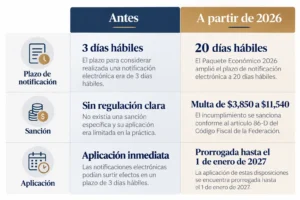
The 2026 Economic Package also modified the timeframe for taxpayers to be considered notified through their tax mailbox. Previously, the notification took effect just three days after its deposit, a period many considered insufficient to react. Now, that period has been extended to twenty business days, providing greater legal certainty for both individuals and businesses.
This adjustment is partly a response to years of litigation in which taxpayers argued they lacked a real opportunity to review their notifications. The tax authority, for its part, defended the change as a way to reduce conflict and improve the public's perception of the system. It's important to note that this longer timeframe does not replace the obligation to activate the mailbox; it simply provides more time once the notification has been properly delivered.
Tax mailbox versus other means of tax notification
Before digitization, the SAT (Mexican Tax Administration Service) primarily notified taxpayers via certified mail or by posting notices at its offices. Both methods remained in use to a limited extent, although the mandatory electronic tax mailbox became the preferred channel for the vast majority of administrative actions. Therefore, a taxpayer who only checks their postal mail risks missing notifications that were already submitted electronically weeks earlier.
The tax authority retains the power to post notices when the taxpayer's registered address cannot be located or when the mailbox is unusable due to reasons attributable to the taxpayer. However, this method is reserved for exceptional situations, not for the regular flow of notifications. Furthermore, physical postings require the interested party to appear in person to review them, which is far less practical than electronic notification accessible from any device.
What does this mean for the tax defense strategy?
Consequently, any modern tax defense strategy must be based on the premise that the tax mailbox is the primary source of information regarding actions by the tax authorities. Law firms that litigate tax matters routinely review their clients' mailboxes precisely because this is often where the first indication of an audit procedure appears before it is formalized through other means. Likewise, having timely access to the mailbox allows for preparing a defense from the earliest stages, rather than reacting belatedly to a decision that has already been made.
| NOTICE: Don't face this process alone. At Baráibar & Asociados, we have tax specialists ready to defend your interests in Mexico City. |
How to enable the mandatory tax mailbox step by step?

The first step is to log in to the SAT portal using the taxpayer's e.firma (electronic signature) or current password. Within the tax mailbox section, the platform requests the email address and cell phone number that will serve as official contact information. For example, it's advisable to use an email account that the responsible department checks daily, not a secondary inbox that is rarely accessed.
Second, the system sends a confirmation code to each registered contact method. This code must be entered within 72 hours, as explained previously. Finally, it's advisable to check the mailbox status every six months, as changes in personnel, cell phone numbers, or email providers can cause contact information to become outdated without anyone noticing immediately.
Best practices for medium and large companies
Similarly, companies with multiple RFCs (taxpayer identification numbers) must assign a clear person responsible for each authorization, ensuring that no entity within the group is left without an active mailbox due to lack of follow-up. Furthermore, it is advisable to internally document the date of each confirmation, providing internal evidence of compliance in case of a discrepancy with the tax authority.
Furthermore, it's advisable to establish an internal review schedule that doesn't rely on a single person's memory. A simple semi-annual reminder, formally assigned to the administration department or external accounting firm, significantly reduces the risk of staff changes leaving the inbox unattended for months. Finally, some companies choose to register an institutional email address instead of a personal one, precisely so that responsibility doesn't depend on the tenure of a specific employee within the organization.
Common mistakes and risks of not updating your mailbox
One of the most frequent mistakes is registering the email address of someone who no longer works at the company. Consequently, notifications arrive in an inbox that no one checks, even though the mailbox is officially enabled. This oversight creates the same practical risk as not having a mailbox at all, even if the company appears to be compliant from a formal standpoint.
Another common mistake is failing to verify that a registered cell phone number remains active after switching phone companies. For example, when a number is disconnected, confirmation codes stop arriving, and the taxpayer may not even realize their voicemail is invalid. However, both errors can be corrected with a simple periodic review that any administrative department can easily incorporate into its schedule.
A third, less obvious error is confusing the initial confirmation of the contact information with permanent validation. The SAT (Mexican Tax Administration Service) does not automatically request further confirmation as long as the information remains unchanged, creating a false impression that the process is permanently resolved. However, any subsequent update, such as a change of cell phone number, restarts the confirmation process and requires immediate attention within the corresponding 72-hour period.
| Protect your operation with expert legal advice from Baráibar & Asociados against the mandatory tax mailbox 2026. |
Conclusion: Don't wait until January 2027
The mandatory tax mailbox already has legal consequences, even though the financial penalty is still under extension. Therefore, enabling it and keeping it updated is the simplest way to avoid both the fine and the risk of missing the deadline for filing a defense. Finally, it's worth remembering that the legal certainty gained with the new twenty-day period only benefits those who actually check their mailbox.
Between August 2026 and January 2027, there is a practical window to correct any omissions without the reputational cost of an ongoing audit. Taking advantage of this time, instead of waiting until the deadline, avoids surprises both in the company's finances and its legal defense schedule. A fifteen-minute review today can save weeks of unnecessary litigation tomorrow.
Frequently asked questions about the mandatory tax mailbox
What is the mandatory tax mailbox?
It is the digital channel that the SAT (Mexican Tax Administration Service) uses to notify taxpayers of administrative acts. Since the reform to the Federal Tax Code published on April 9, 2016, failure to enable it constitutes an infraction punishable under Article 86-D.
Who should enable it?
All individuals and legal entities registered with the Federal Taxpayer Registry, regardless of their tax regime. This also includes those who pay taxes under simplified schemes or digital platforms.
What is the fine for not enabling it?
Article 86-D of the Federal Tax Code (CFF) stipulates a fine of between 3,850 and 11,540 pesos. However, the effective application of this penalty is postponed until January 1, 2027, according to the 2026 Miscellaneous Tax Resolution (RMF).
What contact methods does the SAT require?
An email address and a ten-digit cell phone number with a national area code. Each method must be confirmed within seventy-two hours using the code automatically sent by the platform.
Did the notification deadline change?
Yes, the 2026 Economic Package extended the deadline for the notification to take effect from three to twenty business days. Therefore, taxpayers have more time to react once they have been notified.
Can I have my mailbox enabled but outdated?
The risk is equivalent to not having it active at all, since notifications can arrive via a contact method that no one checks. It's advisable to verify the status every six months to avoid missing important legal deadlines.
Legal references
ENLACE EXTERNO: Buzón Tributario, sitio oficial del SAT → https://www.sat.gob.mx/minisitio/BuzonTributario/index.html
ENLACE EXTERNO: Código Fiscal de la Federación → https://www.diputados.gob.mx/LeyesBiblio/pdf/CFF.pdf
ENLACE INTERNO: Reforma LFPCA 2026: Guía Definitiva para el Nuevo Juicio Contencioso Administrativo → https://baraibar.com.mx/reforma-lfpca-2026/
ENLACE INTERNO: Ley de Amparo 2025: Guía Estratégica para Empresas en CDMX → https://baraibar.com.mx/reforma-ley-de-amparo-2025-empresas-cdmx-2/
Este artículo es de carácter informativo y no constituye asesoría legal formal ni establece relación abogado-cliente