
by paulina@baraibar.com.mx | Aug 24, 2026 | Corporate Law, Labor Law
Housing benefits offered as alternatives to Infonavit can no longer simply replace the legal obligation to contribute to the institute. This was determined by the full Supreme Court of Justice of the Nation on August 3, 2026, in its ruling on Amparo Appeal 633/2026. The case arose from a claim by a retired Pemex employee who demanded recognition of his unpaid contributions. Therefore, this ruling mandates a thorough review of any internal housing program offered by a company as a substitute for legal contributions. Consequently, legal and human resources directors must take action before the issue escalates to litigation.
What did the Supreme Court of Justice of the Nation (SCJN) decide regarding alternative housing benefits to Infonavit?
The full Court confirmed that the benchmark for evaluating any alternative housing system is the Infonavit Law, along with Article 136 of the Federal Labor Law. It is not sufficient, therefore, for a company's internal regulations to provide benefits such as rental assistance or support for acquiring a home. Furthermore, the courts must expressly compare these extra-legal benefits against the legal framework that protects the right to housing. Only in this way can it be determined whether the scheme offers benefits equal to or greater than those required by law. Otherwise, the company remains obligated to make the corresponding contributions to the National Workers' Housing Fund Institute (Infonavit).
It is worth noting that this ruling stems from a labor matter, but its scope extends beyond the energy sector. Any Mexican company with its own housing benefit schemes that operate as alternatives to Infonavit now faces the same standard of review. Furthermore, the ruling confirms that an internal work regulation, by itself, does not replace the constitutional obligation established in Article 123, Section A, Paragraph XII.
Background: The Case of a Retired Pemex Worker
A former Pemex employee filed a labor lawsuit claiming various benefits that were not provided during his employment. Among these, he demanded recognition and payment of the contributions omitted from his Infonavit (National Workers' Housing Fund Institute). In the first instance, the labor authority ordered the company to register him with the IMSS (Mexican Social Security Institute) and make the corresponding contributions. However, a collegiate court overturned that ruling, considering that Pemex's Regulations for Management Personnel provided for their own housing system.
Articles 47 and 76 of this regulation provide for benefits such as housing allowances and financial support for home purchases. For this reason, the collegiate court determined that Pemex was exempt from contributing to Infonavit. However, the worker appealed this decision to the Supreme Court. Ultimately, the full court overturned the lower court's ruling and returned the case to the collegiate court for a new decision, this time in accordance with the parameters established by the Supreme Court.
Do you have questions about this? The lawyers at Baráibar & Asociados in Mexico City can guide you. Schedule your consultation today.
Why are Internal Regulations Not Enough to Replace Infonavit?
The Legal Parameter: Infonavit Law and Article 136 of the LFT
The Court was clear: no internal regulations can supersede the legal social security system. On the contrary, any alternative scheme must be measured against the Infonavit Law and Article 136 of the Federal Labor Law, which establishes the employer's obligation to contribute to the housing fund. Therefore, housing benefits that are alternatives to Infonavit are only valid when they offer a benefit equal to or greater than the legally mandated one. Likewise, the company must demonstrate this equivalence with objective and verifiable data, not with a mere contractual declaration.
The Mandatory Comparison Between Extralegal and Legal Benefits
Collegiate courts can no longer simply verify the existence of internal regulations regarding housing benefits. Instead, they must conduct an explicit comparative analysis between the two systems. For example, if the rental assistance offered by a company is less than the amount it would contribute to Infonavit, the alternative scheme does not meet the constitutional standard. In that case, the company must regularize its contributions and could face tax penalties, surcharges, and interest adjustments.
Other Criteria of the SCJN in the Same Session of August 3, 2026
The ruling on alternative housing to Infonavit was not the only one issued. That same day, the full court resolved three other matters of importance to businesses and individuals. First, it confirmed that declarations of Protected Natural Areas are a valid form of property ownership, without triggering the right to a prior hearing under Article 14 of the Constitution. Second, it upheld the constitutionality of the desk audits provided for in the Social Security Law, considering them an act of intrusion in accordance with Article 16 of the Constitution.
Additionally, the Plenary established binding precedent requiring collegiate courts to assume full jurisdiction when ruling on suspensions in direct amparo proceedings, when the omission of the responsible authority is deemed justified. Taken together, these rulings demonstrate a particularly active session regarding economic, social, and procedural rights, with a direct impact on the relationship between companies, authorities, and workers.
Impact on State-Owned Enterprises and the Energy Sector
The origin of this legal precedent in a case against Pemex is not accidental. For decades, various state-owned enterprises and parastatal entities have had internal regulations offering housing benefits alternative to Infonavit (the Mexican National Housing Fund) to their management personnel. For example, the Federal Electricity Commission (CFE) and other entities in the energy sector maintain similar schemes, inherited from historical collective bargaining agreements. Consequently, these entities now face the same requirement for documented comparison with the legal framework.
Similarly, private companies operating under specialized outsourcing schemes or that inherited personnel management regulations from other public entities must review their situation. Therefore, it is not enough to argue that a scheme “has always worked this way”; the Court now requires technical and comparative support, updated according to the realities of the real estate market in each region of the country.
What does this criterion mean for companies with their own housing schemes?
Numerous Mexican companies, particularly in the energy, industrial, and service sectors, offer housing benefits as alternatives to Infonavit as part of their compensation packages. However, very few have formally documented the equivalence between these benefits and the legal system. For this reason, the Supreme Court's ruling represents an urgent call for self-evaluation. Failure to do so leaves the company vulnerable to a claim for retroactive payment of unpaid contributions by an employee at any point during the employment relationship or even after retirement.
Furthermore, the issue is not limited to the workplace. There is also a significant tax risk, as Infonavit can determine credits for omitted contributions, with interest and penalties that accrue over time. For their part, affected workers retain the option of pursuing legal action to demand recognition of their rights, as occurred in the case resolved by the full court.
Statute of Limitations and Time Limits for Claiming Omitted Contributions
It is important to remember that labor actions related to social security benefits are subject to statutes of limitations. As a general rule, the Federal Labor Law establishes a one-year period to demand compliance with benefits arising from the employment relationship, counted from the date the obligation became due. However, regarding contributions to Infonavit (the Mexican National Housing Fund), various judicial rulings have modified this period, especially when the omission is continuous throughout the entire employment relationship.
For this reason, a company should not assume that the passage of time automatically protects it from claims like the one resolved by the Plenary. Instead, it is advisable to address the contingency proactively, before an active or retired employee decides to assert their rights in labor courts.
Risks of Non-Compliance Regarding Alternative Housing to Infonavit
Among the main risks a company faces without documented comparisons are the following: tax credits for omitted contributions, accumulated updates and surcharges, individual or collective labor lawsuits, and reputational damage with investors and authorities. Similarly, a poorly designed scheme can generate contingent liabilities that affect audit processes, mergers, or acquisitions.
On the other hand, companies operating under collective bargaining agreements should review whether their housing clauses comply with the standard set by the Court. In many cases, these clauses were drafted years ago, without updating their amounts to reflect inflation or the actual cost of housing in Mexico. This outdated information increases the risk that the benefit will be less than the legally mandated amount. Similarly, in mergers and acquisitions, contingent liabilities for omitted contributions often emerge as significant findings during labor due diligence, which can affect the final transaction price. Therefore, mergers and acquisitions teams should incorporate this criterion as a standard part of their checklist before closing any deal.
Don't face this process alone. At Baráibar & Asociados, we have specialists in Labor and Corporate Law ready to defend your interests in Mexico City.
Labor Compliance Recommendations for 2026
First, every company offering housing benefits other than those provided by Infonavit should commission a comparative audit of its internal regulations against the Infonavit Law. Next, it is advisable to document in writing the technical analysis that supports the equivalence of benefits, using updated figures and objective criteria. Likewise, it is prudent to review collective bargaining agreements and individual labor contracts to verify that the housing clauses reflect current and reasonable amounts.
Similarly, it is advisable to establish an internal mechanism for periodic review, preferably annual, to update the amounts of alternative benefits as housing costs evolve. Finally, it is recommended to train the human resources department on this new jurisprudential standard so that any future benefits are designed in accordance with the parameters validated by the Court. Otherwise, the company will remain vulnerable to litigation like the case that prompted this ruling.
What Should a Housing Benefits Comparison Report Contain?
A technical comparison report should include several specific elements. First, a detailed list of the housing benefits currently in effect under the company's internal regulations, with exact amounts and payment schedules. Second, a calculation of the corresponding contribution under the Infonavit Law for the same group of workers, considering their base salary for social security contributions. Third, a comparative table showing, month by month, the difference between the two schemes.
The report must also identify workers covered by the alternative scheme, distinguishing between management, unionized, and retired personnel. Labor lawyers recommend updating this document every fiscal year, given that minimum wages and contribution caps change periodically. A regulation that has been in effect for several years likely no longer reflects current housing market conditions.
Companies with operations in multiple states face an additional challenge: housing costs vary significantly across regions. A uniform national benefit might be sufficient in some cities but insufficient in others, particularly in metropolitan areas with high real estate demand. Documenting this regional variation strengthens the company's defense against any subsequent review, whether administrative or judicial.
How to proceed if your company offers housing benefits other than Infonavit?
If your company has its own housing program, the first step is to gather all the necessary documentation for the benefit: amounts, frequency, covered population, and eligibility requirements. Next, it's advisable to compare this information with the requirements of the Infonavit Law for the same group of workers. If a discrepancy is identified, the company can choose to adjust the program, supplement it, or switch to regular contributions.
Furthermore, this review should be carried out with specialized legal support, as it involves labor, social security and, sometimes, tax regulations.
EXTERNAL LINK: Infonavit Law
EXTERNAL LINK: Federal Labor Law, Article 136
EXTERNAL LINK: SCJN Press Release No. 108/2026
Additionally, it is useful to review how other recent Court rulings have modified the relationship between companies and authorities.
INTERNAL LINK: Amparo Law 2025: Strategic Guide for Companies in Mexico City
INTERNAL LINK: Labor certification for agricultural exports + environmental grounds
Protect your company with expert legal advice from Baráibar & Asociados before a housing contingency turns into litigation.
Conclusion
The Supreme Court's ruling marks a turning point for alternative housing benefits to Infonavit in Mexico. From now on, no internal regulation alone will be sufficient to exempt a company from its legally mandated contributions. On the contrary, each scheme must demonstrate, with objective data, that it offers benefits equivalent to or greater than those required by law. Companies that act proactively will reduce their exposure to litigation, tax liabilities, and labor disputes. Conversely, those that ignore this ruling could face claims similar to the one that prompted the Supreme Court's intervention.
Frequently Asked Questions (FAQs)
What did the Supreme Court decide regarding alternative housing benefits to Infonavit?
The Plenary determined that these benefits must be expressly compared against the Infonavit Law and Article 136 of the Federal Labor Law, in accordance with Amparo in Review 633/2026 resolved on August 3, 2026.
Can a company be exempt from contributing to Infonavit if it offers housing on its own?
Only if it demonstrates, with objective data, that its scheme offers benefits equal to or greater than those legally mandated. Otherwise, it remains obligated to make contributions in accordance with the Infonavit Law and Article 123 of the Constitution.
Which companies should review their housing benefits as alternatives to Infonavit?
Any company with internal regulations, collective agreements or its own schemes that replace legal contributions, especially in energy, industrial and service sectors with high staff turnover.
What risks does a company face without this documented comparison?
Tax credits for omitted contributions, surcharges, updates, labor claims and contingent liabilities that may affect audits or merger processes, according to the criteria set by the Plenary.
What happened to the specific case that the Court resolved?
The Plenary revoked the ruling of the collegiate court and returned the matter for a new resolution to be issued, applying the comparative parameter between the Pemex regulations and the Infonavit Law.
Where can I find the full Supreme Court ruling?
The criterion is found in Press Release No. 108/2026 of the SCJN and in the file of the Amparo in Review 633/2026, resolved in the Plenary session of August 3, 2026.
Legal References
- Press Release SCJN No. 108/2026, August 3, 2026.
- Amparo en Revisión 633/2026, Pleno de la SCJN.
- Law of the National Housing Fund Institute for Workers.
- Federal Labor Law, articles 136 and 516.
- Political Constitution of the United Mexican States, article 123, section A, subsection XII.
This article is for informational purposes only and does not constitute formal legal advice or establish an attorney-client relationship.

by paulina@baraibar.com.mx | Aug 14, 2026 | Constitutional Law, Human Rights, Uncategorized
The right of admission to private elementary schools can no longer be exercised arbitrarily in Mexico. This was established by the First Chamber of the Supreme Court of Justice of the Nation through Jurisprudential Theses 1a./J. 15/2024 and 1a./J. 17/2024. Both rulings stem from Amparo Appeal 57/2022, decided on January 25, 2023, under the opinion of Justice Jorge Mario Pardo Rebolledo. Therefore, no private elementary school can openly and arbitrarily reserve the right to admit or reject students. Consequently, parents and educational institutions must be aware of the true scope of this ruling.
What Does the Thesis Say About the Right of Admission in Private Schools?
The First Chamber determined that no private educational institution at the basic education level may adopt normative, advertising, contractual, or de facto positions. Such positions cannot openly reserve the right of admission to students. On the contrary, access to these institutions must be granted under conditions of equal opportunity and non-discrimination. Furthermore, the Court specified that the social repercussions of a reserved admission policy affect the right to education, protected by Article Three of the Constitution. It also affects the best interests of the child, protected by Article Four.
According to Guillermo Pablo López Andrade, Of Counsel at Baráibar & Asociados, the Court recognized something many families had suspected for years. “The prestige of a school cannot translate into the right to freely discriminate between whom it admits and whom it does not,” the specialist points out. This reflection summarizes the spirit of the ruling, which aims to balance the contractual freedom of schools with the fundamental rights of children and adolescents.
Background of the Litigation that Gave Rise to the Criterion
The case reached the Supreme Court through an appeal for review, filed against the denial of enrollment for a family at a private school. During the litigation, it was argued that the school had exercised its right of admission without further justification. However, the First Chamber considered this argument insufficient in light of the constitutional rights at stake. For this reason, the analysis focused on the General Law of Education and the obligations it imposes on private entities.
This law establishes the duty of private educational institutions to avoid compromising equal treatment of students. It also empowers the federal education authority to issue regulations governing school administration in basic education. These regulations must facilitate enrollment, re-enrollment, accreditation, promotion, regularization, and certification of studies. Therefore, the Court concluded that reserving the right of admission without objective and verifiable criteria violates this legal framework.
Do you have questions about this? The lawyers at Baráibar & Asociados in Mexico City can guide you. Schedule your consultation today.
Constitutional Basis of the Right of Admission to Private Schools
Article Three: The Right to Education
Article Three of the Constitution recognizes the right of every person to receive an education. Therefore, any practice that hinders access to this right, even if carried out by private entities, is subject to constitutional review. In this regard, the Court emphasized that basic education is of a public interest that transcends the contractual relationship between the school and the family.
Article Four: The Best Interests of the Child
Article Four of the Constitution, for its part, mandates that all decisions concerning children and adolescents must consider their best interests. Likewise, the General Law on the Rights of Children and Adolescents requires adults to adopt measures that promote and protect these rights. This obligation extends to private institutions. Consequently, a refusal of admission without objective justification violates this constitutional standard.
Background: The Debate on Discrimination in Access to Private Services
This criterion did not arise in isolation. Over the past decade, various courts have analyzed whether private entities, when providing services, can arbitrarily deny access. The Federal Law to Prevent and Eliminate Discrimination has long recognized that denying a service for discriminatory reasons constitutes a legal violation. These reasons include ethnic origin and social status, among other protected categories. However, in the case of basic education, the Court added an additional element: the best interests of the child. This element strengthens protection against arbitrary decisions.
Therefore, this criterion aligns with a growing body of case law that expands constitutional oversight of the actions of private entities. This oversight applies when they provide services of public interest, such as education, healthcare, or transportation. Consequently, private schools cease to operate under a purely contractual framework and become subject to the same standards of equality as public institutions.
What can other service sectors learn from this criterion?
Although the thesis specifically addresses basic education, its reasoning is useful for other sectors that serve the general public. Sports clubs, daycare centers, private clinics, and membership platforms face similar questions about the limits of their contractual freedom in relation to the rights of their users. For example, denying access to a service without objective and documented criteria can generate liability, even outside the educational sphere, when fundamental rights are at stake.
In fact, the Federal Law to Prevent and Eliminate Discrimination already includes sanctions for service providers who deny access for discriminatory reasons. However, this ruling by the First Chamber strengthens that protection by directly linking it to the best interests of the child, thus raising the bar for any institution that serves minors, beyond the strictly educational sector.
How does this criterion affect you if you are trying to register a minor?
If your family applies to enroll a child in a private elementary school, the institution can no longer deny admission without objectively explaining the reasons. For example, it is not enough to invoke a generic "right of admission reserved" clause in the contract or in the school's advertising. Instead, the school must demonstrate reasonable, verifiable, and non-discriminatory criteria, such as available space or academic requirements clearly communicated in advance.
Likewise, if you believe your family was arbitrarily rejected, you can pursue legal action to demand respect for this legal precedent. Similarly, local and federal education authorities have oversight mechanisms for the school regulations that private institutions must follow. Additionally, the National Council to Prevent Discrimination can receive complaints when a denial of admission masks unequal treatment based on categories protected by law.
Don't face this process alone. At Baráibar & Asociados, we have specialists in Educational and Constitutional Law ready to defend your interests in Mexico City.
What clauses should schools avoid in contracts and advertising?
Many private schools still include clauses such as “the institution reserves the right of admission” in their enrollment contracts or in their print and digital advertising. These types of clauses, drafted generically and without objective criteria, directly contravene the ruling of the First Chamber. For example, denying admission to a minor based on their appearance, perceived socioeconomic status, or family structure, without documentary evidence, constitutes an arbitrary refusal of admission.
However, clauses establishing quota limits per group, academic requirements applicable equally to all applicants, or objective and transparent psycho-pedagogical evaluation processes are valid. Therefore, the central difference lies in the objectivity and uniform application of the criteria, not in the very existence of a selection process.
Documents that a School Must Keep to Accredit Objective Criteria
An educational institution wishing to avoid legal issues must maintain documentary evidence of its admissions processes. Each applicant's file should include the application form, the results of any administered assessments, and all communications sent to the family. The criteria for available spaces per group must also be recorded, along with the date of the last update and the person responsible for defining them.
Schools with psychoeducational assessment processes need clear protocols outlining what each instrument measures and how the results are interpreted. An instrument administered without a transparent methodology can be interpreted as a hidden barrier to admission, particularly if its results disproportionately exclude certain groups of applicants. School principals should receive regular training on these standards, given that admission decisions are often made at the school level, without direct legal oversight.
Institutional advertising deserves special attention. School brochures, websites, and social media should not suggest, even implicitly, that certain types of families are welcome and others are not. Regularly reviewing these materials, with legal counsel, significantly reduces the risk of a complaint or lawsuit succeeding. Maintaining evidence of this review also constitutes valuable documentary evidence against any future claims.
Implications for Private Educational Institutions
Private elementary schools should review their internal regulations, enrollment contracts, and advertising materials to eliminate any clauses that reserve the right to admit students in an open or arbitrary manner. Furthermore, they should document objective selection criteria, where they exist, such as enrollment limits or academic requirements that apply equally to all applicants.
According to Guillermo Pablo López Andrade, “educational institutions that operate transparently in their admissions processes not only comply with the law, but also strengthen families' trust in their school community.” Therefore, rather than a limitation, this criterion represents an opportunity to professionalize the admissions process.
Differences between Basic Education and Other Educational Levels
It is worth clarifying that this thesis focuses specifically on basic education, given the paramount importance of children's well-being. In contrast, upper secondary and higher education levels could allow for greater discretion, provided that objective and non-discriminatory academic criteria exist, such as standardized entrance exams or minimum grade point averages. Nevertheless, the general principle of equality of opportunity remains a relevant reference point for any educational level.
Furthermore, private universities retain greater autonomy in designing their selection processes, by virtue of their constitutionally recognized academic freedom. However, even within this context, discrimination based on factors other than academic merit remains prohibited under the Federal Law to Prevent and Eliminate Discrimination. Therefore, all educational institutions, regardless of their level, must avoid practices that exclude applicants based on subjective or discriminatory criteria.
High schools, for example, typically administer standardized entrance exams with publicly available rules and predetermined minimum scores. This type of mechanism, in principle, meets the standard of objectivity required by jurisprudence. Universities, on the other hand, document their selection processes through public calls for applications, which makes it easier to demonstrate the absence of arbitrariness in any subsequent review.
Practical Recommendations for Families and Institutions
First, families should request in writing the reasons for any enrollment rejection. Then, they should keep all advertising materials, contracts, and communications related to the admissions process. For their part, educational institutions should train their administrative staff on this criterion so that enrollment processes comply with the standards set by the Court.
Similarly, it is advisable that schools update their enrollment contracts with the support of specialized legal counsel, replacing generic clauses with objective and verifiable criteria. Finally, both families and schools can benefit from preventative legal advice, which anticipates conflicts and reduces the risk of unnecessary litigation.
EXTERNAL LINK: Tesis 1a./J. 17/2024 (11a.)
EXTERNAL LINK: Tesis 1a./J. 15/2024 (11a.)
EXTERNAL LINK: General Education Law
Additionally, this criterion complements other recent developments in the area of fundamental rights and constitutional litigation.
INTERNAL LINK: Constitutional Reform of June 3, 2026 — Postponement of Judicial Election and New Ground for Electoral Nullity
INTERNAL LINK: Amparo Law 2025: Strategic Guide for Companies in Mexico City
Protect the rights of your family or institution with expert legal advice from Baráibar & Asociados.
Conclusion
With these principles, the right of admission to private schools has found a clear limit against arbitrariness. Based on this criterion, no institution at the basic education level can reject applications without objectively justifying its reasons. On the contrary, equal opportunities and non-discrimination become the mandatory standard for any enrollment process. Families thus gain a solid legal tool against arbitrary decisions. Meanwhile, educational institutions must adapt their processes to avoid legal contingencies and strengthen the trust of the school community.
Frequently Asked Questions (FAQs)
What does the thesis establish regarding the right of admission to private schools?
It determines that no basic level institution can openly reserve the right of admission, in accordance with the theses 1a./J. 15/2024 and 1a./J. 17/2024 of the First Chamber of the SCJN.
Since when has this criterion been mandatory?
The theses were published on January 26, 2024 and are mandatory from January 29, 2024, according to the Judicial Weekly of the Federation.
Does this criterion apply to all educational levels?
No. The thesis focuses on basic education, given the best interests of the child. Other levels could allow for greater discretion, always with objective and non-discriminatory criteria.
What can a family do if a school denies them access without justification?
You can request in writing the reasons for the rejection and, if necessary, resort to the jurisdictional route to demand respect for this jurisprudential criterion and your constitutional rights.
What should private schools review to meet this criterion?
Their internal regulations, registration contracts and advertising, eliminating clauses that reserve the right of admission openly or arbitrarily towards applicants.
In what case did this Supreme Court criterion originate?
This criterion comes from Amparo en Revisión 57/2022, resolved on January 25, 2023 by the First Chamber, with Minister Jorge Mario Pardo Rebolledo as rapporteur.
Legal References
- Jurisprudence Thesis 1a./J. 15/2024 (11a.), Judicial Weekly of the Federation.
- Jurisprudence Thesis 1a./J. 17/2024 (11a.), Judicial Weekly of the Federation.
- Amparo en Revisión 57/2022, Primera Cámara de la SCJN.
- Political Constitution of the United Mexican States, Articles 3 and 4.
- General Education Law.
- Federal Law to Prevent and Eliminate Discrimination.
This article is for informational purposes only and does not constitute formal legal advice or establish an attorney-client relationship.
Item Type: thesis-what-is (angle “What it says and why it matters”)
Thesis of the month: Educational institutions cannot reserve the right of admission — thesis 1a./J. 15/2024 and 1a./J. 17/2024
Cited partner: Guillermo Pablo López Andrade, Esq., Of Counsel at Baráibar & Asociados
Focus Keyphrase: right of admission to private schools
Meta Title: Right of Admission to Private Schools: Definitive Guide 2026 on the Supreme Court's Thesis
Slug: derecho-de-admision-en-escuelas-privadas-2026
Meta Description: “Derecho de admisión en escuelas privadas: qué resolvió la SCJN en su tesis de 2024 y cómo protege hoy a las familias mexicanas frente a rechazos arbitrarios.” (157 caracteres)
Categoría: Derecho Constitucional / Derechos Humanos
10 Tags SEO: derecho de admisión, escuelas privadas, SCJN, tesis jurisprudencial, derecho a la educación, interés superior de la niñez, discriminación, Primera Sala, derecho constitucional, educación básica
Breadcrumb: Inicio > Blog > Derecho Constitucional > Derecho de Admisión en Escuelas Privadas
Intención de búsqueda: Informacional — familias e instituciones educativas que buscan entender el alcance de un criterio jurisprudencial de la SCJN
Keyphrase Density: 6 apariciones en el cuerpo (verificado programáticamente); distribuidas en introducción, 2 subtítulos H2, conclusión y FAQ
Flesch estimado: 45.5 (fórmula Fernández-Huerta, verificado programáticamente); por debajo del rango 55-65 por la carga de terminología constitucional
Voz pasiva estimada: ~1.8% de las oraciones (verificado programáticamente); predominancia clara de voz activa
Palabras de transición: 36.9% (verificado programáticamente: 41 de 111 oraciones)
Frases consecutivas con misma inicial: 0 (conteo real tras verificación programática, incluyendo subtítulos en el flujo)
Frases con más de 25 palabras: 19.8% (verificado programáticamente: 22 de 111 oraciones; regla Yoast ≤25%)
Distribución de subtítulos: 0 bloques mayores a 300 palabras (conteo real programático); bloque máximo: 234 palabras
Outbound Links: 3 (Tesis 1a./J. 17/2024, Tesis 1a./J. 15/2024, Ley General de Educación)
Internal Links: 2 (Reforma Constitucional del 3 de Junio de 2026; Ley de Amparo 2025: Guía Estratégica para Empresas en CDMX)
Imágenes/Visuales: 3 fichas completas (1 hero + 2 de cuerpo)
Cluster próximos 3 artículos sugeridos: “Qué hacer si CONAPRED admite tu queja: guía práctica”; “Contratos de inscripción escolar: cláusulas que ya no puedes usar”; “Derechos de la niñez frente a instituciones privadas en México”
Redes Sociales — Artículo 2
LinkedIn
Private elementary schools can no longer simply reserve the right of admission. The First Chamber of the Supreme Court of Justice of the Nation (SCJN) established this through rulings 1a./J. 15/2024 and 1a./J. 17/2024, stemming from a case resolved in 2023. This ruling mandates that access to private elementary education be based on equality and non-discrimination. According to Guillermo Pablo López Andrade, Of Counsel at our firm, “a school’s prestige cannot translate into the right to freely discriminate against whom it admits.” For institutions, this means reviewing regulations, contracts, and advertising. For families, it represents a concrete legal tool against arbitrary rejections. Has your institution already adapted its admissions processes to this standard?
#DerechoEducativo #SCJN #DerechoConstitucional #DerechosDeLaNiñez #DerechoMéxico
Instagram
Ninguna escuela particular puede decir “nos reservamos el derecho de admisión” sin más. La Suprema Corte ya lo resolvió: el acceso a la educación básica privada debe ser igualitario y sin discriminación. Esto protege a miles de familias mexicanas frente a rechazos arbitrarios. Conoce qué dice la tesis, cómo te afecta y qué deben cambiar las escuelas en Baráibar & Asociados. Link en bio para leer el análisis completo.
#DerechoDeAdmisión #EscuelasPrivadas #SCJN #DerechosDeLaNiñez #DerechoConstitucional #FamiliasMexicanas #EducaciónPrivada #AbogadosCDMX #TesisSCJN #BaraibarAsociados
Facebook
¿Te han rechazado alguna vez de una escuela privada sin una explicación clara? La Suprema Corte de Justicia de la Nación resolvió que ningún colegio de nivel básico puede reservarse abiertamente el derecho de admisión. El criterio protege el derecho a la educación y el interés superior de la niñez de miles de familias en México. En Baráibar & Asociados explicamos qué significa esta tesis y qué pueden hacer las familias afectadas. ¿Conoces algún caso similar? Cuéntanos en los comentarios.
#DerechoEducativo #SCJN #DerechosDeLaNiñez

by paulina@baraibar.com.mx | Aug 7, 2026 | Labor Law
The reduction of the workweek is now a legal reality in Mexico, although its full implementation will take several years. Since March 2026, Article 123 of the Constitution has stipulated that the maximum workweek will gradually decrease from 48 to 40 hours by 2030. Therefore, every company operating in the country must adjust its schedules, payroll, and contracts as the official timeline progresses. This guide explains the origin of the reform, its exact timeline, and the practical obligations employers face in Mexico City and throughout the rest of the country.
1. What is the reduction of working hours and how was it approved?
The reduction of the workweek is a constitutional reform that modifies sections IV and XI of Article 123, paragraph A, to lower the weekly work limit from 48 to 40 hours. The Senate approved the bill on March 3, 2026, and the Official Gazette of the Federation published the decree that same day, making its constitutional component immediately effective.
However, the constitutional reform alone does not immediately change everyday labor relations. For this reason, Congress also approved changes to the Federal Labor Law, which were published in the Official Gazette of the Federation on May 1, 2026. Consequently, there are now two regulatory levels: the constitutional mandate, which sets the ultimate goal, and secondary legislation, which defines the specific mechanisms for transitioning to the new work schedule.
According to the Senate's approved ruling, the reform garnered broad political support, with 104 votes in favor in the April 2026 vote. Subsequently, the Chamber of Deputies ratified the bill on April 22, without substantial changes to the original draft. This legislative consensus largely explains the speed with which both the constitutional decree and its secondary legislation were published, in a period of just two months.
Compared to other recent labor reforms, this initiative enjoyed simultaneous support from both labor unions and business associations, although the latter expressed reservations about the pace of implementation. Therefore, the final text incorporated a phased five-year timeline, rather than immediate implementation, precisely to allow productive sectors time to adapt.
2. Implementation schedule 2026-2030
The reduction schedule is gradual and mandatory for all employers in the country. During 2026, the workweek will remain at 48 hours, as it currently operates. Starting in 2027, the limit will decrease to 46 hours; in 2028, to 44 hours; in 2029, to 42 hours; and finally, in 2030, the target of 40 hours per week will be reached.
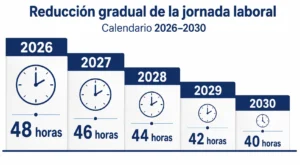
It is important to note that the reform expressly prohibits reducing workers' salaries or benefits as a result of reduced hours. In other words, companies must maintain the same full salary even if actual working time decreases. Furthermore, the reform does not differentiate based on company size or economic sector, meaning that both SMEs and multinational corporations must comply with the same schedule.
For example, a company that currently pays an employee a fixed monthly salary for 48 hours per week will have to pay the same salary for 46 actual hours of work by 2027. In practical terms, this equates to an increase in the cost per hour worked, even if the total payroll remains nominally unchanged. Consequently, finance and human resources departments will need to coordinate their budget projections, taking this cumulative effect into account over the next four years.
| Do you have questions about this topic? The lawyers at Baráibar & Asociados in Mexico City can guide you. Schedule your consultation today. |
3. Key changes to the Federal Labor Law following the reduction of the working day
The reform to the Federal Labor Law, published on May 1, 2026, adapts the secondary legal framework to the new constitutional work schedule. This regulatory adjustment modifies provisions regarding overtime, rest periods, and the weekly distribution of working time, in order to provide legal certainty to both employers and employees during the transition period toward 2030.
Overtime and weekly limits
Before the reform, the law allowed a maximum of nine overtime hours per week. Now, that limit increases to twelve hours per week, although these cannot exceed four hours per day distributed over a maximum of four days. Therefore, companies will need to redesign their shift schedules and overtime pay systems, especially in sectors such as manufacturing, logistics, and retail, where extended workdays are common.
This involves reviewing attendance control systems to accurately differentiate between regular and overtime hours as the weekly limit changes each year. Otherwise, miscalculating overtime can lead to incomplete payments and, potentially, labor lawsuits for wage discrepancies.
Mandatory day off and full pay
Furthermore, the reform reinforces the obligation to grant at least one paid day off for every six days worked. It also clarifies that the gradual reduction of working hours should not result in disguised salary cuts or the elimination of previously granted benefits. For its part, the Ministry of Labor and Social Welfare will issue additional operational guidelines as each stage of the 2027-2030 timeline progresses.
It is worth noting that these guidelines could include specific criteria for mixed work schedules, shift work, and work-from-home arrangements—modalities that current law does not always regulate precisely. Consequently, the Ministry of Labor and Social Welfare (STPS) is expected to publish supplementary rules before the first effective reduction takes place in January 2027.
4. Economic and operational impact on companies
The economic impact of this reform varies considerably by sector. Labor-intensive industries, such as manufacturing, construction, and retail, will face greater pressure to maintain production levels with fewer available hours per worker. For example, a plant that currently operates with 48-hour shifts will need to consider additional hiring, technological upgrades, or process redesign by 2027.
Several business associations have requested differentiated transition periods by sector, arguing that a uniform reduction could disproportionately affect industries with lower profit margins. To date, however, the constitutional timetable does not include sectoral exceptions, so any differentiated adjustments would depend on additional reforms to secondary legislation.
On the other hand, sectors with already flexible work schedules, such as some areas of professional services and technology, could absorb the change with less operational friction. However, all companies will need to update their internal attendance policies, timekeeping systems, and payroll structures, since the calculation of overtime and breaks will change as each phase of the official calendar progresses.
Furthermore, it's important to anticipate the effect on productivity per hour worked. Companies that already measure performance indicators by results, rather than by physical hours spent at the workplace, will likely absorb the transition with less financial impact than those organizations still anchored to traditional timekeeping systems.
5. Sectors with the highest risk of non-compliance
Certain sectors face a particular risk of non-compliance during the transition. For example, the export manufacturing sector, with its 48-hour rotating shift schedules, will need to rethink its operational organization starting in 2027. Similarly, the retail sector, which operates with extended hours on weekends, will have to review the distribution of mandatory rest periods to avoid penalties.
Similarly, the construction sector, where working hours are typically tied to project deadlines, will face difficulties in reconciling reduced hours with contractual timelines agreed upon with clients. Therefore, it is recommended that these industries begin an internal assessment now, rather than waiting until each deadline in the 2027-2030 calendar approaches.
The call center and customer service sector, which operates with staggered 24-hour shift schedules, will also face additional challenges in distributing mandatory breaks without disrupting service. Finally, the agricultural sector, subject to harvest seasons with intensive workdays, will need to negotiate accumulated work schedules in advance that comply with the new weekly limit.
In all these cases, the recommendation is the same: document each operational adjustment with legal backing, instead of improvising informal solutions that later prove difficult to defend in the event of a labor inspection or a lawsuit from a worker.
| Don't face this process alone. At Baráibar & Asociados, we have specialists in Labor Law ready to defend your interests in Mexico City. |
6. What should companies do to prepare?
First, it's advisable to conduct an audit of current schedules to identify areas and positions most affected by the reform. This audit should include a detailed breakdown by department, shift, and contract type, so the company has accurate data before negotiating any adjustments with unions or employee representatives. Additionally, it's recommended to model the financial impact of each stage of the schedule, considering potential hiring or investments in automation.
A third step involves mapping positions with rotating shift schedules or frequent overtime, as these will concentrate the majority of the legal and financial risk during the transition. Internal legal departments, for their part, should establish their own regulatory review schedule now, aligned with each effective date of the official 2027-2030 calendar.
Contractual and payroll adjustments
It is also prudent to review collective and individual employment contracts to ensure they accurately reflect the new limits on working hours and overtime. Similarly, payroll and attendance systems must be updated before 2027 to avoid errors in calculating earnings and overtime pay. Finally, it is advisable to train middle managers on the new regulations, as they typically manage the schedules of operational staff directly.
These middle managers, in their daily work, are the ones who authorize overtime, approve breaks, and resolve attendance issues. Consequently, inadequate training at this hierarchical level often results in operational non-compliance, even when corporate policies are correctly written on paper.
7. Legal risks of non-compliance
Failure to comply with the new work schedule may result in lawsuits before the Conciliation and Arbitration Board or the corresponding labor courts, in addition to administrative sanctions imposed by the Ministry of Labor and Social Welfare. For example, exceeding the permitted overtime limits or failing to grant the mandatory day of rest may generate significant employer liability.
Similarly, reducing salaries or benefits under the pretext of decreased working hours constitutes a direct violation of the constitutional reform. Consequently, companies that implement salary adjustments without legal justification risk costly labor disputes and reputational damage. For their part, unions and workers' representatives have already announced that they will closely monitor compliance with each phase of the official timeline.
🔗 INTERNAL LINK: Labor certification for agricultural exports → https://baraibar.com.mx/certificacion-laboral-para-agroexportacion-causales-ambientales/
🔗 INTERNAL LINK: 2025 Amparo Law Reform for Businesses in Mexico City → https://baraibar.com.mx/reforma-ley-de-amparo-2025-empresas-cdmx-2/
🔗 EXTERNAL LINK: Official Gazette of the Federation (DOF) Decree, constitutional reform to Article 123 → https://www.dof.gob.mx/nota_detalle.php?codigo=5781417&fecha=03032026
🔗 EXTERNAL LINK: Official Gazette of the Federation (DOF) Decree, amendment to the Federal Labor Law → https://www.dof.gob.mx/nota_detalle.php?codigo=5786537&fecha=01052026
| » Protect your company's operations with expert legal advice from Baráibar & Asociados in the face of this new work calendar. |
Conclusion
This reduction in the workday will gradually transform the relationship between companies and workers until 2030. Although 2026 still operates under the 48-hour workweek, the regulatory clock is already ticking for every employer in Mexico. Therefore, anticipating this through internal audits, payroll adjustments, and training is more cost-effective than facing penalties or labor disputes later on.
Companies that begin their transition plan from 2026 onward, rather than waiting until the last quarter of 2027, will have more time to negotiate with unions, redesign processes, and train their teams without operational pressure. At Baráibar & Asociados, we support companies through every phase of this regulatory transition process, from the initial assessment to the final contract update.
Frequently asked questions about reducing working hours
When does the reduction in working hours come into effect? The schedule is gradual: 48 hours in 2026, 46 in 2027, 44 in 2028, 42 in 2029 and 40 hours per week from 2030 onwards, according to the decree published in the DOF on March 3, 2026.
Does a reduction in hours imply a lower salary? No. The constitutional reform expressly prohibits reducing workers' salaries or benefits as a consequence of the gradual reduction of the weekly working hours.
How many overtime hours can be worked now? The limit increased from nine to twelve hours per week, distributed in a maximum of four hours per day for up to four days, according to the reform to the Federal Labor Law published on May 1, 2026.
Which companies must comply with this reform? All companies operating in Mexican territory, regardless of size or economic sector, must comply with the constitutional schedule for reducing working hours until 2030.
What if a company doesn't meet the deadline? You may face labor lawsuits, administrative sanctions from the Ministry of Labor and Social Welfare, and employer liability for violations of working hours and overtime limits.
Should I update my employment contracts now? It is recommended. Reviewing collective and individual contracts, as well as payroll systems, before 2027 avoids calculation errors and reduces legal risks during the transition.
Legal references
- Official Gazette of the Federation, Decree of constitutional reform to article 123, section A, March 3, 2026.
- Official Gazette of the Federation, Decree reforming the Federal Labor Law, May 1, 2026.
- Political Constitution of the United Mexican States, article 123, section A, subsections IV and XI.
- Federal Labor Law, provisions on working hours, breaks and overtime.
This article is for informational purposes only and does not constitute formal legal advice or establish an attorney-client relationship.

by paulina@baraibar.com.mx | Jul 28, 2026 | Criminal law
Esta Ley avanza en el Congreso mexicano como la respuesta legislativa más ambiciosa frente a un delito que hasta hoy se castiga de forma desigual en cada estado. Por primera vez, el país tendrá criterios homologados de investigación, sanción y reparación del daño. Además, la iniciativa llega acompañada de penas de hasta 70 años de prisión y de un catálogo amplio de agravantes. Para despachos, empresas y organizaciones civiles, entender el alcance de esta reforma ya no es opcional. Este artículo explica su origen constitucional, su contenido normativo y el calendario legislativo previsto para agosto de 2026. Asimismo, se revisan las implicaciones prácticas para quienes operan en Ciudad de México y en el resto del país, desde despachos hasta áreas corporativas de cumplimiento.
1. ¿Qué es la Ley General de Feminicidio y por qué surge ahora?
Es la legislación que el Congreso de la Unión debe expedir para unificar los tipos penales, las sanciones y los protocolos de investigación del feminicidio en todo el territorio nacional. Actualmente, cada entidad federativa define el delito de manera distinta, lo cual genera criterios dispares y, en consecuencia, impunidad en muchos casos. Por esta razón, la presidenta Claudia Sheinbaum envió al Congreso, el 15 de julio de 2026, una iniciativa de 62 artículos y 12 transitorios distribuidos en cinco títulos.
Dicha iniciativa no nace de manera aislada. Antes bien, responde a años de exigencia social y a recomendaciones de organismos internacionales de derechos humanos. Asimismo, se apoya en cifras oficiales que documentan un patrón persistente de violencia feminicida en varias regiones del país. De igual manera, busca cerrar espacios de interpretación que hoy permiten confundir un feminicidio con un homicidio doloso simple, con las consecuencias procesales que ello implica.
Organismos como la Comisión Interamericana de Derechos Humanos han señalado en distintos informes que la falta de homologación normativa en México favorece la impunidad estructural. Por lo tanto, la nueva ley busca también atender observaciones internacionales pendientes desde hace más de una década. Cabe destacar que el mecanismo elegido, una ley general y no una simple reforma al Código Penal Federal, obliga a todas las entidades federativas a adoptar el mismo piso normativo, sin excepción.
2. Antecedentes: la reforma constitucional al artículo 73
El fundamento jurídico de esta ley no apareció de un día para otro. En abril de 2026, el Senado aprobó por unanimidad, con 119 votos, una reforma al artículo 73 constitucional para facultar al Congreso a legislar en materia de feminicidio como ley general. Posteriormente, el Diario Oficial de la Federación publicó el decreto correspondiente el 6 de mayo de 2026, y este entró en vigor al día siguiente.
A partir de esa fecha, el Congreso cuenta con 180 días naturales para expedir la legislación secundaria. En consecuencia, el plazo vence a inicios de noviembre de 2026, lo cual explica la celeridad con la que avanza el proceso legislativo actual. Cabe destacar que este mecanismo de “ley general” ya se utiliza en México para otros delitos de alto impacto, como el secuestro y la desaparición forzada, precisamente porque permite establecer un piso mínimo de protección aplicable en los 32 estados.
Este mismo modelo normativo ha demostrado resultados mixtos en el pasado. Por ejemplo, la Ley General en materia de Desaparición Forzada, vigente desde 2017, logró unificar protocolos de búsqueda, aunque su implementación estatal siguió siendo desigual por falta de presupuesto. En consecuencia, los especialistas anticipan que el verdadero reto de la Ley General de Feminicidio no será su aprobación legislativa, sino su instrumentación efectiva en fiscalías con capacidades técnicas y financieras muy distintas entre sí.
| Do you have questions about this topic? The lawyers at Baráibar & Asociados in Mexico City can guide you. Schedule your consultation today. |
3. Contenido clave de la Ley General de Feminicidio: sanciones y agravantes
La propuesta enviada al Senado contempla penas de entre 50 y 70 años de prisión para quien cometa feminicidio. Además, introduce sanciones que van más allá de la privación de la libertad, entre ellas la pérdida de la patria potestad sobre hijos en común y la pérdida de derechos sucesorios respecto de los bienes de la víctima.
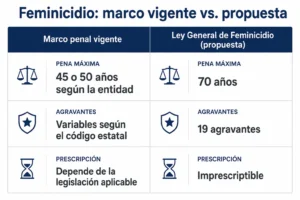
Penas de prisión y circunstancias agravantes
El proyecto contempla diecinueve circunstancias agravantes que incrementan la pena hasta en una mitad. Por ejemplo, se agravará el delito cuando la víctima estuviera embarazada, tuviera alguna discapacidad, ejerciera el periodismo, fuera defensora de derechos humanos o se encontrara en situación de movilidad. De esta manera, la ley busca reconocer contextos de vulnerabilidad que agravan la responsabilidad penal del agresor.
Otras agravantes contempladas incluyen la relación de parentesco o confianza entre víctima y agresor, el uso de violencia sexual previa, y la exposición pública del cuerpo de la víctima con fines de intimidación. Por su parte, los jueces deberán motivar de forma expresa cada agravante aplicado, lo cual busca evitar criterios discrecionales que hoy generan sentencias contradictorias entre circuitos judiciales distintos.
Igualmente relevante resulta la imprescriptibilidad del delito. En otras palabras, el paso del tiempo no extinguirá la posibilidad de investigar, sancionar o exigir justicia, ni tampoco la obligación de reparar el daño. Esta característica coloca al feminicidio en la misma categoría que otros delitos que el derecho internacional considera de especial gravedad.
Reparación integral del daño y pérdida de derechos
Por su parte, el título cuarto de la iniciativa regula los derechos de las víctimas indirectas y el mecanismo de reparación integral. Este mecanismo contempla componentes económicos, psicológicos y simbólicos, alineados con estándares interamericanos de derechos humanos. Sin embargo, la ley también exige que las fiscalías estatales cuenten con protocolos de investigación obligatorios y homogéneos, lo cual representa un reto operativo considerable para procuradurías con recursos limitados.
También, se prevé la creación de un registro nacional de casos de feminicidio, con información desagregada por entidad y por tipo de agravante. Este registro permitiría, en teoría, medir con mayor precisión la efectividad de las fiscalías y detectar patrones regionales de violencia. No obstante, especialistas en política pública advierten que un registro nacional solo será útil si cuenta con presupuesto etiquetado y mecanismos reales de rendición de cuentas.
4. Cronología legislativa: del Senado a la votación final
El proceso legislativo ha avanzado en etapas bien definidas. Primero, en abril de 2026, el Pleno del Senado aprobó la reforma constitucional habilitante. Después, en mayo, el Ejecutivo publicó el decreto en el DOF. Enseguida, el 15 de julio, la presidenta envió la iniciativa de ley general propiamente dicha. Finalmente, el 22 de julio, el Senado inició el análisis formal en comisiones, y el 29 de julio la Comisión para la Igualdad de Género aprobó la ruta crítica de discusión.
De acuerdo con el calendario legislativo difundido por el propio Senado, el dictamen final se elaborará entre el 25 y el 30 de agosto de 2026. Por lo tanto, aún no existe una ley general vigente al momento de esta publicación; lo que existe es una reforma constitucional en vigor y una iniciativa en discusión avanzada. No obstante, dado el respaldo político con el que cuenta la propuesta, es previsible que el Congreso concluya el proceso dentro del plazo constitucional de 180 días.
Vale la pena recordar que el plazo constitucional vence a inicios de noviembre de 2026. Por consiguiente, incluso si el Senado aprueba el dictamen a finales de agosto, todavía restará la discusión y votación en la Cámara de Diputados, así como el proceso de publicación en el DOF. En este sentido, resulta razonable estimar que la ley general entre en vigor entre septiembre y noviembre de 2026, salvo que surjan controversias que retrasen el dictamen.
5. Impacto para empresas, instituciones y sociedad civil
La nueva ley no solo interesa a fiscalías y tribunales. Las empresas, especialmente aquellas con áreas de cumplimiento, recursos humanos y responsabilidad social corporativa, también deberán revisar sus protocolos internos. Por ejemplo, los mecanismos de atención a víctimas de violencia de género dentro del entorno laboral tendrán que alinearse con los nuevos estándares de homologación.
Así mismo las instituciones educativas y las organizaciones de la sociedad civil que colaboran con fiscalías en la atención a víctimas necesitarán actualizar sus protocolos de canalización. Asimismo, los despachos jurídicos que representan a víctimas o a personas imputadas deberán familiarizarse con los nuevos tipos penales y agravantes, dado que estos modificarán la estrategia procesal en cada caso. Por su parte, las áreas de comunicación corporativa deberán cuidar el lenguaje institucional al abordar públicamente este tema, evitando la revictimización.
También conviene mencionar a las aseguradoras y a las administradoras de fondos de pensiones, dado que la pérdida de derechos sucesorios prevista en la ley afectará directamente los procesos de sucesión de bienes y de pago de seguros de vida en casos de feminicidio. Del mismo modo, las instituciones bancarias que gestionan fideicomisos familiares deberán prever protocolos internos para atender estos escenarios conforme a la nueva legislación.
| » No enfrentes este proceso solo. En Baráibar & Asociados contamos con especialistas en Derecho Penal listos para defender tus intereses en Ciudad de México. |
6. ¿Qué deben hacer las empresas para prepararse ante la nueva ley?
En primer lugar, conviene realizar una auditoría de los protocolos internos de atención a la violencia de género, incluyendo canales de denuncia y rutas de acompañamiento psicológico. Adicionalmente, es recomendable capacitar a las áreas de recursos humanos y de cumplimiento sobre los nuevos tipos penales, agravantes y plazos de imprescriptibilidad que introduce la reforma.
Un tercer punto, con frecuencia subestimado, consiste en revisar las pólizas de seguro de vida y los fideicomisos corporativos que puedan verse afectados por la pérdida de derechos sucesorios del agresor. Los comités de ética empresarial, por su parte, deberían incorporar explícitamente el feminicidio y sus agravantes dentro de los códigos de conducta interna, sobre todo en organizaciones con operación en varios estados.
Recomendaciones específicas para el sector privado
Por ejemplo, las empresas con presencia en varios estados deberán homologar sus políticas internas conforme al nuevo estándar federal, en lugar de replicar criterios estatales dispersos. También resulta prudente revisar los contratos de prestación de servicios con terceros, sobre todo cuando existan cláusulas relacionadas con protocolos de seguridad o de atención a incidentes de violencia. Finalmente, es aconsejable mantener comunicación con asesores legales especializados, de manera que la organización pueda anticipar reformas a leyes secundarias, como el Código Penal Federal y los códigos penales estatales.
7. Comparación con la legislación penal vigente
Hoy, el feminicidio ya está tipificado en el Código Penal Federal y en la mayoría de los códigos estatales. Sin embargo, las penas, los elementos del tipo y los agravantes varían considerablemente entre entidades. Por ejemplo, algunos estados contemplan penas máximas de 45 o 50 años, mientras que otros no reconocen ciertas circunstancias agravantes que la nueva ley sí incorporará.
Por su parte, la Ley General de Feminicidio busca eliminar precisamente esa dispersión normativa. De este modo, una vez vigente, funcionará como piso mínimo obligatorio para todas las legislaciones locales, las cuales deberán armonizarse en un plazo determinado por los artículos transitorios. Cabe destacar que esta armonización no ocurrirá de manera automática, sino que exigirá reformas específicas en cada congreso estatal.
Estados con códigos penales más rezagados en la materia probablemente enfrentarán mayor presión legislativa y presupuestal para cumplir el nuevo estándar federal a tiempo.
🔗 ENLACE INTERNO: hecho delictivo en órdenes de aprehensión → https://baraibar.com.mx/hecho-delictivo-en-ordenes-de-aprehension-y-vinculacion-a-proceso/
🔗 ENLACE INTERNO: principio de inmediación penal → https://baraibar.com.mx/principio-de-inmediacion-penal-garantia-de-un-juicio-justo/
🔗 ENLACE EXTERNO: Decreto DOF, reforma al artículo 73 constitucional → https://www.dof.gob.mx/nota_detalle.php?codigo=5786617&fecha=06%2F05%2F2026
🔗 ENLACE EXTERNO: Comunicado oficial del Senado sobre la reforma constitucional → https://comunicacionsocial.senado.gob.mx/informacion/comunicados/14975-el-pleno-del-senado-de-la-republica-aprueba-reforma-constitucional-para-combatir-el-feminicidio
| » Protege los intereses de tu organización con la asesoría legal experta de Baráibar & Asociados frente a este nuevo marco normativo. |
Conclusion
La Ley General de Feminicidio representa un cambio estructural en la manera en que México investiga y sanciona este delito. Todavía falta la votación final, prevista para finales de agosto de 2026, pero el rumbo legislativo ya está trazado. Por lo tanto, anticiparse a sus efectos, tanto en el ámbito penal como en el corporativo, resulta la estrategia más prudente para despachos, empresas y organizaciones sociales.
Mientras el Congreso concluye el dictamen, conviene revisar protocolos internos, actualizar políticas de recursos humanos y capacitar a los equipos legales sobre los nuevos tipos penales y agravantes. De lo contrario, las organizaciones podrían enfrentar contingencias legales o reputacionales una vez que la ley entre en vigor. En Baráibar & Asociados damos seguimiento puntual a este proceso legislativo para mantener informados a nuestros clientes y anticipar cada fase de su implementación.
Preguntas frecuentes sobre la Ley General de Feminicidio
¿Qué es la Ley General de Feminicidio? Es la legislación que homologará los tipos penales, sanciones y protocolos de investigación del feminicidio en todo México, con fundamento en la reforma al artículo 73 constitucional publicada en el DOF el 6 de mayo de 2026.
¿Cuáles son las penas que propone la nueva ley? La iniciativa contempla penas de 50 a 70 años de prisión, además de la pérdida de la patria potestad y de derechos sucesorios, conforme al proyecto de 62 artículos enviado al Senado el 15 de julio de 2026.
¿Cuándo entrará en vigor la Ley General de Feminicidio? Aún no tiene fecha exacta. El dictamen final se prepara entre el 25 y el 30 de agosto de 2026, dentro del plazo de 180 días que marca el artículo transitorio de la reforma constitucional.
¿La ley aplica igual en todos los estados? Sí, ese es su propósito. Una vez vigente, funcionará como piso mínimo obligatorio, por lo que los códigos penales estatales deberán armonizarse conforme a los artículos transitorios correspondientes.
¿Las empresas ante esta reforma, qué deben hacer ? Conviene revisar protocolos de atención a la violencia de género, capacitar a recursos humanos y actualizar políticas internas, en línea con el nuevo estándar homologado que propone la iniciativa federal.
¿El feminicidio prescribe conforme a la nueva ley? No. La iniciativa establece expresamente que el delito, la sanción y la reparación del daño serán imprescriptibles, de manera que el paso del tiempo no impedirá investigar ni sancionar el caso.
Legal references
- Diario Oficial de la Federación, Decreto de reforma al artículo 73 constitucional, 6 de mayo de 2026.
- Constitución Política de los Estados Unidos Mexicanos, artículo 73, fracción XXI, inciso a).
- Código Penal Federal, Libro Segundo, Título Decimonoveno, Capítulo V (feminicidio).
- Iniciativa de Ley General para Prevenir, Investigar, Sancionar y Reparar el Daño por el Delito de Feminicidio, presentada el 15 de julio de 2026.
This article is for informational purposes only and does not constitute formal legal advice or establish an attorney-client relationship.

by paulina@baraibar.com.mx | Jul 18, 2026 | Administrative Law
The regularization of national water concessions formally began on July 16, 2026, one day after the publication of the corresponding agreement in the Official Gazette of the Federation. Signed by the Director General of the National Water Commission, Efraín Morales López, the instrument opens a twelve-month window for individuals, ejidos (communal landholdings), municipalities, and irrigation districts to bring their expired water rights up to date between 2009 and July 2026. However, this opportunity comes with concrete risks: those who do not act within the deadline could face the expiration of unused water volumes. Therefore, understanding the true scope of the agreement is essential for any company with operations that depend on water resources in Mexico.
What does the water concession regularization agreement establish?
The instrument published on July 15, 2026, implements temporary administrative simplification measures. It applies to concession and allocation titles whose validity expired between January 1, 2009, and the agreement's entry into force. The condition is that the interested party had not requested an extension, or had submitted it after the deadline. The measures cover domestic, urban public, agricultural, livestock, and aquaculture uses. Agro-industrial use is expressly excluded, in accordance with Article 2, Section 17, of the Regulations of the National Water Law.
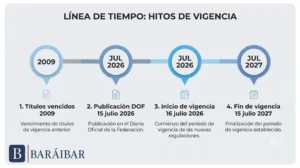
Twelve months of validity: from July 16, 2026 to July 15, 2027.
Regarding the beneficiaries, the agreement distinguishes three profiles. Irrigation districts, irrigation units, and ejidos (communal landholdings) can regularize their water usage without volume limits. Similarly, state and municipal governments that directly provide water services are exempt from volume limits. Individuals, however, have a limit of one million cubic meters per year. It is worth noting that this scheme aligns with the 2024-2030 National Water Plan, whose fourth pillar seeks comprehensive and transparent water management.
The program's legal basis is anchored in Article 24 of the National Water Law, which regulates concession extensions, and in the law's regulations. For its part, the authority justifies the measure as a direct response to what it has termed the "black market" for water rights, that is, the informal transfer of rights without the knowledge or control of the National Water Commission (Conagua).
🔗 EXTERNAL LINK: See the full agreement in the Official Gazette of the Federation (DOF) → https://dof.gob.mx/nota_detalle.php?codigo=5793639&fecha=15/07/2026
Requirements to access the regularization of water concessions
Thirteen requirements are necessary to qualify for the program, and none are optional. Among the most important are having a property in operation for the last two years, having a meter installed, and being up-to-date on payments for the last five fiscal years. Additionally, the applicant must not have any pending administrative sanction proceedings related to the property title they intend to regularize.
This documentary requirement is not accidental. Consequently, the Federal Government seeks to regulate the concession system and reduce the informal market for permits to extract groundwater. Centralized control falls to Conagua through the National Public Water Registry, which will compile information on ownership, authorized volumes, and actual water use reported by each concession holder.
Minimum recommended documentation
- Certified copy of the original concession or assignment title
- Proof of payment of fees for the last five fiscal years
- Photographic and technical evidence of the capture work in operation
- Certificate of no outstanding debt with the National Water Commission
- Report of extracted volumes, when a meter is installed.
In practice, several errors delay the process: submitting the title without proof of payment for the last five years, or failing to report that the water intake structure has changed location without formal registration with Conagua (the National Water Commission). For example, if the authority detects inconsistencies between the reported volume and the actual usage observed in the field, the process can be suspended until the discrepancy is clarified. Therefore, it is advisable to gather all the necessary documentation from the beginning, rather than waiting for a later request.
⚖️ Do you have questions about this topic? The lawyers at Baráibar & Asociados in Mexico City can guide you. Schedule your consultation today.
Risk of expiration if the regularization of water concessions is not addressed in time
Anyone who chooses to ignore this administrative window faces a quantifiable risk. The agreement instructs Conagua to verify, for two years after its entry into force, the actual use of the allocated water volumes. For its part, the authority will conduct reconciliation processes to adjust the authorized volume to the volume actually used, taking into account national water security and the marginalization index of the populations involved.
For businesses, this means that unused water rights could be subject to expiration. Therefore, it is crucial to maintain robust documentation regarding water usage, metering, and timely payment of fees. If the entire allocated volume is not used, companies can also initiate procedure CONAGUA-01-019 to interrupt the expiration of the rights corresponding to the unused volumes.
Let's consider the case of a medium-sized agro-industrial plant that was granted a specific water allocation a decade ago, but which today consumes only a fraction of that amount. Under the new system, that difference could be returned to the national water supply without any compensation. Therefore, conducting an internal audit of actual consumption becomes a preventative measure, not just an administrative one.
🔗 INTERNAL LINK: Learn how to defend yourself against acts of administrative authority → https://baraibar.com.mx/reforma-lfpca-2026/
Impact of the regularization of water concessions on industrial and infrastructure sectors
Although this first phase is aimed at non-industrial uses, its effects extend to sectors with higher water consumption. The December 2025 reform to the National Water Law replaced traditional mechanisms for transferring water rights with reassignment schemes subject to the direct intervention of the National Water Commission (Conagua). It also incorporated a national water reserve fund to reincorporate unused volumes and limited the validity of the water guarantee to a maximum of five years.
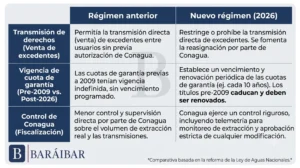
The new scheme centralizes the reassignment of water rights in Conagua.
These measures have direct relevance for water-intensive manufacturing, mining, energy, and data center projects. Any water rights management for new developments must be processed directly with Conagua, with no option to acquire water volumes through private transfer of water rights with a change of use.
A concrete example illustrates the change. Before the reform, a manufacturing company could acquire additional water volumes by purchasing a water rights from another concessionaire, with a simple subsequent notification to Conagua (the National Water Commission). Today, however, that same operation requires demonstrating to the authority that the corresponding basin has actual water availability, which can considerably lengthen the planning time for a new industrial project.
Sectors with greater exposure to the new regime
- Manufacturing and data centers: They require constant volumes and depend entirely on the direct allocation of Conagua.
- Mining: It faces greater scrutiny under the new water crimes regime incorporated in the December 2025 reform.
- Real estate development: You should verify the actual availability of water before committing to new projects.
- Agribusiness: Although excluded from this first stage, it must anticipate future phases of sectoral regularization.
Therefore, legal and corporate compliance departments must incorporate this new regime into their water risk assessment before initiating any project that requires a new concession.
Implications for irrigation districts, communal lands, and agricultural operations
Irrigation districts, irrigation units, and ejidos are among the main beneficiaries of the agreement, as they can regularize their water titles without volume limits. However, this advantage does not exempt these entities from complying with the thirteen general requirements, including proof of an operational project for the past two years.
In practice, many irrigation districts operate infrastructure built decades ago, with documentation scattered across various agencies. Therefore, the first recommended step is to reconstruct the technical file for each permit before contacting Conagua directly. Otherwise, the lack of an organized file can prolong the process beyond what is expected.
Furthermore, the volume reconciliation stipulated in the agreement will take into account food security and the marginalization index of the beneficiary populations. Consequently, municipalities that directly provide drinking water services should take advantage of the absence of volume limits to regularize all of their supply sources, thus avoiding future disputes with the National Water Commission.
📋 Don't face this process alone. At Baráibar & Asociados, we have specialists in Administrative and Corporate Law ready to defend your interests in Mexico City.
Legal context: from the National Water Law to the General Water Law
For nearly three decades, the 1992 National Water Law regulated the granting of concessions under a primarily administrative approach, with little emphasis on tracing actual water use. However, this approach changed with the December 2025 reform, which substantially modified the National Water Law itself and gave rise to the new General Water Law.
The General Water Law, published on December 11, 2025, is based on a different premise: water is no longer understood as a mere commodity but is expressly recognized as a human right. This paradigm shift translates into concrete mechanisms, such as the national water reserve fund and the limitation of the guaranteed quota to five years.
In this context, the agreement to regularize water concessions serves as the first operational instrument of this new policy. It does not modify the existing legal framework, but it does put it into practice by offering a concrete administrative process for clearing the registry of expired permits. It is also worth noting that this transition coincides with a strengthening of the sanctions regime, aimed at penalizing unauthorized water extraction and the misuse of hydraulic infrastructure.
For businesses, understanding this regulatory evolution is not an academic exercise. How Conagua interprets and applies the water concession regularization agreement in the coming months will set the tone for the program's subsequent stages. Therefore, it is advisable to closely monitor the operational criteria that the authority publishes, rather than assuming that the text of the agreement contains all the relevant information for the process.
🔗 EXTERNAL LINK: Consult the current text of the General Water Law → https://www.diputados.gob.mx/LeyesBiblio/pdf/LGAg.pdf
How to prepare for the new water policy in Mexico
The regularization of water concessions should be understood as part of a broader policy of traceability and state control over water resources. For companies, this means proactively reviewing the status of each concession title and assessing the advisability of joining the program before its expiration on July 15, 2027.
Recommended steps before applying for regularization
- Internally audit all current or expired concession and allocation titles.
- Verify the installation and calibration of extraction meters.
- Gather proof of payment of fees for the last five fiscal years.
- Confirm that there are no open sanctioning procedures before Conagua.
- Submit the application with specialized legal support before the twelve-month period expires.
It is also advisable to review any pending concession, extension, or modification procedures, as the agreement allows for the registration of favorable resolutions issued since April 1, 2019, in the National Public Water Registry. Otherwise, the risk of losing unused volumes will increase as Conagua progresses with its verification processes.
🔗 INTERNAL LINK: Review the implications of the 2025 Amparo Law for companies in Mexico City → https://baraibar.com.mx/reforma-ley-de-amparo-2025-empresas-cdmx-2/
⚖️ Protect your company's water resources with expert legal advice from Baráibar & Asociados.
Conclusion
The regularization of water concessions represents a limited-time opportunity, not a mere administrative formality. Those with permits that expired between 2009 and July 2026 must act within the twelve-month validity period of the agreement to avoid the expiration of unused water volumes. Furthermore, the new water traceability regime requires companies in all sectors to strengthen their documentation submitted to Conagua (the National Water Commission). Finally, having specialized legal support makes all the difference between taking advantage of the regularization window and facing costly expiration proceedings in the future.
Frequently asked questions about the regularization of water concessions
Who can access the regularization of water concessions in 2026?
Irrigation districts, irrigation units, ejidos, federal entities, municipalities and individuals with titles that expired between 2009 and July 2026 can access it, in accordance with the agreement published in the DOF on July 15, 2026 and article 24 of the National Water Law.
What happens if I don't regularize my concession within the deadline?
The unused volume may be subject to a declaration of forfeiture. Conagua will verify actual usage during the two years following the entry into force of the agreement, in accordance with the powers granted to it by the current National Water Law.
Does the agreement apply to industrial use concessions?
Not directly, since the agreement expressly excludes agro-industrial use volumes, in accordance with article 2, section 17, of the Regulations of the National Water Law, although the general traceability regime does affect industrial sectors.
How long does the regularization agreement remain valid?
It is valid for 365 calendar days starting on July 16, 2026, so the term ends on July 15, 2027, as established in the agreement itself published in the Official Gazette of the Federation.
What documents do I need to start the process with Conagua?
Among other documents, a certified copy of the title, proof of payment of fees for the last five fiscal years, evidence of the work in operation and proof of no debt are required, in accordance with the thirteen requirements set out in the agreement.
Can I avoid expiration if I don't use my entire allocated volume?
Yes, it is possible to initiate the CONAGUA-01-019 procedure to interrupt the expiration of rights related to unused volumes, provided that a justified cause is proven before the corresponding authority.
Legal references: Official Gazette of the Federation (July 15, 2026); National Water Law and its Regulations; General Water Law (DOF, December 11, 2025); National Water Plan 2024-2030.
This article is for informational purposes only and does not constitute formal legal advice or establish an attorney-client relationship.