
by paulina@baraibar.com.mx | Jul 28, 2026 | Criminal law
Esta Ley avanza en el Congreso mexicano como la respuesta legislativa más ambiciosa frente a un delito que hasta hoy se castiga de forma desigual en cada estado. Por primera vez, el país tendrá criterios homologados de investigación, sanción y reparación del daño. Además, la iniciativa llega acompañada de penas de hasta 70 años de prisión y de un catálogo amplio de agravantes. Para despachos, empresas y organizaciones civiles, entender el alcance de esta reforma ya no es opcional. Este artículo explica su origen constitucional, su contenido normativo y el calendario legislativo previsto para agosto de 2026. Asimismo, se revisan las implicaciones prácticas para quienes operan en Ciudad de México y en el resto del país, desde despachos hasta áreas corporativas de cumplimiento.
1. ¿Qué es la Ley General de Feminicidio y por qué surge ahora?
Es la legislación que el Congreso de la Unión debe expedir para unificar los tipos penales, las sanciones y los protocolos de investigación del feminicidio en todo el territorio nacional. Actualmente, cada entidad federativa define el delito de manera distinta, lo cual genera criterios dispares y, en consecuencia, impunidad en muchos casos. Por esta razón, la presidenta Claudia Sheinbaum envió al Congreso, el 15 de julio de 2026, una iniciativa de 62 artículos y 12 transitorios distribuidos en cinco títulos.
Dicha iniciativa no nace de manera aislada. Antes bien, responde a años de exigencia social y a recomendaciones de organismos internacionales de derechos humanos. Asimismo, se apoya en cifras oficiales que documentan un patrón persistente de violencia feminicida en varias regiones del país. De igual manera, busca cerrar espacios de interpretación que hoy permiten confundir un feminicidio con un homicidio doloso simple, con las consecuencias procesales que ello implica.
Organismos como la Comisión Interamericana de Derechos Humanos han señalado en distintos informes que la falta de homologación normativa en México favorece la impunidad estructural. Por lo tanto, la nueva ley busca también atender observaciones internacionales pendientes desde hace más de una década. Cabe destacar que el mecanismo elegido, una ley general y no una simple reforma al Código Penal Federal, obliga a todas las entidades federativas a adoptar el mismo piso normativo, sin excepción.
2. Antecedentes: la reforma constitucional al artículo 73
El fundamento jurídico de esta ley no apareció de un día para otro. En abril de 2026, el Senado aprobó por unanimidad, con 119 votos, una reforma al artículo 73 constitucional para facultar al Congreso a legislar en materia de feminicidio como ley general. Posteriormente, el Diario Oficial de la Federación publicó el decreto correspondiente el 6 de mayo de 2026, y este entró en vigor al día siguiente.
A partir de esa fecha, el Congreso cuenta con 180 días naturales para expedir la legislación secundaria. En consecuencia, el plazo vence a inicios de noviembre de 2026, lo cual explica la celeridad con la que avanza el proceso legislativo actual. Cabe destacar que este mecanismo de “ley general” ya se utiliza en México para otros delitos de alto impacto, como el secuestro y la desaparición forzada, precisamente porque permite establecer un piso mínimo de protección aplicable en los 32 estados.
Este mismo modelo normativo ha demostrado resultados mixtos en el pasado. Por ejemplo, la Ley General en materia de Desaparición Forzada, vigente desde 2017, logró unificar protocolos de búsqueda, aunque su implementación estatal siguió siendo desigual por falta de presupuesto. En consecuencia, los especialistas anticipan que el verdadero reto de la Ley General de Feminicidio no será su aprobación legislativa, sino su instrumentación efectiva en fiscalías con capacidades técnicas y financieras muy distintas entre sí.
| Do you have questions about this topic? The lawyers at Baráibar & Asociados in Mexico City can guide you. Schedule your consultation today. |
3. Contenido clave de la Ley General de Feminicidio: sanciones y agravantes
La propuesta enviada al Senado contempla penas de entre 50 y 70 años de prisión para quien cometa feminicidio. Además, introduce sanciones que van más allá de la privación de la libertad, entre ellas la pérdida de la patria potestad sobre hijos en común y la pérdida de derechos sucesorios respecto de los bienes de la víctima.
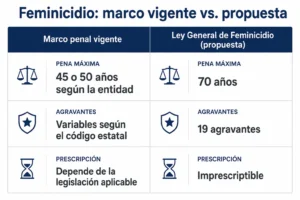
Penas de prisión y circunstancias agravantes
El proyecto contempla diecinueve circunstancias agravantes que incrementan la pena hasta en una mitad. Por ejemplo, se agravará el delito cuando la víctima estuviera embarazada, tuviera alguna discapacidad, ejerciera el periodismo, fuera defensora de derechos humanos o se encontrara en situación de movilidad. De esta manera, la ley busca reconocer contextos de vulnerabilidad que agravan la responsabilidad penal del agresor.
Otras agravantes contempladas incluyen la relación de parentesco o confianza entre víctima y agresor, el uso de violencia sexual previa, y la exposición pública del cuerpo de la víctima con fines de intimidación. Por su parte, los jueces deberán motivar de forma expresa cada agravante aplicado, lo cual busca evitar criterios discrecionales que hoy generan sentencias contradictorias entre circuitos judiciales distintos.
Igualmente relevante resulta la imprescriptibilidad del delito. En otras palabras, el paso del tiempo no extinguirá la posibilidad de investigar, sancionar o exigir justicia, ni tampoco la obligación de reparar el daño. Esta característica coloca al feminicidio en la misma categoría que otros delitos que el derecho internacional considera de especial gravedad.
Reparación integral del daño y pérdida de derechos
Por su parte, el título cuarto de la iniciativa regula los derechos de las víctimas indirectas y el mecanismo de reparación integral. Este mecanismo contempla componentes económicos, psicológicos y simbólicos, alineados con estándares interamericanos de derechos humanos. Sin embargo, la ley también exige que las fiscalías estatales cuenten con protocolos de investigación obligatorios y homogéneos, lo cual representa un reto operativo considerable para procuradurías con recursos limitados.
También, se prevé la creación de un registro nacional de casos de feminicidio, con información desagregada por entidad y por tipo de agravante. Este registro permitiría, en teoría, medir con mayor precisión la efectividad de las fiscalías y detectar patrones regionales de violencia. No obstante, especialistas en política pública advierten que un registro nacional solo será útil si cuenta con presupuesto etiquetado y mecanismos reales de rendición de cuentas.
4. Cronología legislativa: del Senado a la votación final
El proceso legislativo ha avanzado en etapas bien definidas. Primero, en abril de 2026, el Pleno del Senado aprobó la reforma constitucional habilitante. Después, en mayo, el Ejecutivo publicó el decreto en el DOF. Enseguida, el 15 de julio, la presidenta envió la iniciativa de ley general propiamente dicha. Finalmente, el 22 de julio, el Senado inició el análisis formal en comisiones, y el 29 de julio la Comisión para la Igualdad de Género aprobó la ruta crítica de discusión.
De acuerdo con el calendario legislativo difundido por el propio Senado, el dictamen final se elaborará entre el 25 y el 30 de agosto de 2026. Por lo tanto, aún no existe una ley general vigente al momento de esta publicación; lo que existe es una reforma constitucional en vigor y una iniciativa en discusión avanzada. No obstante, dado el respaldo político con el que cuenta la propuesta, es previsible que el Congreso concluya el proceso dentro del plazo constitucional de 180 días.
Vale la pena recordar que el plazo constitucional vence a inicios de noviembre de 2026. Por consiguiente, incluso si el Senado aprueba el dictamen a finales de agosto, todavía restará la discusión y votación en la Cámara de Diputados, así como el proceso de publicación en el DOF. En este sentido, resulta razonable estimar que la ley general entre en vigor entre septiembre y noviembre de 2026, salvo que surjan controversias que retrasen el dictamen.
5. Impacto para empresas, instituciones y sociedad civil
La nueva ley no solo interesa a fiscalías y tribunales. Las empresas, especialmente aquellas con áreas de cumplimiento, recursos humanos y responsabilidad social corporativa, también deberán revisar sus protocolos internos. Por ejemplo, los mecanismos de atención a víctimas de violencia de género dentro del entorno laboral tendrán que alinearse con los nuevos estándares de homologación.
Así mismo las instituciones educativas y las organizaciones de la sociedad civil que colaboran con fiscalías en la atención a víctimas necesitarán actualizar sus protocolos de canalización. Asimismo, los despachos jurídicos que representan a víctimas o a personas imputadas deberán familiarizarse con los nuevos tipos penales y agravantes, dado que estos modificarán la estrategia procesal en cada caso. Por su parte, las áreas de comunicación corporativa deberán cuidar el lenguaje institucional al abordar públicamente este tema, evitando la revictimización.
También conviene mencionar a las aseguradoras y a las administradoras de fondos de pensiones, dado que la pérdida de derechos sucesorios prevista en la ley afectará directamente los procesos de sucesión de bienes y de pago de seguros de vida en casos de feminicidio. Del mismo modo, las instituciones bancarias que gestionan fideicomisos familiares deberán prever protocolos internos para atender estos escenarios conforme a la nueva legislación.
| » No enfrentes este proceso solo. En Baráibar & Asociados contamos con especialistas en Derecho Penal listos para defender tus intereses en Ciudad de México. |
6. ¿Qué deben hacer las empresas para prepararse ante la nueva ley?
En primer lugar, conviene realizar una auditoría de los protocolos internos de atención a la violencia de género, incluyendo canales de denuncia y rutas de acompañamiento psicológico. Adicionalmente, es recomendable capacitar a las áreas de recursos humanos y de cumplimiento sobre los nuevos tipos penales, agravantes y plazos de imprescriptibilidad que introduce la reforma.
Un tercer punto, con frecuencia subestimado, consiste en revisar las pólizas de seguro de vida y los fideicomisos corporativos que puedan verse afectados por la pérdida de derechos sucesorios del agresor. Los comités de ética empresarial, por su parte, deberían incorporar explícitamente el feminicidio y sus agravantes dentro de los códigos de conducta interna, sobre todo en organizaciones con operación en varios estados.
Recomendaciones específicas para el sector privado
Por ejemplo, las empresas con presencia en varios estados deberán homologar sus políticas internas conforme al nuevo estándar federal, en lugar de replicar criterios estatales dispersos. También resulta prudente revisar los contratos de prestación de servicios con terceros, sobre todo cuando existan cláusulas relacionadas con protocolos de seguridad o de atención a incidentes de violencia. Finalmente, es aconsejable mantener comunicación con asesores legales especializados, de manera que la organización pueda anticipar reformas a leyes secundarias, como el Código Penal Federal y los códigos penales estatales.
7. Comparación con la legislación penal vigente
Hoy, el feminicidio ya está tipificado en el Código Penal Federal y en la mayoría de los códigos estatales. Sin embargo, las penas, los elementos del tipo y los agravantes varían considerablemente entre entidades. Por ejemplo, algunos estados contemplan penas máximas de 45 o 50 años, mientras que otros no reconocen ciertas circunstancias agravantes que la nueva ley sí incorporará.
Por su parte, la Ley General de Feminicidio busca eliminar precisamente esa dispersión normativa. De este modo, una vez vigente, funcionará como piso mínimo obligatorio para todas las legislaciones locales, las cuales deberán armonizarse en un plazo determinado por los artículos transitorios. Cabe destacar que esta armonización no ocurrirá de manera automática, sino que exigirá reformas específicas en cada congreso estatal.
Estados con códigos penales más rezagados en la materia probablemente enfrentarán mayor presión legislativa y presupuestal para cumplir el nuevo estándar federal a tiempo.
🔗 ENLACE INTERNO: hecho delictivo en órdenes de aprehensión → https://baraibar.com.mx/hecho-delictivo-en-ordenes-de-aprehension-y-vinculacion-a-proceso/
🔗 ENLACE INTERNO: principio de inmediación penal → https://baraibar.com.mx/principio-de-inmediacion-penal-garantia-de-un-juicio-justo/
🔗 ENLACE EXTERNO: Decreto DOF, reforma al artículo 73 constitucional → https://www.dof.gob.mx/nota_detalle.php?codigo=5786617&fecha=06%2F05%2F2026
🔗 ENLACE EXTERNO: Comunicado oficial del Senado sobre la reforma constitucional → https://comunicacionsocial.senado.gob.mx/informacion/comunicados/14975-el-pleno-del-senado-de-la-republica-aprueba-reforma-constitucional-para-combatir-el-feminicidio
| » Protege los intereses de tu organización con la asesoría legal experta de Baráibar & Asociados frente a este nuevo marco normativo. |
Conclusion
La Ley General de Feminicidio representa un cambio estructural en la manera en que México investiga y sanciona este delito. Todavía falta la votación final, prevista para finales de agosto de 2026, pero el rumbo legislativo ya está trazado. Por lo tanto, anticiparse a sus efectos, tanto en el ámbito penal como en el corporativo, resulta la estrategia más prudente para despachos, empresas y organizaciones sociales.
Mientras el Congreso concluye el dictamen, conviene revisar protocolos internos, actualizar políticas de recursos humanos y capacitar a los equipos legales sobre los nuevos tipos penales y agravantes. De lo contrario, las organizaciones podrían enfrentar contingencias legales o reputacionales una vez que la ley entre en vigor. En Baráibar & Asociados damos seguimiento puntual a este proceso legislativo para mantener informados a nuestros clientes y anticipar cada fase de su implementación.
Preguntas frecuentes sobre la Ley General de Feminicidio
¿Qué es la Ley General de Feminicidio? Es la legislación que homologará los tipos penales, sanciones y protocolos de investigación del feminicidio en todo México, con fundamento en la reforma al artículo 73 constitucional publicada en el DOF el 6 de mayo de 2026.
¿Cuáles son las penas que propone la nueva ley? La iniciativa contempla penas de 50 a 70 años de prisión, además de la pérdida de la patria potestad y de derechos sucesorios, conforme al proyecto de 62 artículos enviado al Senado el 15 de julio de 2026.
¿Cuándo entrará en vigor la Ley General de Feminicidio? Aún no tiene fecha exacta. El dictamen final se prepara entre el 25 y el 30 de agosto de 2026, dentro del plazo de 180 días que marca el artículo transitorio de la reforma constitucional.
¿La ley aplica igual en todos los estados? Sí, ese es su propósito. Una vez vigente, funcionará como piso mínimo obligatorio, por lo que los códigos penales estatales deberán armonizarse conforme a los artículos transitorios correspondientes.
¿Las empresas ante esta reforma, qué deben hacer ? Conviene revisar protocolos de atención a la violencia de género, capacitar a recursos humanos y actualizar políticas internas, en línea con el nuevo estándar homologado que propone la iniciativa federal.
¿El feminicidio prescribe conforme a la nueva ley? No. La iniciativa establece expresamente que el delito, la sanción y la reparación del daño serán imprescriptibles, de manera que el paso del tiempo no impedirá investigar ni sancionar el caso.
Legal references
- Diario Oficial de la Federación, Decreto de reforma al artículo 73 constitucional, 6 de mayo de 2026.
- Constitución Política de los Estados Unidos Mexicanos, artículo 73, fracción XXI, inciso a).
- Código Penal Federal, Libro Segundo, Título Decimonoveno, Capítulo V (feminicidio).
- Iniciativa de Ley General para Prevenir, Investigar, Sancionar y Reparar el Daño por el Delito de Feminicidio, presentada el 15 de julio de 2026.
This article is for informational purposes only and does not constitute formal legal advice or establish an attorney-client relationship.

by paulina@baraibar.com.mx | Jun 29, 2026 | Criminal law
| Manuel Baráibar Tovar contributed to the construction of jurisprudence on the principle of immediacy in criminal proceedings in the Mexican oral accusatory system. |
This principle is one of the cornerstones of the oral adversarial system established in Article 20 of the Constitution. Essentially, it requires that the judge who presided over the presentation of evidence in the oral trial be the same judge who issues the sentence. However, this is not always the case, and the procedural consequences of violating it are significant.
Knowing the criteria of the Supreme Court of Justice of the Nation (SCJN) on this principle is essential for defendants and their defenders in Mexico.
Principle of immediacy in criminal law within the accusatory system
The principle of immediacy in criminal proceedings establishes that all hearings in the oral trial must be held before the judge, who cannot delegate their functions to another person. This guarantee ensures the judge's direct contact with the evidence: they hear statements from witnesses, experts, and the accused, observe their behavior, and form their conviction based on what they perceive during the hearing.
Far from being a mere formality, this principle constitutes a substantive guarantee. Its purpose is to protect the defendant's right to be tried by the same judge who directly reviewed the evidence.
Furthermore, the adversarial oral system was created to correct the shortcomings of the inquisitorial model, in which the investigating judge rarely handed down the sentence. In this context, the principle of immediacy in criminal proceedings strengthens judicial impartiality and the reliability of decisions.
What do the Constitution and the National Code say about principio de inmediación penal?
Article 20 of the Political Constitution of the United Mexican States establishes that criminal justice shall be accusatory and oral, governed by the principles of publicity, adversarial proceedings, concentration, continuity, and immediacy. Therefore, the principle of immediacy in criminal proceedings is not merely a jurisprudential criterion: it has constitutional status, and its violation can compromise the validity of the entire trial.
For its part, the National Code of Criminal Procedure (CNPP) elaborates on this principle in Article 9, stating that no procedural action may be delegated. Additionally, Article 67 of the CNPP stipulates that when a judge is replaced, the actions previously taken must be repeated before the new judge.
The jurisprudence of the SCJN interprets this mandate strictly.
| ⚖️ Do you have questions about your rights in a criminal trial? The lawyers at Baráibar & Asociados in Mexico City can guide you. Schedule your consultation today. |
How has the Supreme Court of Justice of the Nation (SCJN) defined the principle of immediacy in criminal proceedings?
The Supreme Court of Justice of the Nation has issued important rulings on the scope of the principle of immediacy in criminal proceedings. Specifically, it maintains that it would be pointless for the judge to hear the parties, take the defendant's statement, and question the witnesses if this is done in isolated instances or before different judges.
|
“The principle of immediacy in criminal proceedings is the difference between a genuine oral trial and a sham trial in the adversarial system. When the judge who hands down the sentence was not the one who heard the evidence, the decision loses its most fundamental procedural legitimacy. The Supreme Court of Justice of the Nation (SCJN) has been clear on this point, and at Baráibar & Asociados we have successfully invoked it in cases where attempts were made to replace the judge after the evidence had been presented. My participation in shaping the legal precedent allowed me, with great pride, to contribute to the development of the interpretation that now protects this principle in the Mexican adversarial system.”
— Manuel Baráibar Tovar, Esq., Founding Partner, Baráibar & Associates
|
The Supreme Court of Justice of the Nation (SCJN) also determined that the principle of immediacy in criminal proceedings operates as an essential procedural rule. This implies the presence of the judge throughout the entire oral trial hearing, from the presentation of evidence to the pronouncement of the sentence.
The judge who hears the oral trial must be the same one who hands down the sentence.
The rule is clear: the judge presiding over the oral trial must issue the sentence.
The Supreme Court of Justice of the Nation (SCJN) maintains that this requirement cannot be waived for reasons of administrative convenience or the workload of the Judiciary. If the judge is removed, reassigned, or replaced for any reason after the presentation of evidence has begun, the oral trial must be held again before the new judge.
Furthermore, a violation of the principle of immediacy in criminal proceedings produces a specific procedural consequence: the nullity of the oral trial. This means that a guilty verdict issued by a judge who did not witness the presentation of evidence can be overturned through an appeal or a direct amparo proceeding.
However, there is an important clarification that the Supreme Court of Justice of the Nation (SCJN) has established. This principle cannot be absolutely demanded at all stages of the process. The reason is that the constitutional reform prioritized guaranteeing judicial impartiality: a judge who knows all the background information from the beginning could lose objectivity when issuing a ruling.
When is the principle of immediacy in criminal proceedings violated?
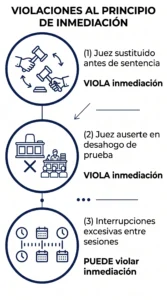
Three main allegations of rape.
The jurisprudence of the SCJN identifies three main assumptions of violation of the principle of criminal immediacy.
First assumption. The judge who hands down the sentence is different from the one who presided over the presentation of evidence, without the evidence having been presented again before the new judge.
Second assumption. The judge was not present at all the hearings of the oral trial, either because he delegated his presence to another official or because he was unjustifiably absent during the presentation of relevant evidence.
Third assumption. There are excessive and unjustified interruptions between sessions of the oral trial that disrupt the concentration and continuity of the proceedings. In these cases, the judge loses a direct and complete understanding of the evidence.
An oral trial divided into sessions widely separated from each other can compromise the principle of immediacy in criminal proceedings, especially when the judge is replaced between sessions.
| 📋 Don't face criminal proceedings without specialized defense. At Baráibar & Asociados, we have experts in Criminal Law ready to defend your interests in Mexico City. |
Procedural consequences: the nullity of the oral trial
- As a rule, the violation of the principle of immediacy in criminal proceedings gives rise to the nullity of the oral trial.
- As a resultThe trial must be held again, with the full presentation of the evidence before the new judge, who will be the same one who issues the sentence.
- This nullityHowever, it is not updated automatically, but must be alleged and proven through the corresponding resources and means of appeal.
- The Supreme Court also He pointed out that the nullity resulting from the violation of the principle of immediacy in criminal proceedings does not always imply the immediate release of the accused.
Limits of the principle of immediacy in criminal proceedings according to the SCJN
As noted, the principle of immediacy in criminal proceedings cannot be absolutely demanded at all stages of the criminal process. The Supreme Court of Justice of the Nation (SCJN) has recognized that this principle operates primarily in the oral trial phase, not in prior stages such as the investigation, the initial hearing, or the preliminary hearing. Therefore, the fact that different judges are involved in these stages does not in itself violate the principle of immediacy.
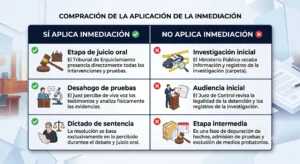
Furthermore, the Supreme Court of Justice of the Nation (SCJN) has determined that the principle of immediacy in criminal proceedings cannot be invoked to demand that the same judge preside over the case from its very inception. Strictly speaking, the principle requires that the judge presiding over the presentation of evidence in the oral trial be the same judge who hands down the sentence.
In that regard, it should be noted that the replacement of the judge before the formal start of the oral trial does not violate the principle, provided that the new judge presides over the trial hearings in their entirety and is the one who ultimately delivers the sentence.
| ⚖️ Protect your rights with expert legal advice from Baráibar & Asociados. We understand the accusatory system and know how to defend you. |
Conclusion: the principle of immediacy in criminal proceedings protects the legitimacy of the trial
The principle of immediacy in criminal proceedings is a constitutional guarantee that ensures that the oral trial is what it should be: a direct and personal evaluation of the evidence by the person who will make the most important decision regarding the defendant's freedom. Its violation is not a procedural technicality. It is a real infringement of the right to a fair trial.
At Baráibar & Asociados, we have specialists in Criminal Law who have in-depth knowledge of the Supreme Court of Justice of the Nation's jurisprudence on the oral adversarial system and who have participated in the development of these legal precedents. If the principle of immediacy in criminal proceedings was violated in your case, contact us to evaluate the available defense options.
Frequently asked questions about the principle of immediacy in criminal proceedings
1. In which article of the Constitution is the principle of immediacy in criminal proceedings found?
The principle of immediacy in criminal proceedings is enshrined in Article 20 of the Political Constitution of the United Mexican States, which establishes the principles of the oral adversarial system: publicity, adversarial proceedings, concentration, continuity, and immediacy. Its procedural development is found in Article 9 of the National Code of Criminal Procedure (CNPP).
2. What happens if the judge presiding over the oral trial is replaced before issuing a sentence?
If the trial judge is replaced before sentencing, the trial must be held again before the new judge, including the full presentation of evidence. If a sentence is issued without complying with this requirement, it constitutes a violation of the principle of immediacy in criminal proceedings and is subject to appeal. Legal basis: Articles 9 and 67 of the National Code of Criminal Procedure; Supreme Court of Justice of the Nation (SCJN) ruling ADR 492/2017.
3. Does a violation of the principle of immediacy in criminal proceedings lead to the release of the accused?
Not necessarily. A violation of the principle of immediacy in criminal proceedings results in the annulment of the oral trial and requires a new one. This does not imply an automatic acquittal of the accused, but rather that the process must be restarted respecting the guarantees of the adversarial system. However, in certain cases, it may justify a review of the pretrial detention measure while the proceedings are being restarted.
4. Does the principle of immediacy in criminal proceedings apply during the investigation stage?
No. The Supreme Court of Justice of the Nation (SCJN) has determined that the principle of immediacy in criminal proceedings operates primarily during the oral trial phase, not in prior stages such as the investigation, the initial hearing, or the intermediate stage. Therefore, it is valid for different judges to preside over these stages without this constituting a violation. Legal basis: SCJN rulings ADR 492/2017 and ADR 1644/2021.
5. How is a violation of the principle of immediacy in criminal proceedings challenged?
It may be challenged by means of an appeal against the final judgment, arguing a violation of procedural law that affects the defense and impacts the outcome of the ruling. Alternatively, it may be raised in a direct amparo proceeding. Legal basis: Articles 467, section IV, and 468 of the National Code of Criminal Procedure; Article 170 of the Amparo Law.
6. Can it be invoked if the judge was absent during a hearing?
Yes. If the judge was not present at all hearings of the oral trial—either because they delegated their presence to another official or because they were absent during the presentation of key evidence—this may constitute a violation of the principle of immediacy in criminal proceedings. The defense must accurately document the absence and demonstrate that it affected the outcome of the trial. Legal basis: Article 20, Section A, Paragraph V, CPEUM; Article 9 CNPP.
Legal references:
🔗 Article 20 of the Constitution — Principles of the accusatory system (CPEUM)
🔗 SCJN — Principle of Immediacy in Criminal Justice: Jurisprudence Notebook (2024)
🔗 Criminal act in arrest warrants and indictment — Baráibar & Associates
🔗 Constitutional Reform June 2026 — Postponement of Judicial Election
This article is for informational purposes only and does not constitute formal legal advice or establish an attorney-client relationship.

by paulina@baraibar.com.mx | May 12, 2026 | Criminal law
Criminal act It can no longer be treated as an “automatic” phrase to justify a arrest warrant or a order to proceed to trialSince March 2026, a mandatory criterion emphasizes that, by last ratio and the guarantor function of the criminal type, the Prosecutor's Office must provide minimum test data that show in fact the basic characteristics of the alleged crime, before affecting freedom (article 16 of the Constitution).
In practice, this standard reorders the debate: it is not enough to narrate, one has to minimally checkFor companies and individuals under investigation in Mexico City, this opens a clear defensive avenue to combat "generic" accusations and, at the same time, compels them to strengthen compliance strategies and evidence management.
1) What changed in 2026: “criminal act” as the minimum verifiable factual element
The widely disseminated criterion as “CRIMINAL ACT. ITS BASIC CONNOTATION IN LIGHT OF THE PRINCIPLES OF LAST RESORT AND GUARANTEE FUNCTION OF THE CRIMINAL TYPE” It upholds an operational idea: the “criminal act” of Article 16 of the Constitution requires a minimum evidentiary sufficiency that shows, in the factual world, a behavior with basic features of the criminal offense preliminarily attributed. That burden falls on the Prosecutor's Office and is essential requirement both for arrest warrant as for link to process, due to its direct or indirect impact on freedom.
Why does it matter for an arrest warrant (art. 16 CPEUM)
Article 16 of the Constitution requires (among other things) that get data that establish that the act has been committed and that there is a probability of participation.
The point of criterion 2026 is that this “fact” cannot be an empty label: it must have minimum anchorage in test data that show the basic materiality of typical behavior.
Why does it matter for indictment (art. 316 CNPP)
Article 316 of the CNPP requires evidence establishing that an act defined as a crime by law was committed, understanding that such evidence exists when there is reasonable indications that allow one to suppose.
The 2026 criterion pushes for those “reasonable indications” to translate into verifiable factual features of the criminal type, not only in broad inferences.
2) Date of mandatory nature and actual procedural scope
This criterion was published in the Weekly March 6, 2026 and it was considered mandatory application from 9 March 2026.
Practical scope:
- It becomes a control parameter for control judges when analyzing arrest requests and to resolve link to process.
- The cost of litigating with "textbook" charges increases: if the prosecution does not ground the criminal offense in verifiable facts, the defense has a technical argument to deny, revoke o protect.
⚖️ spin: Do you have questions about this topic? The lawyers at Baráibar & Asociados in Mexico City can guide you. Schedule your consultation today.
3) The core of the criterion: last resort + guarantee function of the criminal type
The criterion explains that criminal law, being last ratioIt must be used with a reinforced standard when the procedural act affects liberty. Furthermore, the guarantee function of the criminal type requires that only the commission of conduct typified (and not “similar”) justify intense measures such as apprehension or continuation of the process.
What does “guarantee function” mean in litigation language?
In court proceedings, the "guarantee function" translates into control:
- Delimit the punishable conduct (what is and is not included in the type).
- Demand that the Prosecutor's Office show basic facts that coincide with that framework.
- To prevent the process from being used as an "extended investigation" with already restricted freedom.
Last resort as a minimum evidentiary standard, not as discourse
The criterion does not say "prove the complete crime" at the initial stage. It says: contribute the minimum verifiable amount of the type charged, because the State is using its most powerful tool. That difference is key: it's not a request for an early sentence, it's a demand. factual floor.
4) Arrest warrant: where the Prosecutor's request breaks with this standard
In the CNPP, the judge can order a summons, appearance, or apprehension When a complaint is filed, the Public Prosecutor's Office announces data that establishes the criminal act and the probability of authorship, and—for apprehension— need for caution.
Using the 2026 criterion, typical vulnerable points are:
A) “Generic” facts without typical features
Example: “seized resources”, “defrauded”, “threatened”, “altered documents”, without describing as, when, with what medium, with what resultand without supporting data. The standard requires showing basic characteristics of the type (conduct/object/result relevant to the crime).
B) Inferential leaps without hard data
When the Prosecutor requests arrest with inferences (“because of his position he should have known”, “he had access”, “he is an administrator”), without minimal external data (traceability, messages, preliminary expert reports, records, witnesses with verifiable context).
C) “Need for caution” as a crutch
Although the criterion focuses on "criminal act", in practice it requires reviewing whether the apprehension is being used to drive without basic factual support. If the "fact" is weak, the caution becomes disproportionate.
Typical business risk (CDMX): Internal complaints or those from former employees that escalate to a formal case file; if the company fails to preserve evidence and a clear narrative, the prosecution can fill in the gaps with assumptions. This criterion makes it more cost-effective to litigate the standard from the outset.
5) Linking to the process: the debate is no longer just a probability of participation
Article 316 CNPP requires evidence of the criminal act and the probability of intervention.
The 2026 criterion strengthens the first component: criminal act as verifiable minimum factual of the basic characteristics of the crime.
How to use it strategically in initial audiences:
- Separate The discussion: first “criminal act” (factual basis), then “probability”.
- Ask the judge to identify what basic typical features They are considered satisfied and with what information (not with what “said”).
- Attacking the “minimum typicality” when the imputation is narrative but not verifiable.
Common defensive mistakes (that you should avoid):
- Discussing “innocence” or “full proof” (is not the standard).
- To go straight to subtle contradictions without first addressing the lack of basic features of the type.
- Do not tie the argument to the impact on freedom (precautionary measures, appearances, reputational restriction, etc.).
Don't face this process alone. At Baráibar & Asociados, we have criminal law specialists ready to defend your interests in Mexico City.
6) Tactical checklist: what the prosecution should provide and what the defense should demand
This criterion functions as a litigable checklist.
The minimum that must exist (depending on the crime)
Without inventing “universal lists”, the logic is: basic features of the type + minimum test data that makes them verifiable.
Examples of “minimum verifiable” (in the abstract):
- Assets: traceability of disposal, specific impact, base document/record, identification of the asset/value.
- Documentaries: existence of the document, attributed intervention, preliminary expertise or verifiable objective feature.
- Threats/violence: context, medium, basic content, temporality, objective element that supports the claim.
How to structure a defensive objection
- “Your Honor, even if the narrative is granted for now, no minimum data that factually demonstrate the basic characteristics of criminal type X; due to its guarantee function and as a last resort, freedom cannot be affected by an unverifiable fact.”
Risk: that the judge “supplants” the standard
The real danger is that the judge will mentally "fill in the gaps" left by the prosecution ("it sounds like fraud"). This criterion provides grounds for demanding a more thorough ruling. methodical: typical feature + fact.
7) Impact on companies: criminal compliance and evidence management from day 1
For companies (fintech, retail, construction, logistics, pharma, tech) the 2026 standard has two interpretations:
1) More powerful early defense
If the case file was built with vague testimonies or disconnected documents, the defense can halt the arrest/indictment with an approach of verifiable minimum typicality.
2) Greater internal demands
Companies must quickly build their "verifiable factual explanation":
- Preservation of emails/chats, logs, accounting records.
- Internal chain of custody (without replacing the authority, but avoiding destruction/alteration).
- Internal research protocols (to avoid creating contradictions that could later be used as "facts" against the company or its executives).
Frequent gray area: Poorly documented internal investigations that create “facts” without technical support. The 2026 criterion rewards accuracy and penalizes narrative.
8) Protection strategy: when this criterion is decisive
Judgment itself is built in scenarios of arrest warrant and link to process, and states that Article 16 requires that minimum threshold.
When is it usually decisive:
- When the judicial resolution does not identify what data support the basic characteristics of the crime.
- When the Public Prosecutor "announces" data, but in court it does not translate into verifiable facts.
- When the resolution relies on standard phrases (“reasonable indications”) without explanation indicios de qué.
How this translates into procedural risk for the Prosecutor's Office:
- Higher probability of revocation/denial,
- Greater exposure to protection due to insufficient motivation,
- Greater pressure to "strengthen" cases before requesting restrictive measures.
Protect your freedom and your defense strategy with expert legal advice from Baráibar & Asociados in Mexico City.
Conclusion
The mandatory criterion of March 2026 redefines the concept of criminal act in its correct place: a verifiable minimum factual that the Prosecutor's Office must show to justify measures that impact freedom, consistent with the last ratio and the guarantor function of the criminal type.
For criminal defense (and for business risk management) the message is clear: litigation is no longer won with rhetoric; it is won by forcing the criminal type to land on verifiable basic facts, from the first act that intends to restrict rights.
FAQs (Mexico) — Snippet-type answers (45–60 words)
1) What is a “criminal act” for the purposes of an arrest warrant?
The reported fact is that la ley señala como delito, supported by data that allow establishing what occurred and that there is a probability of participation. The constitutional standard derives from Article 16 of the Mexican Constitution and is operationalized in the National Code of Criminal Procedure. In 2026, it was emphasized that there must be a verifiable minimum of facts.
2) Does the prosecution have to prove the entire crime in order to bring charges?
No. For linkage, the CNPP requires test data e reasonable indications, not conclusive proof. However, there must be a verifiable minimum of the basic features of the imputed crime, in accordance with the mandatory criterion of 2026 and article 316 CNPP.
3) What happens if the arrest warrant is based on generic facts?
If the application and the resolution do not show minimum data that factually demonstrate the basic characteristics of the crime, a violation of article 16 CPEUM can be argued due to the insufficiency of the "criminal act", and judicial control or protection can be sought as appropriate.
4) Since when is the criterion “CRIMINAL ACT. ITS BASIC CONNOTATION…” mandatory?
It was published on March 6, 2026 and it was considered mandatory from March 9, 2026, according to the Gazette of the Judicial Weekly of the Federation. This impacts decisions regarding arrest and indictment.
5) How does Article 141 of the CNPP relate to the “criminal act”?
Article 141 of the CNPP allows for summons, appearance, or arrest when there is a complaint/accusation and the Public Prosecutor presents information establishing the criminal act and the probability of authorship; for arrest, there is also a need for precautionary measures. Criterion 2026 requires that this “act” have a minimum verifiable factual basis.
6) What should the defense request in the hearing to apply this standard?
It must require the judge to identify what basic features of the criminal type are considered satisfied and with what information specific, avoiding generic motivations. The basis is in article 16 CPEUM, 316 CNPP and the mandatory criterion of 2026 on “criminal act”.
References (official) + latest reform
Disclaimer: This article is for informational purposes only and does not constitute legal advice or an attorney-client relationship.
SEO Summary
- Focus Keyphrase:
- Keywords secundarias: artículo 16 constitucional, artículo 316 CNPP, artículo 141 CNPP, última ratio penal, función garantista del tipo penal, datos de prueba mínimos, juez de control CDMX, defensa penal estratégica
- Meta Description: Criminal act in 2026: minimum verifiable standard for arrest warrant and indictment. Avoids risks and nullities.
- Meta Title: Criminal act and arrest/indictment order: minimum verifiable standard 2026
- Slug SEO: hecho-delictivo-orden-aprehension-vinculacion-estandar-minimo-2026
- Breadcrumb: Inicio > Penal > Hecho delictivo y órdenes de aprehensión 2026
- Categoría: Penal
- Intención de búsqueda: preventiva + informacional (con componente transaccional)
- Outbound links: CPEUM Diputados; CNPP Diputados; Gaceta SCJN (PDF)
- Internal links (sugeridos): “Amparo contra orden de aprehensión en CDMX”; “Audiencia inicial y vinculación a proceso: estrategia”; “Medidas cautelares: riesgos y defensa”
- Keyphrase Density (estimada): 0.8%–1.2%
- Flesch estimado: 58–63
- Voz pasiva estimada: < 12%
- “Orden de aprehensión en CDMX: cómo combatir la necesidad de cautela (2026)”
- Keyword: necesidad de cautela orden de aprehensión
- Intención: preventiva/defensiva
- Relación: complementa el estándar de hecho delictivo con el eje cautelar
- Potencial comercial: defensa en audiencia y amparo
- “Vinculación a proceso: cómo desmontar imputaciones genéricas con el artículo 316 CNPP (2026)”
- Keyword: artículo 316 CNPP vinculación a proceso
- Intención: informacional + transaccional
- Relación: baja a técnica de audiencia inicial
- Potencial comercial: litigio estratégico penal
- “Evidencia digital y datos de prueba mínimos: guía de preservación para empresas investigadas (CDMX 2026)”
- Keyword: preservación de evidencia digital empresa investigación penal
- Intención: preventiva/compliance
- Relación: fortalece el “mínimo verificable” desde el día 1
- Potencial comercial: compliance penal corporativo y gestión de crisis