


The reduction of the workweek is now a legal reality in Mexico, although its full implementation will take several years. Since March 2026, Article 123 of the Constitution has stipulated that the maximum workweek will gradually decrease from 48 to 40 hours by 2030. Therefore, every company operating in the country must adjust its schedules, payroll, and contracts as the official timeline progresses. This guide explains the origin of the reform, its exact timeline, and the practical obligations employers face in Mexico City and throughout the rest of the country.
1. What is the reduction of working hours and how was it approved?
The reduction of the workweek is a constitutional reform that modifies sections IV and XI of Article 123, paragraph A, to lower the weekly work limit from 48 to 40 hours. The Senate approved the bill on March 3, 2026, and the Official Gazette of the Federation published the decree that same day, making its constitutional component immediately effective.
However, the constitutional reform alone does not immediately change everyday labor relations. For this reason, Congress also approved changes to the Federal Labor Law, which were published in the Official Gazette of the Federation on May 1, 2026. Consequently, there are now two regulatory levels: the constitutional mandate, which sets the ultimate goal, and secondary legislation, which defines the specific mechanisms for transitioning to the new work schedule.
According to the Senate's approved ruling, the reform garnered broad political support, with 104 votes in favor in the April 2026 vote. Subsequently, the Chamber of Deputies ratified the bill on April 22, without substantial changes to the original draft. This legislative consensus largely explains the speed with which both the constitutional decree and its secondary legislation were published, in a period of just two months.
Compared to other recent labor reforms, this initiative enjoyed simultaneous support from both labor unions and business associations, although the latter expressed reservations about the pace of implementation. Therefore, the final text incorporated a phased five-year timeline, rather than immediate implementation, precisely to allow productive sectors time to adapt.
2. Implementation schedule 2026-2030
The reduction schedule is gradual and mandatory for all employers in the country. During 2026, the workweek will remain at 48 hours, as it currently operates. Starting in 2027, the limit will decrease to 46 hours; in 2028, to 44 hours; in 2029, to 42 hours; and finally, in 2030, the target of 40 hours per week will be reached.
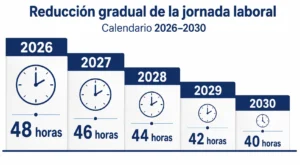
It is important to note that the reform expressly prohibits reducing workers' salaries or benefits as a result of reduced hours. In other words, companies must maintain the same full salary even if actual working time decreases. Furthermore, the reform does not differentiate based on company size or economic sector, meaning that both SMEs and multinational corporations must comply with the same schedule.
For example, a company that currently pays an employee a fixed monthly salary for 48 hours per week will have to pay the same salary for 46 actual hours of work by 2027. In practical terms, this equates to an increase in the cost per hour worked, even if the total payroll remains nominally unchanged. Consequently, finance and human resources departments will need to coordinate their budget projections, taking this cumulative effect into account over the next four years.
| Do you have questions about this topic? The lawyers at Baráibar & Asociados in Mexico City can guide you. Schedule your consultation today. |
3. Key changes to the Federal Labor Law following the reduction of the working day
The reform to the Federal Labor Law, published on May 1, 2026, adapts the secondary legal framework to the new constitutional work schedule. This regulatory adjustment modifies provisions regarding overtime, rest periods, and the weekly distribution of working time, in order to provide legal certainty to both employers and employees during the transition period toward 2030.
Overtime and weekly limits
Before the reform, the law allowed a maximum of nine overtime hours per week. Now, that limit increases to twelve hours per week, although these cannot exceed four hours per day distributed over a maximum of four days. Therefore, companies will need to redesign their shift schedules and overtime pay systems, especially in sectors such as manufacturing, logistics, and retail, where extended workdays are common.
This involves reviewing attendance control systems to accurately differentiate between regular and overtime hours as the weekly limit changes each year. Otherwise, miscalculating overtime can lead to incomplete payments and, potentially, labor lawsuits for wage discrepancies.
Mandatory day off and full pay
Furthermore, the reform reinforces the obligation to grant at least one paid day off for every six days worked. It also clarifies that the gradual reduction of working hours should not result in disguised salary cuts or the elimination of previously granted benefits. For its part, the Ministry of Labor and Social Welfare will issue additional operational guidelines as each stage of the 2027-2030 timeline progresses.
It is worth noting that these guidelines could include specific criteria for mixed work schedules, shift work, and work-from-home arrangements—modalities that current law does not always regulate precisely. Consequently, the Ministry of Labor and Social Welfare (STPS) is expected to publish supplementary rules before the first effective reduction takes place in January 2027.
4. Economic and operational impact on companies
The economic impact of this reform varies considerably by sector. Labor-intensive industries, such as manufacturing, construction, and retail, will face greater pressure to maintain production levels with fewer available hours per worker. For example, a plant that currently operates with 48-hour shifts will need to consider additional hiring, technological upgrades, or process redesign by 2027.
Several business associations have requested differentiated transition periods by sector, arguing that a uniform reduction could disproportionately affect industries with lower profit margins. To date, however, the constitutional timetable does not include sectoral exceptions, so any differentiated adjustments would depend on additional reforms to secondary legislation.
On the other hand, sectors with already flexible work schedules, such as some areas of professional services and technology, could absorb the change with less operational friction. However, all companies will need to update their internal attendance policies, timekeeping systems, and payroll structures, since the calculation of overtime and breaks will change as each phase of the official calendar progresses.
Furthermore, it's important to anticipate the effect on productivity per hour worked. Companies that already measure performance indicators by results, rather than by physical hours spent at the workplace, will likely absorb the transition with less financial impact than those organizations still anchored to traditional timekeeping systems.
5. Sectors with the highest risk of non-compliance
Certain sectors face a particular risk of non-compliance during the transition. For example, the export manufacturing sector, with its 48-hour rotating shift schedules, will need to rethink its operational organization starting in 2027. Similarly, the retail sector, which operates with extended hours on weekends, will have to review the distribution of mandatory rest periods to avoid penalties.
Similarly, the construction sector, where working hours are typically tied to project deadlines, will face difficulties in reconciling reduced hours with contractual timelines agreed upon with clients. Therefore, it is recommended that these industries begin an internal assessment now, rather than waiting until each deadline in the 2027-2030 calendar approaches.
The call center and customer service sector, which operates with staggered 24-hour shift schedules, will also face additional challenges in distributing mandatory breaks without disrupting service. Finally, the agricultural sector, subject to harvest seasons with intensive workdays, will need to negotiate accumulated work schedules in advance that comply with the new weekly limit.
In all these cases, the recommendation is the same: document each operational adjustment with legal backing, instead of improvising informal solutions that later prove difficult to defend in the event of a labor inspection or a lawsuit from a worker.
| Don't face this process alone. At Baráibar & Asociados, we have specialists in Labor Law ready to defend your interests in Mexico City. |
6. What should companies do to prepare?
First, it's advisable to conduct an audit of current schedules to identify areas and positions most affected by the reform. This audit should include a detailed breakdown by department, shift, and contract type, so the company has accurate data before negotiating any adjustments with unions or employee representatives. Additionally, it's recommended to model the financial impact of each stage of the schedule, considering potential hiring or investments in automation.
A third step involves mapping positions with rotating shift schedules or frequent overtime, as these will concentrate the majority of the legal and financial risk during the transition. Internal legal departments, for their part, should establish their own regulatory review schedule now, aligned with each effective date of the official 2027-2030 calendar.
Contractual and payroll adjustments
It is also prudent to review collective and individual employment contracts to ensure they accurately reflect the new limits on working hours and overtime. Similarly, payroll and attendance systems must be updated before 2027 to avoid errors in calculating earnings and overtime pay. Finally, it is advisable to train middle managers on the new regulations, as they typically manage the schedules of operational staff directly.
These middle managers, in their daily work, are the ones who authorize overtime, approve breaks, and resolve attendance issues. Consequently, inadequate training at this hierarchical level often results in operational non-compliance, even when corporate policies are correctly written on paper.
7. Legal risks of non-compliance
Failure to comply with the new work schedule may result in lawsuits before the Conciliation and Arbitration Board or the corresponding labor courts, in addition to administrative sanctions imposed by the Ministry of Labor and Social Welfare. For example, exceeding the permitted overtime limits or failing to grant the mandatory day of rest may generate significant employer liability.
Similarly, reducing salaries or benefits under the pretext of decreased working hours constitutes a direct violation of the constitutional reform. Consequently, companies that implement salary adjustments without legal justification risk costly labor disputes and reputational damage. For their part, unions and workers' representatives have already announced that they will closely monitor compliance with each phase of the official timeline.
🔗 INTERNAL LINK: Labor certification for agricultural exports → https://baraibar.com.mx/certificacion-laboral-para-agroexportacion-causales-ambientales/
🔗 INTERNAL LINK: 2025 Amparo Law Reform for Businesses in Mexico City → https://baraibar.com.mx/reforma-ley-de-amparo-2025-empresas-cdmx-2/
🔗 EXTERNAL LINK: Official Gazette of the Federation (DOF) Decree, constitutional reform to Article 123 → https://www.dof.gob.mx/nota_detalle.php?codigo=5781417&fecha=03032026
🔗 EXTERNAL LINK: Official Gazette of the Federation (DOF) Decree, amendment to the Federal Labor Law → https://www.dof.gob.mx/nota_detalle.php?codigo=5786537&fecha=01052026
| » Protect your company's operations with expert legal advice from Baráibar & Asociados in the face of this new work calendar. |
Conclusion
This reduction in the workday will gradually transform the relationship between companies and workers until 2030. Although 2026 still operates under the 48-hour workweek, the regulatory clock is already ticking for every employer in Mexico. Therefore, anticipating this through internal audits, payroll adjustments, and training is more cost-effective than facing penalties or labor disputes later on.
Companies that begin their transition plan from 2026 onward, rather than waiting until the last quarter of 2027, will have more time to negotiate with unions, redesign processes, and train their teams without operational pressure. At Baráibar & Asociados, we support companies through every phase of this regulatory transition process, from the initial assessment to the final contract update.
Frequently asked questions about reducing working hours
When does the reduction in working hours come into effect? The schedule is gradual: 48 hours in 2026, 46 in 2027, 44 in 2028, 42 in 2029 and 40 hours per week from 2030 onwards, according to the decree published in the DOF on March 3, 2026.
Does a reduction in hours imply a lower salary? No. The constitutional reform expressly prohibits reducing workers' salaries or benefits as a consequence of the gradual reduction of the weekly working hours.
How many overtime hours can be worked now? The limit increased from nine to twelve hours per week, distributed in a maximum of four hours per day for up to four days, according to the reform to the Federal Labor Law published on May 1, 2026.
Which companies must comply with this reform? All companies operating in Mexican territory, regardless of size or economic sector, must comply with the constitutional schedule for reducing working hours until 2030.
What if a company doesn't meet the deadline? You may face labor lawsuits, administrative sanctions from the Ministry of Labor and Social Welfare, and employer liability for violations of working hours and overtime limits.
Should I update my employment contracts now? It is recommended. Reviewing collective and individual contracts, as well as payroll systems, before 2027 avoids calculation errors and reduces legal risks during the transition.
Legal references
- Official Gazette of the Federation, Decree of constitutional reform to article 123, section A, March 3, 2026.
- Official Gazette of the Federation, Decree reforming the Federal Labor Law, May 1, 2026.
- Political Constitution of the United Mexican States, article 123, section A, subsections IV and XI.
- Federal Labor Law, provisions on working hours, breaks and overtime.
This article is for informational purposes only and does not constitute formal legal advice or establish an attorney-client relationship.