

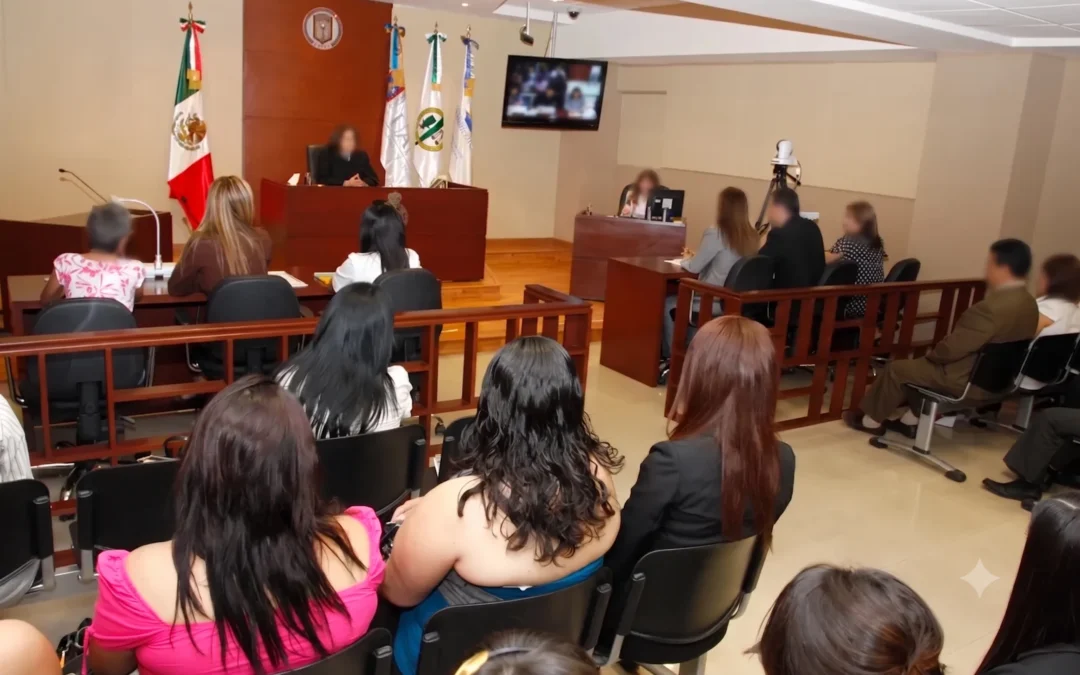
| Manuel Baráibar Tovar contributed to the construction of jurisprudence on the principle of immediacy in criminal proceedings in the Mexican oral accusatory system. |
This principle is one of the cornerstones of the oral adversarial system established in Article 20 of the Constitution. Essentially, it requires that the judge who presided over the presentation of evidence in the oral trial be the same judge who issues the sentence. However, this is not always the case, and the procedural consequences of violating it are significant.
Knowing the criteria of the Supreme Court of Justice of the Nation (SCJN) on this principle is essential for defendants and their defenders in Mexico.
Principle of immediacy in criminal law within the accusatory system
The principle of immediacy in criminal proceedings establishes that all hearings in the oral trial must be held before the judge, who cannot delegate their functions to another person. This guarantee ensures the judge's direct contact with the evidence: they hear statements from witnesses, experts, and the accused, observe their behavior, and form their conviction based on what they perceive during the hearing.
Far from being a mere formality, this principle constitutes a substantive guarantee. Its purpose is to protect the defendant's right to be tried by the same judge who directly reviewed the evidence.
Furthermore, the adversarial oral system was created to correct the shortcomings of the inquisitorial model, in which the investigating judge rarely handed down the sentence. In this context, the principle of immediacy in criminal proceedings strengthens judicial impartiality and the reliability of decisions.
What do the Constitution and the National Code say about principio de inmediación penal?
Article 20 of the Political Constitution of the United Mexican States establishes that criminal justice shall be accusatory and oral, governed by the principles of publicity, adversarial proceedings, concentration, continuity, and immediacy. Therefore, the principle of immediacy in criminal proceedings is not merely a jurisprudential criterion: it has constitutional status, and its violation can compromise the validity of the entire trial.
For its part, the National Code of Criminal Procedure (CNPP) elaborates on this principle in Article 9, stating that no procedural action may be delegated. Additionally, Article 67 of the CNPP stipulates that when a judge is replaced, the actions previously taken must be repeated before the new judge.
The jurisprudence of the SCJN interprets this mandate strictly.
| ⚖️ Do you have questions about your rights in a criminal trial? The lawyers at Baráibar & Asociados in Mexico City can guide you. Schedule your consultation today. |
How has the Supreme Court of Justice of the Nation (SCJN) defined the principle of immediacy in criminal proceedings?
The Supreme Court of Justice of the Nation has issued important rulings on the scope of the principle of immediacy in criminal proceedings. Specifically, it maintains that it would be pointless for the judge to hear the parties, take the defendant's statement, and question the witnesses if this is done in isolated instances or before different judges.
|
“The principle of immediacy in criminal proceedings is the difference between a genuine oral trial and a sham trial in the adversarial system. When the judge who hands down the sentence was not the one who heard the evidence, the decision loses its most fundamental procedural legitimacy. The Supreme Court of Justice of the Nation (SCJN) has been clear on this point, and at Baráibar & Asociados we have successfully invoked it in cases where attempts were made to replace the judge after the evidence had been presented. My participation in shaping the legal precedent allowed me, with great pride, to contribute to the development of the interpretation that now protects this principle in the Mexican adversarial system.” — Manuel Baráibar Tovar, Esq., Founding Partner, Baráibar & Associates |
The Supreme Court of Justice of the Nation (SCJN) also determined that the principle of immediacy in criminal proceedings operates as an essential procedural rule. This implies the presence of the judge throughout the entire oral trial hearing, from the presentation of evidence to the pronouncement of the sentence.
The judge who hears the oral trial must be the same one who hands down the sentence.
The rule is clear: the judge presiding over the oral trial must issue the sentence.
The Supreme Court of Justice of the Nation (SCJN) maintains that this requirement cannot be waived for reasons of administrative convenience or the workload of the Judiciary. If the judge is removed, reassigned, or replaced for any reason after the presentation of evidence has begun, the oral trial must be held again before the new judge.
Furthermore, a violation of the principle of immediacy in criminal proceedings produces a specific procedural consequence: the nullity of the oral trial. This means that a guilty verdict issued by a judge who did not witness the presentation of evidence can be overturned through an appeal or a direct amparo proceeding.
However, there is an important clarification that the Supreme Court of Justice of the Nation (SCJN) has established. This principle cannot be absolutely demanded at all stages of the process. The reason is that the constitutional reform prioritized guaranteeing judicial impartiality: a judge who knows all the background information from the beginning could lose objectivity when issuing a ruling.
When is the principle of immediacy in criminal proceedings violated?
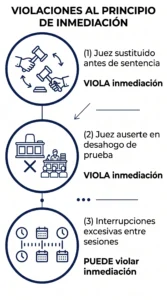
Three main allegations of rape.
The jurisprudence of the SCJN identifies three main assumptions of violation of the principle of criminal immediacy.
First assumption. The judge who hands down the sentence is different from the one who presided over the presentation of evidence, without the evidence having been presented again before the new judge.
Second assumption. The judge was not present at all the hearings of the oral trial, either because he delegated his presence to another official or because he was unjustifiably absent during the presentation of relevant evidence.
Third assumption. There are excessive and unjustified interruptions between sessions of the oral trial that disrupt the concentration and continuity of the proceedings. In these cases, the judge loses a direct and complete understanding of the evidence.
An oral trial divided into sessions widely separated from each other can compromise the principle of immediacy in criminal proceedings, especially when the judge is replaced between sessions.
| 📋 Don't face criminal proceedings without specialized defense. At Baráibar & Asociados, we have experts in Criminal Law ready to defend your interests in Mexico City. |
Procedural consequences: the nullity of the oral trial
- As a rule, the violation of the principle of immediacy in criminal proceedings gives rise to the nullity of the oral trial.
- As a resultThe trial must be held again, with the full presentation of the evidence before the new judge, who will be the same one who issues the sentence.
- This nullityHowever, it is not updated automatically, but must be alleged and proven through the corresponding resources and means of appeal.
- The Supreme Court also He pointed out that the nullity resulting from the violation of the principle of immediacy in criminal proceedings does not always imply the immediate release of the accused.
Limits of the principle of immediacy in criminal proceedings according to the SCJN
As noted, the principle of immediacy in criminal proceedings cannot be absolutely demanded at all stages of the criminal process. The Supreme Court of Justice of the Nation (SCJN) has recognized that this principle operates primarily in the oral trial phase, not in prior stages such as the investigation, the initial hearing, or the preliminary hearing. Therefore, the fact that different judges are involved in these stages does not in itself violate the principle of immediacy.
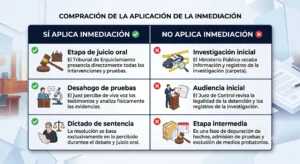
Furthermore, the Supreme Court of Justice of the Nation (SCJN) has determined that the principle of immediacy in criminal proceedings cannot be invoked to demand that the same judge preside over the case from its very inception. Strictly speaking, the principle requires that the judge presiding over the presentation of evidence in the oral trial be the same judge who hands down the sentence.
In that regard, it should be noted that the replacement of the judge before the formal start of the oral trial does not violate the principle, provided that the new judge presides over the trial hearings in their entirety and is the one who ultimately delivers the sentence.
| ⚖️ Protect your rights with expert legal advice from Baráibar & Asociados. We understand the accusatory system and know how to defend you. |
Conclusion: the principle of immediacy in criminal proceedings protects the legitimacy of the trial
The principle of immediacy in criminal proceedings is a constitutional guarantee that ensures that the oral trial is what it should be: a direct and personal evaluation of the evidence by the person who will make the most important decision regarding the defendant's freedom. Its violation is not a procedural technicality. It is a real infringement of the right to a fair trial.
At Baráibar & Asociados, we have specialists in Criminal Law who have in-depth knowledge of the Supreme Court of Justice of the Nation's jurisprudence on the oral adversarial system and who have participated in the development of these legal precedents. If the principle of immediacy in criminal proceedings was violated in your case, contact us to evaluate the available defense options.
Frequently asked questions about the principle of immediacy in criminal proceedings
1. In which article of the Constitution is the principle of immediacy in criminal proceedings found?
The principle of immediacy in criminal proceedings is enshrined in Article 20 of the Political Constitution of the United Mexican States, which establishes the principles of the oral adversarial system: publicity, adversarial proceedings, concentration, continuity, and immediacy. Its procedural development is found in Article 9 of the National Code of Criminal Procedure (CNPP).
2. What happens if the judge presiding over the oral trial is replaced before issuing a sentence?
If the trial judge is replaced before sentencing, the trial must be held again before the new judge, including the full presentation of evidence. If a sentence is issued without complying with this requirement, it constitutes a violation of the principle of immediacy in criminal proceedings and is subject to appeal. Legal basis: Articles 9 and 67 of the National Code of Criminal Procedure; Supreme Court of Justice of the Nation (SCJN) ruling ADR 492/2017.
3. Does a violation of the principle of immediacy in criminal proceedings lead to the release of the accused?
Not necessarily. A violation of the principle of immediacy in criminal proceedings results in the annulment of the oral trial and requires a new one. This does not imply an automatic acquittal of the accused, but rather that the process must be restarted respecting the guarantees of the adversarial system. However, in certain cases, it may justify a review of the pretrial detention measure while the proceedings are being restarted.
4. Does the principle of immediacy in criminal proceedings apply during the investigation stage?
No. The Supreme Court of Justice of the Nation (SCJN) has determined that the principle of immediacy in criminal proceedings operates primarily during the oral trial phase, not in prior stages such as the investigation, the initial hearing, or the intermediate stage. Therefore, it is valid for different judges to preside over these stages without this constituting a violation. Legal basis: SCJN rulings ADR 492/2017 and ADR 1644/2021.
5. How is a violation of the principle of immediacy in criminal proceedings challenged?
It may be challenged by means of an appeal against the final judgment, arguing a violation of procedural law that affects the defense and impacts the outcome of the ruling. Alternatively, it may be raised in a direct amparo proceeding. Legal basis: Articles 467, section IV, and 468 of the National Code of Criminal Procedure; Article 170 of the Amparo Law.
6. Can it be invoked if the judge was absent during a hearing?
Yes. If the judge was not present at all hearings of the oral trial—either because they delegated their presence to another official or because they were absent during the presentation of key evidence—this may constitute a violation of the principle of immediacy in criminal proceedings. The defense must accurately document the absence and demonstrate that it affected the outcome of the trial. Legal basis: Article 20, Section A, Paragraph V, CPEUM; Article 9 CNPP.
Legal references:
🔗 Article 20 of the Constitution — Principles of the accusatory system (CPEUM)
🔗 SCJN — Principle of Immediacy in Criminal Justice: Jurisprudence Notebook (2024)
🔗 Criminal act in arrest warrants and indictment — Baráibar & Associates
🔗 Constitutional Reform June 2026 — Postponement of Judicial Election
This article is for informational purposes only and does not constitute formal legal advice or establish an attorney-client relationship.