


Commercial or civil contract: key differences you should know.
Knowing whether you have a commercial or civil contract is not a technical detail. The answer determines the judge before whom you must file your lawsuit, the procedure followed, and even the applicable legal interest rate. In early September 2026, the Supreme Court of Justice of the Nation upheld a ruling that halted a claim for approximately $181 million, precisely because it was filed through civil proceedings when it should have been filed through commercial proceedings.
In this article we explain what the Court decided, how to distinguish between both types of contract and what measures to take to avoid losing a case before discussing the merits.
What did the Supreme Court decide in the Kenchy Enterprise case?
As reported by El CEO on September 3, 2026, the Supreme Court unanimously resolved two cases presented by Justice Lenia Batres Guadarrama. Both stemmed from the litigation between Kenchy Enterprise and the La Cruz Azul Cooperative.
The origin of the conflict
According to the report, the contract pertained to tax consulting services provided since 2003. Among other tasks, the company was required to work with the Ministry of Finance to have a tax loss for the cooperative recognized in terms of income tax. Based on this contract, Kenchy claimed approximately $181 million.
The inappropriateness of the civil route
The lawsuit was originally filed in a civil court with oral proceedings in Mexico City. However, the court ruled the civil route inadmissible and maintained that the matter should be processed as a commercial case. Dissatisfied, Kenchy filed for amparo (a constitutional remedy). In resolving the case, the Supreme Court held that the responsible authority had correctly classified the contract and, consequently, upheld the ruling that the civil route was inadmissible.
The award of costs
In the second case, the Court granted the cooperative's request for an injunction, ordering the civil judge to determine whether the plaintiff company must pay the court costs. Thus, in addition to not being able to pursue its claim, the plaintiff could face litigation expenses.
What are coastlines and why do they matter?
Court costs are the expenses and fees that one party may be required to pay to the other at the end of a lawsuit. In commercial matters, Article 1084 of the Commercial Code establishes the circumstances under which such costs are awarded. Thus, before litigating, it is advisable to assess not only the likelihood of winning, but also the potential cost of losing due to a procedural issue.
Why does this matter to any company?
Although this case involves exceptional sums of money and a well-known institution, the lesson is general and applies equally to small and medium-sized businesses. Choosing the wrong legal avenue can lead to a lawsuit being dismissed without the judge even considering whether the claim was justified. Therefore, identifying from the outset whether you have a commercial contract is a strategic decision.
What is a commercial contract and what distinguishes it from a civil contract?
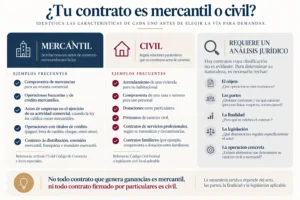
In Mexico, two main contractual regimes coexist: commercial law, regulated primarily by the Commercial Code, and civil law, regulated by the civil codes. The difference lies not in the name the parties give to the contract, but in the nature of the act.
EXTERNAL LINK: Código de Comercio → https://www.diputados.gob.mx/LeyesBiblio/ref/ccom.htm
The acts of commerce
Article 75 of the Commercial Code lists the acts that the law considers commercial. These include purchases and sales for the purpose of commercial speculation, banking operations, negotiable instruments, supply companies, commission and agency companies, and transactions between merchants. Furthermore, its final section includes any other act of an analogous nature, which requires the judge to analyze each case individually.
The nature of the parties and the purpose
As a general rule, a commercial contract is entered into for profit within an organized business activity, whether it involves buying, selling, intermediation, financing, or providing services to other businesses. In contrast, a civil contract typically addresses personal or consumer needs, without any speculative intent. For example, Article 76 of the Commercial Code excludes purchases made for the buyer's own use or consumption from commercial acts.
The name of the contract is not enough
Many companies use templates with generic titles, such as "service contract" or "collaboration agreement." However, the judge is not guided by the title, but by what the parties actually agreed upon and how it was executed. The same template can result in a civil contract in one case and a commercial contract in another.
The mixed acts
What happens if the transaction is considered commercial by one party and civil by the other? Article 1050 of the Commercial Code resolves this question: in such cases, the dispute is governed by commercial law. This rule is crucial for companies that contract with individuals or non-commercial entities, such as civil associations, cooperatives, or independent professionals, because it defines from the outset the procedure applicable to any conflict.
Signs that you are dealing with a commercial contract
Before filing a lawsuit, check these signs. If several are present, it's likely a commercial contract:
- At least one of the parties is a merchant and acts within its line of business.
- El objeto tiene un propósito de especulación o de lucro.
- There are invoices, orders, or other documents typical of the business.
- There are invoices, orders, or other typical documents of the business.
| Not sure if your contract is commercial or civil? The lawyers at Baráibar Temblador y Asociados in Mexico City can review it before you file a lawsuit. Schedule your consultation today. |
Why can choosing the right path decide a trial?
En términos sencillos, la vía procesal es el camino que la ley prevé para resolver una controversia. Por lo tanto, si se elige la incorrecta, el juez no puede estudiar el fondo del asunto.
The origin of the road is reviewed ex officio
For years, the First Chamber of the Supreme Court has held in jurisprudence 1a./J. 25/2005 that the admissibility of the chosen legal avenue is a procedural requirement that the judge must examine ex officio before ruling on the merits. In other words, even if the opposing party does not raise the objection, the judge may declare the chosen legal avenue inadmissible.
The practical consequences
When a legal avenue is deemed inappropriate, the claim fails in that proceeding, and the plaintiff must initiate a new one through the correct channel. Meanwhile, months or years can pass, expenses incur, and, as the case discussed demonstrated, a court order for costs may be issued. Therefore, an initial error can prove very costly.
Practical differences between a commercial contract and a civil contract
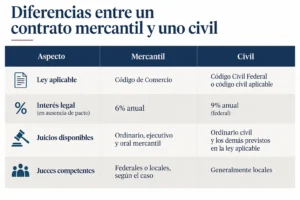
Beyond the competent judge, the nature of the contract also has concrete effects on your business. Here are some relevant differences:
Legal interest rate
When the parties do not agree on interest rates, the legal rate applies. For commercial matters, Article 362 of the Commercial Code sets a legal interest rate of 6% per annum. In contrast, Article 2395 of the Federal Civil Code provides for a legal interest rate of 9% per annum.
EXTERNAL LINK: Código Civil Federal → https://www.diputados.gob.mx/LeyesBiblio/pdf/CCF.pdf
Available procedures
The Commercial Code provides for ordinary, executive, and oral commercial proceedings, depending on the type of document and the amount in dispute. For example, a promissory note allows for an executive commercial proceeding, which begins with a demand for payment and, if applicable, an attachment of assets. Similarly, oral commercial proceedings are reserved for certain amounts that are updated annually.
Litigation time and costs
Each procedure has different stages, deadlines, and resources. A commercial oral trial, for example, concentrates the proceedings in hearings and is usually resolved more quickly than an ordinary trial. Understanding these differences allows you to better estimate how much time and resources your case will require.
Concurrent jurisdiction
Commercial disputes can be brought before federal or local judges because there is concurrent jurisdiction. In contrast, civil matters between private individuals generally fall under the jurisdiction of local courts. This difference allows for the development of different strategies depending on the case.
INTERNAL LINK: creditor opposition in business mergers → https://baraibar.com.mx/oposicion-de-acreedores-en-fusiones-empresariales/
[PROPOSED CITATION – PENDING APPROVAL] According to Jorge Arriaga Chan Temblador, Managing Partner of Civil, Commercial and Labor Lawsuits at Baráibar Temblador y Asociados, “before filing any lawsuit we review the nature of the contract and the parties; that initial decision defines the judge, the deadlines and, often, the outcome of the trial.”
| Don't face a contractual dispute alone. At Baráibar Temblador y Asociados, we have specialists in civil and commercial litigation, ready to defend your interests in Mexico City. |
Common examples of commercial contracts in the life of a company
To clarify these concepts, it's helpful to review some of the contracts that companies sign every day. In most cases, it's a commercial contract, although there are always nuances.
Supply, distribution and commission
Supply, distribution, commission, and agency contracts are generally considered commercial because the Commercial Code expressly links them to business activity. Similarly, the purchase and sale of goods for resale is a typical commercial transaction.
Real estate leasing: a criterion that changed
For years, real estate leases were considered to be always civil matters. However, in August 2023, the First Chamber resolved direct appeal for review 172/2023 and recognized that, depending on the nature of the transaction, claims can also be pursued through commercial law. This marked a departure from a previous precedent and required judges to analyze each case using the rule of analogy established in Article 75.
Credit titles
Promissory notes, checks, and bills of exchange are considered commercial acts by law, even if signed by someone who is not a merchant. Consequently, their collection is processed through commercial channels, typically via summary judgment proceedings.
Professional services contracts: the most confusing case
In practice, professional services contracts, such as consulting or advisory services, are the ones that generate the most questions. Traditionally, the provision of professional services has been considered a civil contract. However, the case discussed shows that the analysis can change depending on how the service is provided.
Factors that courts typically consider
- If the provider operates as an organized company, with a structure and profit-making purpose.
- Also, if the service is part of the commercial activity of either party.
- Also, if the contract contains elements typical of commercial acts, such as commissions or agencies.
- Finally, the method of payment, the duration and the relationship with other commercial transactions.
What you shouldn't assume
Don't assume a contract is civil just because it's titled "Provision of Professional Services." Nor should you assume it's commercial simply because a company signs it. Each case requires a review of the subject matter, the parties involved, and the purpose of the transaction. A fifteen-minute review with your lawyer before filing a lawsuit can save you months of fruitless litigation and a potential court-ordered lawsuit.
How to protect your contracts from the drafting stage?
The best way to avoid arguments about the route is to anticipate them during the drafting process. These recommendations help reduce the risk:
- Clearly describe the purpose of the contract and the professional or commercial activity of each party.
- Indicate if either party is acting as a trader and for what purpose.
- Expressly agrees on the default interest rate, so as not to depend on the legal rate.
- Define the jurisdiction and, if appropriate, an arbitration or mediation clause.
- Document deliveries, progress, and payments throughout the entire business relationship, not just at the end.
The dispute resolution clause
In fact, a well-drafted clause can save years of litigation. However, it's important to remember that the nature of the transaction doesn't change based on what the parties say. Therefore, the clause must be consistent with the reality of the transaction.
INTERNAL LINK: tax obligations of companies and the tax mailbox→ https://baraibar.com.mx/buzon-tributario-obligatorio-2026-sat-mexico/
Commercial contract and alternative mechanisms: resolving without going to court
Not all disputes arising from a commercial contract have to end up in court. The General Law on Alternative Dispute Resolution Mechanisms, published in January 2024, regulates mediation and conciliation as ways for parties to reach agreements with the help of a neutral third party.
Advantages for companies
Mediation is usually faster and less expensive than litigation. Furthermore, it allows for the preservation of business relationships, which is especially valuable when dealing with strategic clients or suppliers. Agreements that meet legal requirements can have the force of res judicata, making them legally binding.
When is it a good time to try?
Mediation is a worthwhile option when the conflict is primarily economic, there is an interest in continuing business, and the relevant information is documented. However, if there is an urgent need to secure assets or a risk that the other party will conceal their wealth, it may be necessary to go directly to court.
What to do if you already have a trial underway?
If you've already filed a lawsuit and there's doubt about the correct procedure, you can still take action. Check with your lawyer whether the opposing party has raised an objection regarding the procedural impropriety and what their arguments are to support it.
If you are the defendant
On the other hand, if you were sued through a legal process you believe was improper, raising this issue promptly can end the case at that stage. Remember that the judge can review it on their own initiative, but a well-founded argument strengthens your defense.
Review your base documents
In any scenario, the case file is built with documents. Gather the signed contract, invoices, emails in which changes were agreed upon, and proof of payment or non-compliance. With this information, your lawyer can determine whether the matter is commercial or civil and which procedure offers the most advantages.
Pay attention to the deadlines
Furthermore, initiating a new lawsuit through the proper channels takes time. In the meantime, it's advisable to review the statute of limitations applicable to your claim, so you don't lose your right simply due to the passage of time.
| Protect your contracts and collections with expert legal advice from Baráibar Temblador y Asociados. We'll review the appropriate course of action before you file a lawsuit. |
Conclusion: Identifying your commercial contract is the first step to winning
The case resolved in September 2026 confirms that the legal process is not a minor matter. A multi-million dollar claim can be halted if it is filed as a civil suit when it involves a commercial contract, or vice versa. Reviewing the nature of the transaction, drafting it clearly, and choosing the correct procedure are decisions that protect your business before litigation even begins.
Frequently asked questions
How do I know if my contract is commercial or civil?
It depends on the nature of the act, not the name of the contract. Article 75 of the Commercial Code lists commercial acts, such as purchases for speculative purposes, negotiable instruments, and supply and commission companies, and includes similar acts. If the purpose is personal or for consumption, it is usually considered a civil act, according to Article 76.
What happens if the contract is commercial for one party and civil for the other?
Article 1050 of the Commercial Code establishes that when an act is commercial for one party and civil for the other, the dispute is governed by commercial law. Therefore, a company that contracts with a private individual will typically litigate in commercial court.
What does it mean for the route to be declared inadmissible?
The chosen procedure is not the one prescribed by law, therefore the judge does not examine the merits of the claim. The First Chamber held in jurisprudence 1a./J. 25/2005 that the admissibility of the chosen procedure is a procedural requirement that must be analyzed ex officio before ruling on the merits.
What is the legal interest in a commercial contract?
If the parties did not agree on interest rates, in commercial matters Article 362 of the Commercial Code establishes a legal interest rate of 6% per annum. In federal civil matters, Article 2395 of the Federal Civil Code provides for 9% per annum. Therefore, it is advisable to expressly stipulate the default interest rate in the contract.
Can a lease agreement be considered a commercial agreement?
Yes, depending on the nature of the transaction. In the direct appeal for review 172/2023, the First Chamber recognized that the fulfillment or rescission of a real estate lease can be claimed through commercial law, applying the rule of analogy of article 75, section XXV, of the Commercial Code.
Can I resolve a contractual dispute without going to court?
Yes. The General Law on Alternative Dispute Resolution Mechanisms, published in January 2024, regulates mediation and conciliation. These mechanisms are usually faster and cheaper, and agreements that meet the legal requirements can be enforced as if they were a final judgment.
Legal references
- Código de Comercio, artículos 75, 76, 362, 1050 y 1084. Cámara de Diputados: https://www.diputados.gob.mx/LeyesBiblio/ref/ccom.htm
- Código Civil Federal, artículo 2395. Cámara de Diputados: https://www.diputados.gob.mx/LeyesBiblio/pdf/CCF.pdf
- SCJN, Primera Sala. Jurisprudencia 1a./J. 25/2005, “Procedencia de la vía. Es un presupuesto procesal que debe estudiarse de oficio antes de resolver el fondo de la cuestión planteada”.
- SCJN, Primera Sala. Amparo directo en revisión 172/2023, resuelto el 30 de agosto de 2023.
- Ley General de Mecanismos Alternativos de Solución de Controversias (DOF, enero de 2024).
- El CEO, “SCJN falla a favor de Cruz Azul en disputa con Kenchy Enterprise por 181 mdd” (3 de septiembre de 2026): https://elceo.com/negocios/scjn-falla-a-favor-de-cruz-azul-en-disputa-con-kenchy-enterprise-por-181-mdd/
Disclaimer: This article is for informational purposes only and does not constitute formal legal advice or establish an attorney-client relationship.