Prosecution by the Public Prosecutor’s Office: An Essential Guide to the SCJN’s Criteria in 2026
Prosecution by the Public Prosecutor’s Office: requirements and criteria of the Supreme Court of Justice of the Nation (SCJN) in effect as of 2026
The prosecution's indictment It is a fundamental step in the criminal process in Mexico. Through this document, the prosecution sets out the facts attributed to an individual, their legal classification, and the evidence it intends to present at trial.
But what happens when the accusation contains errors, omits information, or includes facts other than those investigated?
The Supreme Court of Justice of the Nation (SCJN) addressed these issues in the Amparo review 274/2020, resolved on December 2, 2020. In that judgment, the First Chamber analyzed the requirements for an indictment and their relationship to the rights to an adequate defense and legal certainty.
Although the resolution dates from 2020, its considerations remain relevant for understanding criminal procedure in 2026.
In this article, we explain the legal requirements for an indictment, what occurs during the intermediate stage, and how the defense can respond to potential irregularities.
What did the SCJN decide regarding the accusation made by the Public Prosecutor's Office?
What did the SCJN decide regarding the accusation made by the Public Prosecutor's Office?
During the proceedings, the defendant challenged the constitutionality of Articles 324 (section III), 334, and 335 of the National Code of Criminal Procedure (CNPP).
In essence, he argued that those provisions violated his fundamental rights, particularly the right to an adequate defense and to be treated with dignity.
The First Chamber studied the constitutionality of the challenged provisions and concluded that they establish rules that provide legal certainty to the parties.
Consequently, it denied the *amparo* (constitutional relief) regarding those provisions and reserved the analysis of the remaining questions of legality for the collegiate court.
Official source: Sentencia del amparo en revisión 274/2020, SCJN.
What requirements must the Public Prosecutor’s Office’s formal accusation meet?
Article 335 of the CNPP establishes the content that must be included in the Public Prosecutor's accusation.
The Supreme Court explained that these requirements can be analyzed from two perspectives: formal and substantive.
Both are important because they allow for the identification of the parties, the delineation of the alleged facts, and the proper preparation of the defense.
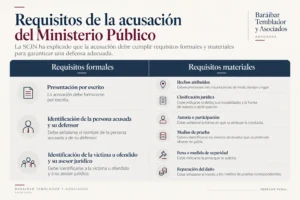
Formal requirements of the accusation
The formal requirements relate to the submission of the written document and the identification of those participating in the procedure.
Among them, the following stand out:
- Submit the accusation in writing.
- Identify the accused person and their defense counsel.
- Identify the victim or aggrieved party and their legal counsel.
These elements make it possible to identify the parties involved and establish who is responsible for intervening during the intermediate stage.
Substantive requirements of the accusation
Substantive requirements refer to the content of the charge and the elements that support the Public Prosecutor’s claim.
The accusation must specify, among other aspects:
- The alleged acts, including the circumstances of manner, time, and place.
- Legal classification and modalities of the crime.
- The specific authorship or participation attributed to the accused.
- The applicable legal provisions.
- The evidence intended to be presented at trial.
- La pena o medida de seguridad solicitada.
- The amount for reparation of damages and the corresponding evidence.
- The other requests provided for in Article 335, where applicable.
The purpose is for the accused to clearly understand the facts and the legal consequences that the prosecution intends to establish.
Can the prosecution modify the facts of the indictment?
Can the prosecution modify the facts of the indictment?
However, the Public Prosecutor's Office may present a different legal classification, provided that it informs the parties accordingly.
Therefore, it is important to distinguish between modifying the legal classification of conduct and introducing new facts that were not part of the initial charges.
Legal source: National Code of Criminal Procedure, Article 335.
Have you received a criminal charge and need to understand its implications? At Baráibar Temblador y Asociados, we can analyze the document, identify potential irregularities, and evaluate defense options tailored to your specific case.
The intermediate stage: what does the judge review before the oral trial?
The intermediate stage is a phase of criminal proceedings that takes place after the supplementary investigation and before the oral trial.
In accordance with Article 334 of the CNPP, its purpose is the presentation and admission of evidence, as well as the refinement of the disputed facts that will be the subject of the trial.
Consequently, it is not a stage intended to determine in advance whether the accused person is guilty or innocent.
Its function consists of preparing the trial and resolving the procedural issues that the law permits to be examined.
Las dos fases de la etapa intermedia
Written phase
It begins with the presentation of the prosecution's charges.
During this phase, actions such as the notification of the accusation, the participation of the victim, and the presentation of arguments by the defense take place.
Oral phase
It takes place during the intermediate hearing.
En ella se abordan las cuestiones procesales correspondientes, los acuerdos probatorios y la admisión o exclusión de los medios de prueba, conforme a las reglas legales.
The stage concludes with the issuance of the order to commence the oral trial, where appropriate.
Formal review and analysis of the indictment
In *amparo* review case 274/2020, the Supreme Court examined the importance of the formal and substantive requirements of an accusation.
Their reasoning makes it clear that the document must contain sufficient elements to define the scope of the criminal dispute and protect the exercise of the defense.
However, this does not mean that the supervisory judge may replace the trial court or make an early determination regarding criminal liability.
The judge’s powers during the intermediate stage are defined by the CNPP.
How is a criminal charge filed, step by step?
The procedure establishes specific moments for the Public Prosecutor's Office to formulate its accusation and for the other parties to exercise their rights.
Understanding this sequence helps in identifying when it is appropriate to submit observations or prepare a defense strategy.
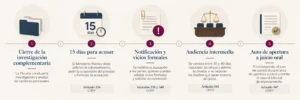
1. Conclusion of the supplementary investigation
Once the supplementary investigation has concluded, the Public Prosecutor’s Office generally has fifteen days to adopt one of the decisions provided for in Article 324 of the CNPP:
- Request a partial or total dismissal.
- Request the suspension of the proceedings.
- Formulate the accusation.
If you believe there are grounds to proceed to trial, you must file the appropriate document.
2. Presentation and notification of the charge
The Public Prosecutor's Office presents its indictment to the supervisory judge.
Subsequently, the parties are notified so that they may become aware of its content and exercise the procedural rights to which they are entitled.
This notification is important because it allows the defense to review the facts, the evidence presented, and the requests made by the prosecution.
3. Preparation for the intermediate hearing
During the written phase, the parties may carry out the actions provided for in the CNPP.
For example, the defense may point out formal defects, prepare its evidence, and state its position regarding potential evidentiary stipulations.
The applicable time limits must be reviewed in accordance with the provisions in force and the procedural circumstances of the case file.
4. Holding of the intermediate hearing
In this hearing, the presiding judge resolves the matters that pertain to this stage.
These include the correction of certain formal defects, requests relating to means of proof, and evidentiary agreements.
5. Order for the commencement of oral trial
At the conclusion of the hearing, if it is appropriate to continue the proceedings, an order for the commencement of trial is issued.
This document establishes the elements necessary for the next stage, including the facts at issue in the trial and the admitted evidence.
For this reason, the participation of the defense during the intermediate stage is especially important.
What errors might arise in the Public Prosecutor's indictment?
A criminal charge must meet the requirements set forth in procedural law.
When deficiencies exist, the defense may analyze them and, depending on their nature, submit the appropriate requests.
However, not all errors produce the same legal consequences.
Imprecise or incomplete facts
An accusation can present problems when it describes the facts in too general a manner.
For example, omitting relevant circumstances regarding time, place, or participation could make it difficult for the accused person to understand the specific conduct attributed to them.
The defense must review whether the narrative meets the requirements of Article 335.
Inconsistent legal classification
Another problem may arise when the proposed legal classification does not clearly correspond to the facts as recounted.
In such cases, it is necessary to examine the consistency between the indictment, the order to initiate formal criminal proceedings, and the applicable penal provisions.
Failure to identify the evidence
The Public Prosecutor's Office must specify the evidence it intends to present, in accordance with legal requirements.
If there are omissions or deficiencies, the defense may submit the corresponding observations.
The exclusion of a piece of evidence, however, requires a legal basis to justify it.
Facts distinct from those underlying the formal initiation of criminal proceedings
Article 335 limits the accusation to the facts and persons included in the indictment order.
Therefore, incorporating facts outside that framework may give rise to an issue of procedural congruence that must be examined in a timely manner.
The consequence will depend on the specific irregularity and the applicable rules.
What can the defense do in the face of a deficient accusation?
Article 340 of the CNPP grants the accused and their defense counsel the opportunity to point out formal defects in the charging document and request their correction.
It also includes other procedural steps that may be relevant for preparing for trial.
Review the attributed facts
El primer paso consiste en comparar el escrito de acusación con el auto de vinculación a proceso.
The defense must verify that there is a correspondence between the alleged facts and those that were the subject of the formal initiation of proceedings.
Examine the legal classification
It is also necessary to analyze whether the proposed legal classification corresponds to the facts described.
This includes examining the modalities of the offense and the form of authorship or participation attributed.
Analyze the evidence
The defense must identify the evidence that the Public Prosecutor's Office intends to present and evaluate its relevance, legality, and connection to the facts.
When there is a legal basis, one may request their exclusion at the appropriate stage.
Request the correction of formal defects
If the document contains formal defects, the defense may request their correction in accordance with Article 340.
It is important to act within the procedural opportunities provided for by legislation.
A timely review allows for better preparation of the defense and helps ensure that certain issues are not left unaddressed.
A timely review allows for better preparation of the defense and helps ensure that certain issues are not left unaddressed.
Amparo review case 274/2020 was resolved prior to the transformation of the Supreme Court’s structure resulting from the judicial reform.
As of September 2025, the SCJN operates under a new composition and organization.
However, the date of a judgment does not, in itself, determine that its reasoning has lost its legal utility.
In this case, the resolution remains a point of reference for understanding the role of the prosecution and its relationship to procedural rights.
A precedent that explains the importance of a clear accusation
The First Chamber concluded that the articles under review provide legal certainty and establish parameters for formulating the accusation.
Thus, the precedent helps explain why the Public Prosecutor's Office must provide sufficiently precise information.
It also helps in understanding the importance of the defense being made aware of the content of the charges in a timely manner.
Is it a binding precedent?
The binding force of a resolution must be analyzed in accordance with the rules applicable to its issuance, the system of precedents, and current jurisprudential criteria.
Therefore, it should not be assumed that every ruling by the Supreme Court automatically constitutes binding case law.
In the case of *amparo* review proceeding 274/2020, its application in other proceedings requires a precise identification of its underlying reasoning and the corresponding legal scope.
What rights does a properly formulated accusation protect?
The requirement for a clear accusation is linked to fundamental rights recognized in the Constitution.
Among them, adequate defense, due process, and legal certainty stand out.
Right to an adequate defense
A person needs to know the facts attributed to them in order to prepare their defense.
When an accusation is imprecise, it may be more difficult to identify which aspects should be contested and what evidence should be presented.
Therefore, the clarity of the accusation is a procedural guarantee.
Right to be informed of the alleged facts
The accused person must have sufficient information regarding the conduct attributed to them.
This allows for the analysis of the charges and participation in the proceedings with knowledge of their content.
Legal certainty during criminal proceedings
Defining the facts and the evidence helps the parties understand the subject matter of the trial.
In this way, the intermediate stage helps to organize the proceedings and protect the rights of those involved.
A criminal charge requires careful legal review. At Baráibar Temblador y Asociados, we provide legal counsel and representation in criminal matters, analyzing the specific circumstances of each case.
Can a company face an accusation from the Public Prosecutor's Office?
Yes. The National Code of Criminal Procedure includes a specific procedure for legal entities in articles 421 through 425.
Therefore, certain companies may face criminal proceedings under the circumstances set forth in the applicable legislation.
However, the criminal liability of a legal entity does not arise automatically from any conduct attributed to its employees or executives.
Determining whether it is appropriate requires analyzing the relevant legal requirements.
Risks for executives and directors
When an investigation involves business activities, it may be necessary to examine the decisions and actions of those involved in management.
The existence of an investigation against a company does not imply, in itself, individual criminal responsibility of its directors.
Each situation must be examined in light of the facts and the applicable provisions.
The importance of internal controls
Companies can reduce certain risks through compliance policies, documentation of decisions, and appropriate oversight mechanisms.
These elements may also be relevant during an investigation, depending on the circumstances of the case.
Preparing the defense from the investigation
Waiting until the midterm hearing may limit opportunities to organize a strategy.
Therefore, when a company becomes aware of a criminal investigation, it is advisable to promptly review the facts, the available documentation, and its legal alternatives. According to Manuel Baráibar Tovar, Founding Partner of Baráibar Temblador y Asociados, “the intermediate stage is the last opportunity to refine a flawed accusation before the trial; a defense that takes full advantage of it can change the course of the entire process.”
Checklist for a Public Prosecutor's indictment
Before the preliminary hearing, it is advisable to review the following aspects:
- Does the prosecution correctly identify the defendant and their lawyer?
- Does it identify the victim or injured party and their legal advisor?
- Describe the events with circumstances of manner, time, and place?
- Do the facts correspond with those stated in the order to proceed to trial?
- Is the legal classification consistent with the facts?
- Does it specify the attributed authorship or participation?
- Does it identify the means of proof offered?
- Does it include the corresponding requests for punishment and reparation of damages?
- Does it meet the other applicable requirements of Article 335 of the CNPP?
This list is a general guide and does not replace a comprehensive review of the file.
Conclusion: A clear accusation is essential for an adequate defense
The prosecution's indictment It fulfills a fundamental function within the accusatory criminal procedure.
In the amparo review 274/2020, the Supreme Court explained the importance of its formal and material requirements to provide legal certainty and protect procedural rights.
An accusation must identify the parties, clearly describe the facts, establish their legal classification, and indicate the corresponding means of proof.
Likewise, the intermediate stage offers opportunities to review certain irregularities and prepare for the oral trial.
Therefore, both the accused persons and the companies involved in criminal proceedings must pay special attention to the content of the accusation and the procedural deadlines.
At Baráibar Temblador y Asociados, we provide legal advice and representation in criminal litigation. If you are facing charges from the Public Prosecutor's Office, we can review your legal situation and evaluate the available defense options.
Frequently asked questions about the Public Prosecutor's accusation
What is the Public Prosecutor's accusation?
This is the document through which the Public Prosecutor's Office formally presents its charges after the supplementary investigation. It must contain the requirements established in Article 335 of the National Code of Criminal Procedure.
What requirements must a criminal accusation contain?
It must identify the parties, describe the alleged facts, establish their legal classification, specify the participation of the accused, and indicate the means of proof, among other legal requirements.
Can the prosecution bring charges for acts other than those for which the case was brought to trial?
No. Article 335 establishes that the accusation can only be formulated for the facts and persons indicated in the order binding the accused. However, a different legal classification may exist, provided that the parties are informed.
What happens if the accusation contains errors?
The defense may point out certain procedural defects and request their correction pursuant to Article 340 of the CNPP. The consequences depend on the nature of the irregularity and the applicable provisions.
What is the intermediate hearing?
It is the hearing in which procedural issues related to the preparation of the trial are resolved, including the admission or exclusion of evidence and the clarification of disputed facts.
Is the amparo in review 274/2020 a 2026 ruling?
No. The First Chamber of the SCJN resolved the matter on December 2, 2020. Its study remains relevant in 2026 to understand the requirements of criminal prosecution.
Can a company be criminally charged?
Yes. The CNPP includes a procedure for legal entities in its articles 421 to 425. Its application depends on the requirements and assumptions established in the corresponding legislation.
Legal references
- Supreme Court of Justice of the Nation. First Chamber. Amparo in review 274/2020, resolved on December 2, 2020. Consultar sentencia oficial.
- National Code of Criminal Procedure. Artículos 324, 334, 335, 338, 340, 341, 347 y 421 a 425. Cámara de Diputados.
- Political Constitution of the United Mexican States. Article 20. Cámara de Diputados.
Legal notice: This content is for informational purposes only and does not constitute individualized legal advice. The application of the provisions and criteria cited depends on the circumstances of each case.
Legal references
- SCJN, Primera Sala. Amparo en revisión 274/2020, sesión del 2 de diciembre de 2020, ponente: Ministro Jorge Mario Pardo Rebolledo: https://www2.scjn.gob.mx/juridica/engroses/1/2020/2/2_271702_5310_firmado.pdf
- Código Nacional de Procedimientos Penales, artículos 324, 334, 335, 338, 340, 341, 347 y 421 a 425. Cámara de Diputados: https://www.diputados.gob.mx/LeyesBiblio/ref/cnpp.htm
- Political Constitution of the United Mexican States, Article 20.
Disclaimer: This article is for informational purposes only and does not constitute formal legal advice or establish an attorney-client relationship.