
by paulina@baraibar.com.mx | Oct 26, 2026 | Commercial Law
Knowing whether you have a commercial or civil contract is not a technical detail. The answer determines the judge before whom you must file your lawsuit, the procedure followed, and even the applicable legal interest rate. In early September 2026, the Supreme Court of Justice of the Nation upheld a ruling that halted a claim for approximately $181 million, precisely because it was filed through civil proceedings when it should have been filed through commercial proceedings.
In this article we explain what the Court decided, how to distinguish between both types of contract and what measures to take to avoid losing a case before discussing the merits.
What did the Supreme Court decide in the Kenchy Enterprise case?
As reported by El CEO on September 3, 2026, the Supreme Court unanimously resolved two cases presented by Justice Lenia Batres Guadarrama. Both stemmed from the litigation between Kenchy Enterprise and the La Cruz Azul Cooperative.
The origin of the conflict
According to the report, the contract pertained to tax consulting services provided since 2003. Among other tasks, the company was required to work with the Ministry of Finance to have a tax loss for the cooperative recognized in terms of income tax. Based on this contract, Kenchy claimed approximately $181 million.
The inappropriateness of the civil route
The lawsuit was originally filed in a civil court with oral proceedings in Mexico City. However, the court ruled the civil route inadmissible and maintained that the matter should be processed as a commercial case. Dissatisfied, Kenchy filed for amparo (a constitutional remedy). In resolving the case, the Supreme Court held that the responsible authority had correctly classified the contract and, consequently, upheld the ruling that the civil route was inadmissible.
The award of costs
In the second case, the Court granted the cooperative's request for an injunction, ordering the civil judge to determine whether the plaintiff company must pay the court costs. Thus, in addition to not being able to pursue its claim, the plaintiff could face litigation expenses.
What are coastlines and why do they matter?
Court costs are the expenses and fees that one party may be required to pay to the other at the end of a lawsuit. In commercial matters, Article 1084 of the Commercial Code establishes the circumstances under which such costs are awarded. Thus, before litigating, it is advisable to assess not only the likelihood of winning, but also the potential cost of losing due to a procedural issue.
Why does this matter to any company?
Although this case involves exceptional sums of money and a well-known institution, the lesson is general and applies equally to small and medium-sized businesses. Choosing the wrong legal avenue can lead to a lawsuit being dismissed without the judge even considering whether the claim was justified. Therefore, identifying from the outset whether you have a commercial contract is a strategic decision.
What is a commercial contract and what distinguishes it from a civil contract?
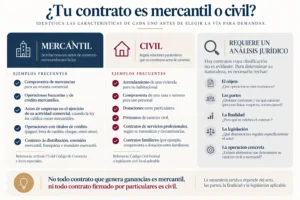
In Mexico, two main contractual regimes coexist: commercial law, regulated primarily by the Commercial Code, and civil law, regulated by the civil codes. The difference lies not in the name the parties give to the contract, but in the nature of the act.
EXTERNAL LINK: Código de Comercio → https://www.diputados.gob.mx/LeyesBiblio/ref/ccom.htm
The acts of commerce
Article 75 of the Commercial Code lists the acts that the law considers commercial. These include purchases and sales for the purpose of commercial speculation, banking operations, negotiable instruments, supply companies, commission and agency companies, and transactions between merchants. Furthermore, its final section includes any other act of an analogous nature, which requires the judge to analyze each case individually.
The nature of the parties and the purpose
As a general rule, a commercial contract is entered into for profit within an organized business activity, whether it involves buying, selling, intermediation, financing, or providing services to other businesses. In contrast, a civil contract typically addresses personal or consumer needs, without any speculative intent. For example, Article 76 of the Commercial Code excludes purchases made for the buyer's own use or consumption from commercial acts.
The name of the contract is not enough
Many companies use templates with generic titles, such as "service contract" or "collaboration agreement." However, the judge is not guided by the title, but by what the parties actually agreed upon and how it was executed. The same template can result in a civil contract in one case and a commercial contract in another.
The mixed acts
What happens if the transaction is considered commercial by one party and civil by the other? Article 1050 of the Commercial Code resolves this question: in such cases, the dispute is governed by commercial law. This rule is crucial for companies that contract with individuals or non-commercial entities, such as civil associations, cooperatives, or independent professionals, because it defines from the outset the procedure applicable to any conflict.
Signs that you are dealing with a commercial contract
Before filing a lawsuit, check these signs. If several are present, it's likely a commercial contract:
- At least one of the parties is a merchant and acts within its line of business.
- El objeto tiene un propósito de especulación o de lucro.
- There are invoices, orders, or other documents typical of the business.
- There are invoices, orders, or other typical documents of the business.
| Not sure if your contract is commercial or civil? The lawyers at Baráibar Temblador y Asociados in Mexico City can review it before you file a lawsuit. Schedule your consultation today. |
Why can choosing the right path decide a trial?
En términos sencillos, la vía procesal es el camino que la ley prevé para resolver una controversia. Por lo tanto, si se elige la incorrecta, el juez no puede estudiar el fondo del asunto.
The origin of the road is reviewed ex officio
For years, the First Chamber of the Supreme Court has held in jurisprudence 1a./J. 25/2005 that the admissibility of the chosen legal avenue is a procedural requirement that the judge must examine ex officio before ruling on the merits. In other words, even if the opposing party does not raise the objection, the judge may declare the chosen legal avenue inadmissible.
The practical consequences
When a legal avenue is deemed inappropriate, the claim fails in that proceeding, and the plaintiff must initiate a new one through the correct channel. Meanwhile, months or years can pass, expenses incur, and, as the case discussed demonstrated, a court order for costs may be issued. Therefore, an initial error can prove very costly.
Practical differences between a commercial contract and a civil contract
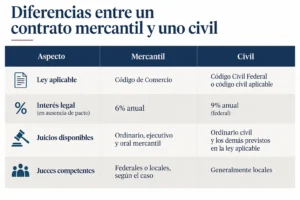
Beyond the competent judge, the nature of the contract also has concrete effects on your business. Here are some relevant differences:
Legal interest rate
When the parties do not agree on interest rates, the legal rate applies. For commercial matters, Article 362 of the Commercial Code sets a legal interest rate of 6% per annum. In contrast, Article 2395 of the Federal Civil Code provides for a legal interest rate of 9% per annum.
EXTERNAL LINK: Código Civil Federal → https://www.diputados.gob.mx/LeyesBiblio/pdf/CCF.pdf
Available procedures
The Commercial Code provides for ordinary, executive, and oral commercial proceedings, depending on the type of document and the amount in dispute. For example, a promissory note allows for an executive commercial proceeding, which begins with a demand for payment and, if applicable, an attachment of assets. Similarly, oral commercial proceedings are reserved for certain amounts that are updated annually.
Litigation time and costs
Each procedure has different stages, deadlines, and resources. A commercial oral trial, for example, concentrates the proceedings in hearings and is usually resolved more quickly than an ordinary trial. Understanding these differences allows you to better estimate how much time and resources your case will require.
Concurrent jurisdiction
Commercial disputes can be brought before federal or local judges because there is concurrent jurisdiction. In contrast, civil matters between private individuals generally fall under the jurisdiction of local courts. This difference allows for the development of different strategies depending on the case.
INTERNAL LINK: creditor opposition in business mergers → https://baraibar.com.mx/oposicion-de-acreedores-en-fusiones-empresariales/
[PROPOSED CITATION – PENDING APPROVAL] According to Jorge Arriaga Chan Temblador, Managing Partner of Civil, Commercial and Labor Lawsuits at Baráibar Temblador y Asociados, “before filing any lawsuit we review the nature of the contract and the parties; that initial decision defines the judge, the deadlines and, often, the outcome of the trial.”
| Don't face a contractual dispute alone. At Baráibar Temblador y Asociados, we have specialists in civil and commercial litigation, ready to defend your interests in Mexico City. |
Common examples of commercial contracts in the life of a company
To clarify these concepts, it's helpful to review some of the contracts that companies sign every day. In most cases, it's a commercial contract, although there are always nuances.
Supply, distribution and commission
Supply, distribution, commission, and agency contracts are generally considered commercial because the Commercial Code expressly links them to business activity. Similarly, the purchase and sale of goods for resale is a typical commercial transaction.
Real estate leasing: a criterion that changed
For years, real estate leases were considered to be always civil matters. However, in August 2023, the First Chamber resolved direct appeal for review 172/2023 and recognized that, depending on the nature of the transaction, claims can also be pursued through commercial law. This marked a departure from a previous precedent and required judges to analyze each case using the rule of analogy established in Article 75.
Credit titles
Promissory notes, checks, and bills of exchange are considered commercial acts by law, even if signed by someone who is not a merchant. Consequently, their collection is processed through commercial channels, typically via summary judgment proceedings.
Professional services contracts: the most confusing case
In practice, professional services contracts, such as consulting or advisory services, are the ones that generate the most questions. Traditionally, the provision of professional services has been considered a civil contract. However, the case discussed shows that the analysis can change depending on how the service is provided.
Factors that courts typically consider
- If the provider operates as an organized company, with a structure and profit-making purpose.
- Also, if the service is part of the commercial activity of either party.
- Also, if the contract contains elements typical of commercial acts, such as commissions or agencies.
- Finally, the method of payment, the duration and the relationship with other commercial transactions.
What you shouldn't assume
Don't assume a contract is civil just because it's titled "Provision of Professional Services." Nor should you assume it's commercial simply because a company signs it. Each case requires a review of the subject matter, the parties involved, and the purpose of the transaction. A fifteen-minute review with your lawyer before filing a lawsuit can save you months of fruitless litigation and a potential court-ordered lawsuit.
How to protect your contracts from the drafting stage?
The best way to avoid arguments about the route is to anticipate them during the drafting process. These recommendations help reduce the risk:
- Clearly describe the purpose of the contract and the professional or commercial activity of each party.
- Indicate if either party is acting as a trader and for what purpose.
- Expressly agrees on the default interest rate, so as not to depend on the legal rate.
- Define the jurisdiction and, if appropriate, an arbitration or mediation clause.
- Document deliveries, progress, and payments throughout the entire business relationship, not just at the end.
The dispute resolution clause
In fact, a well-drafted clause can save years of litigation. However, it's important to remember that the nature of the transaction doesn't change based on what the parties say. Therefore, the clause must be consistent with the reality of the transaction.
INTERNAL LINK: tax obligations of companies and the tax mailbox→ https://baraibar.com.mx/buzon-tributario-obligatorio-2026-sat-mexico/
Commercial contract and alternative mechanisms: resolving without going to court
Not all disputes arising from a commercial contract have to end up in court. The General Law on Alternative Dispute Resolution Mechanisms, published in January 2024, regulates mediation and conciliation as ways for parties to reach agreements with the help of a neutral third party.
Advantages for companies
Mediation is usually faster and less expensive than litigation. Furthermore, it allows for the preservation of business relationships, which is especially valuable when dealing with strategic clients or suppliers. Agreements that meet legal requirements can have the force of res judicata, making them legally binding.
When is it a good time to try?
Mediation is a worthwhile option when the conflict is primarily economic, there is an interest in continuing business, and the relevant information is documented. However, if there is an urgent need to secure assets or a risk that the other party will conceal their wealth, it may be necessary to go directly to court.
What to do if you already have a trial underway?
If you've already filed a lawsuit and there's doubt about the correct procedure, you can still take action. Check with your lawyer whether the opposing party has raised an objection regarding the procedural impropriety and what their arguments are to support it.
If you are the defendant
On the other hand, if you were sued through a legal process you believe was improper, raising this issue promptly can end the case at that stage. Remember that the judge can review it on their own initiative, but a well-founded argument strengthens your defense.
Review your base documents
In any scenario, the case file is built with documents. Gather the signed contract, invoices, emails in which changes were agreed upon, and proof of payment or non-compliance. With this information, your lawyer can determine whether the matter is commercial or civil and which procedure offers the most advantages.
Pay attention to the deadlines
Furthermore, initiating a new lawsuit through the proper channels takes time. In the meantime, it's advisable to review the statute of limitations applicable to your claim, so you don't lose your right simply due to the passage of time.
| Protect your contracts and collections with expert legal advice from Baráibar Temblador y Asociados. We'll review the appropriate course of action before you file a lawsuit. |
Conclusion: Identifying your commercial contract is the first step to winning
The case resolved in September 2026 confirms that the legal process is not a minor matter. A multi-million dollar claim can be halted if it is filed as a civil suit when it involves a commercial contract, or vice versa. Reviewing the nature of the transaction, drafting it clearly, and choosing the correct procedure are decisions that protect your business before litigation even begins.
Frequently asked questions
How do I know if my contract is commercial or civil?
It depends on the nature of the act, not the name of the contract. Article 75 of the Commercial Code lists commercial acts, such as purchases for speculative purposes, negotiable instruments, and supply and commission companies, and includes similar acts. If the purpose is personal or for consumption, it is usually considered a civil act, according to Article 76.
What happens if the contract is commercial for one party and civil for the other?
Article 1050 of the Commercial Code establishes that when an act is commercial for one party and civil for the other, the dispute is governed by commercial law. Therefore, a company that contracts with a private individual will typically litigate in commercial court.
What does it mean for the route to be declared inadmissible?
The chosen procedure is not the one prescribed by law, therefore the judge does not examine the merits of the claim. The First Chamber held in jurisprudence 1a./J. 25/2005 that the admissibility of the chosen procedure is a procedural requirement that must be analyzed ex officio before ruling on the merits.
What is the legal interest in a commercial contract?
If the parties did not agree on interest rates, in commercial matters Article 362 of the Commercial Code establishes a legal interest rate of 6% per annum. In federal civil matters, Article 2395 of the Federal Civil Code provides for 9% per annum. Therefore, it is advisable to expressly stipulate the default interest rate in the contract.
Can a lease agreement be considered a commercial agreement?
Yes, depending on the nature of the transaction. In the direct appeal for review 172/2023, the First Chamber recognized that the fulfillment or rescission of a real estate lease can be claimed through commercial law, applying the rule of analogy of article 75, section XXV, of the Commercial Code.
Can I resolve a contractual dispute without going to court?
Yes. The General Law on Alternative Dispute Resolution Mechanisms, published in January 2024, regulates mediation and conciliation. These mechanisms are usually faster and cheaper, and agreements that meet the legal requirements can be enforced as if they were a final judgment.
Legal references
- Código de Comercio, artículos 75, 76, 362, 1050 y 1084. Cámara de Diputados: https://www.diputados.gob.mx/LeyesBiblio/ref/ccom.htm
- Código Civil Federal, artículo 2395. Cámara de Diputados: https://www.diputados.gob.mx/LeyesBiblio/pdf/CCF.pdf
- SCJN, Primera Sala. Jurisprudencia 1a./J. 25/2005, “Procedencia de la vía. Es un presupuesto procesal que debe estudiarse de oficio antes de resolver el fondo de la cuestión planteada”.
- SCJN, Primera Sala. Amparo directo en revisión 172/2023, resuelto el 30 de agosto de 2023.
- Ley General de Mecanismos Alternativos de Solución de Controversias (DOF, enero de 2024).
- El CEO, “SCJN falla a favor de Cruz Azul en disputa con Kenchy Enterprise por 181 mdd” (3 de septiembre de 2026): https://elceo.com/negocios/scjn-falla-a-favor-de-cruz-azul-en-disputa-con-kenchy-enterprise-por-181-mdd/
Disclaimer: This article is for informational purposes only and does not constitute formal legal advice or establish an attorney-client relationship.

by paulina@baraibar.com.mx | Oct 22, 2026 | Corporate Law, Commercial Law
Precautionary measures in oral commercial trials now have a clear rule regarding how they can be challenged. In March 2026, the Supreme Court, sitting en banc, resolved the Contradiction of Criteria 272/2025. Its conclusion is straightforward: no appeal is admissible against the decision granting or denying one of these measures. Therefore, those litigating in oral proceedings can file for indirect amparo (a constitutional remedy) without exhausting any other legal recourse. This article explains what has changed and how to adjust your strategy.
What did the Supreme Court of Justice of the Nation (SCJN) decide regarding precautionary measures in oral commercial trials?
The conflict between two criteria
The Contradiction of Criteria 272/2025 arose from a genuine disagreement between two judicial bodies. The First Collegiate Court for Civil Matters of the Sixteenth Circuit held that these rulings are not subject to appeal. Meanwhile, the Regional Plenary for Administrative and Civil Matters of the Central-Southern Region defended the opposite position. According to that regional plenary, an appeal was indeed admissible.
This difference regarding precautionary measures in commercial oral proceedings was not a mere technicality. In practice, each position forced litigants to choose a different path, risking dismissal if they made a mistake. Furthermore, the uncertainty affected companies that needed to secure assets or prevent their rapid seizure. For this reason, the Court decided to establish a single criterion.
The response from the Plenary
The full court determined that rulings on precautionary measures issued in oral commercial proceedings are not subject to ordinary appeal. Consequently, there is no appeal that must be exhausted before filing for indirect amparo (constitutional protection). The ruling essentially states that no appeal is admissible against decisions granting or denying these measures.
It is worth noting that the Court ordered the publication of this ruling as binding precedent. Once published, it will be binding on commercial judges and courts. In the meantime, it is advisable to check the record in the Judicial Weekly of the Federation before citing it in any legal document.
What did the Court not resolve?
The decision does not analyze whether a specific order was properly or improperly granted. Nor does it replace the requirements established by the Commercial Code for issuing such an order. It merely defines the available legal recourse, that is, the correct procedural route. Therefore, the merits of each measure continue to depend on the evidence, the urgency of the situation, and the guarantee offered.
Who benefits from the criterion?
Creditors, debtors, legal directors, and law firms litigating in oral proceedings all benefit from a uniform rule. Creditors know that a denial of a measure can be challenged through an appeal. For debtors, the message is that they shouldn't wait for an appeal that will never come. Legal teams can standardize their internal formats and schedules. This uniformity saves costs and reduces disputes about the correct procedure, which often take months.
Judges at first instance also gain certainty, as they now know how their rulings will be reviewed. The review process for amparo (constitutional protection) requires them to more carefully substantiate the risk of irreparable harm and the appearance of a valid claim. A well-reasoned ruling better withstands scrutiny by the federal court.
What are precautionary measures and what purpose do they serve?
Concept and purpose
In simple terms, a precautionary measure is a legal action designed to secure a right while litigation is being resolved. The Commercial Code regulates these measures starting with Article 1168, which includes provisions such as the detention of a person and the seizure of assets. Their purpose is to prevent the debtor from concealing assets or leaving the jurisdiction of the court. They also protect the creditor against potential changes in circumstances.
Precautionary measures in commercial oral proceedings are requested before the lawsuit is filed or during the proceedings. The party requesting them must demonstrate, with sufficient evidence, that a real risk exists. Likewise, the judge may require a guarantee to cover any damages caused by the measure if it is later revoked. In other words, the system seeks a balance between speed and protection of the defendant.
Why do they matter in oral administration?
Commercial oral proceedings were designed to resolve disputes swiftly, and precautionary measures within these proceedings are among their most delicate components. Hearings concentrate the debate and the presentation of evidence. However, this speed comes at a cost: the margin for correcting errors is smaller. Therefore, an improperly issued precautionary measure can freeze bank accounts, inventories, or real estate for months.
For a company, the effect is immediate. Seizing assets can halt payments to suppliers, payroll, or outstanding loans. Conversely, for a creditor, an unfounded denial can leave their collection unprotected. It's worth noting, then, that the manner of challenging a decision is just as important as the substance of the claim.
CALL TO ACTION: Do you have questions about this topic? The lawyers at Baráibar Temblador y Asociados in Mexico City can advise you on precautionary measures and commercial lawsuits. Schedule your consultation today.
The procedural dilemma: appeal or protection?

The general rule of the oral trial
Article 1390 Bis of the Commercial Code establishes that no ordinary appeal is permitted against rulings issued in oral commercial proceedings. This rule aims to prevent delays. Therefore, most of the judge's decisions are only reviewed at the end, along with the final judgment.
The problem arose with precautionary measures in oral commercial trials. Other provisions of the Commercial Code allowed for appeals of certain rulings with immediate processing. On the other hand, the general rule of oral trials closed that door. Consequently, some courts applied the appeal process and others did not.
Why does making a mistake cost so much?
Choosing the wrong legal recourse could have serious consequences. If the litigant appealed and the avenue was not available, they lost valuable time. And if they sought amparo (a constitutional remedy) without exhausting an available appeal, the judge would dismiss it as inadmissible. Furthermore, the deadlines for filing for amparo are short.
Article 17 of the Amparo Law establishes a general rule of fifteen days for filing a lawsuit against acts of authority. For this reason, every day lost in a futile appeal reduced the affected party's options. Finally, the conflicting legal interpretations put an end to this uncertainty.
Why did the Plenary reject the appeal?
Speed, orality and procedural economy
The Court's reasoning regarding precautionary measures in oral commercial trials stems from the nature of oral proceedings. This procedure was designed to be swift, oral, and procedurally efficient. Allowing intermediate appeals would make it slower and more complex. In other words, it would undermine the purpose for which the legislature created this avenue.
Furthermore, the Court conducted a systematic reading of the Commercial Code. It analyzed the rules on appeals and those governing precautionary measures. Ultimately, it concluded that the prohibition in Article 1390 Bis also applies to these determinations. However, this conclusion does not leave the affected party without recourse.
The path that remains open
Since there is no ordinary remedy, the affected party can file for indirect amparo without first exhausting other legal avenues. The Amparo Law allows for challenging actions within a legal proceeding when their effects are irreparable. A ruling that affects property or freedom of movement falls close to this scenario. Therefore, amparo becomes the natural recourse.
However, this doesn't mean that everything will be resolved through legal protection. Each case requires proof of the specific harm suffered and timely filing of the claim. First, the challenged action must be precisely identified. Then, it's advisable to offer evidence demonstrating the current harm.
How does procedural strategy change in oral commercial trials?

For whom is the measure being requested?
A creditor requesting precautionary measures in a commercial oral proceeding must prepare the case file from the very first filing. The request requires data, documents, and a clear explanation of the risk. Otherwise, a denial can only be challenged through an appeal, which is a more technical process. Therefore, it is advisable to invest in a solid request from the outset.
Evidence that should be gathered
The party requesting the measure gathers contracts, invoices, collection emails, and bank statements that demonstrate the debt. Conversely, the party opposing it gathers documents that show the normal operation of their business and the harm caused by the seizure. Both parties must organize the evidence by date and relevance, because the injunction is decided based on what is contained in the file. A disorganized file weakens even the strongest argument.
The guarantee as a key element
It is also advisable to provide collateral in advance. A reasonable amount, backed by an insurance policy or a deposit, increases the likelihood of obtaining the measure. It also helps demonstrate that the applicant assumes responsibility for the consequences of their request. Conversely, a request without collateral typically faces greater resistance.
Who will benefit from this measure?
A defendant affected by precautionary measures in a commercial oral trial must act swiftly. First, they should review whether the ruling is well-founded and justified. Then, they should assess whether irreparable harm exists. Finally, they should decide whether to file for amparo (constitutional protection) or if it will suffice to request the judge to lift the measure with a counter-guarantee.
A common mistake is waiting for the court ruling. Meanwhile, the measure continues to have an impact. For this reason, the analysis should begin on the same day as the notification. Likewise, it is advisable to gather bank statements, contracts, and payroll records that demonstrate the impact.
CALL TO ACTION: Don't face this process alone. At Baráibar Temblador y Asociados, we have specialists in commercial law and corporate litigation ready to defend your interests in Mexico City.
A typical case: from insurance to protection
The stage
Imagine a distributor filing a lawsuit against a client who has defaulted on invoices totaling several million pesos. Before the hearing, the distributor requests the freezing of the client's bank accounts. The judge grants the measure with a brief ruling that barely explains the alleged risk. The next day, the client discovers they cannot pay their employees or cover their main suppliers. This is a hypothetical example, but it reflects what many companies experience when such measures are imposed without prior notice.
The client's lawyer reviews the case file and identifies three problems. The ruling fails to explain why there is a risk of the assets being lost. The guarantee amount is significantly lower than the potential damages. And the insured amount clearly exceeds the amount claimed in the lawsuit. Based on the Court's ruling, the lawyer doesn't waste time on a non-existent appeal and immediately prepares the indirect amparo claim.
La ruta de defensa
The petition for amparo (constitutional protection) must precisely identify the challenged act, which is the resolution that granted the seizure. It must also describe the specific damages with supporting documentation: bank statements, contracts with suppliers, and pay stubs. While the petition is being processed, the client can request a stay of the act to mitigate the immediate impact of the measure. Simultaneously, their attorney proposes an alternative guarantee to the presiding judge that would allow for the release of some of the funds.
The distributor, for its part, defends the measure with evidence proving the debt and the risk of insolvency. Both parties are now litigating on two fronts: the injunction and the commercial trial. Whoever is better prepared on each front will have the advantage. The case demonstrates why precautionary measures in oral commercial trials require swift decisions, well-organized evidence, and coordination between the legal and financial teams.
What should companies, creditors, and debtors do?
Practical list for the legal field
Legal departments can turn this criterion into an internal protocol. First, record the notification date of any ruling and calculate the fifteen-day period. Second, prepare an impact assessment with real figures. Third, define who authorizes the injunction and with what budget.
In addition, review contracts with guarantee clauses. Some require notification to partners or financiers when a measure is taken. For example, a bank loan may be declared in default if a significant asset is seized. Consequently, the response must be coordinated with treasury and finance.
When is it advisable to negotiate?
Not every conflict requires litigation to the end. Sometimes, offering an alternative guarantee resolves the matter in a few days. Similarly, an agreement with a payment schedule can render the measure moot. For their part, creditors also benefit by gaining certainty about receiving payment.
It's important to note that negotiation does not replace a formal defense. It's advisable to file for legal protection in a timely manner while negotiations are underway. This allows the company to retain its rights and maintain legitimate pressure. However, every decision must be documented in writing.
Common errors with precautionary measures in commercial oral proceedings
Four recurring stumbles
The first mistake is confusing the general rule with the exception. Some lawyers continue to file appeals out of habit, even though the Court has already closed that avenue. The second mistake is ignoring the time limits for filing an injunction. A third problem arises when a measure is challenged without proof of actual harm. Finally, many forget that the guarantee can change the course of the case.
Another common pitfall is conflating oral proceedings with ordinary trials. Although both are commercial matters, they follow different rules. Therefore, before taking any action, it's essential to confirm the procedure for the main trial. If the procedure is ordinary, the analysis may change.
How to avoid waste?
The best prevention is to review the current criteria on precautionary measures in commercial oral proceedings each time an appeal is prepared. The courts update their rulings and publish new precedents frequently. Therefore, a quick consultation of the Judicial Weekly Bulletin avoids surprises. Furthermore, a specialized lawyer can identify nuances that a summary might not reveal.
It also helps to maintain a file of sample documents for each scenario. With it, the team can react in hours, not days. In contrast, improvising under pressure increases errors. Therefore, prior preparation is a competitive advantage.
CALL TO ACTION: Protect your rights with expert legal advice from Baráibar Temblador y Asociados. Our team can review your case and propose the best legal course of action.
Conclusion: a clearer way to litigate quickly
The Contradiction of Criteria 272/2025 provides a practical message for commercial litigation. Appeals against precautionary measures in oral commercial trials are not permitted, and indirect amparo (constitutional protection) is available without exhausting other remedies. This clarity reduces the risk of dismissals and expedites the defense.
One final piece of advice for legal departments and law firms: document every decision regarding precautionary measures in commercial oral proceedings, including dates, responsible parties, and reasons. This record helps explain to management why the injunction, negotiation, or counter-guarantee was chosen. It also facilitates the defense if the matter is reviewed by a collegiate court, where the clarity of the case file carries significant weight.
However, the rule does not eliminate the need for a careful strategy. Timeframes remain tight, and proof of damage remains essential. Consequently, companies and creditors would be wise to review their protocols and consult with specialists before taking any action. Early preparation makes the difference between protecting assets and losing them.
Article links
EXTERNAL LINK: Código de Comercio vigente (Cámara de Diputados) → https://www.diputados.gob.mx/LeyesBiblio/pdf/CCom.pdf
EXTERNAL LINK:Proyecto de la Contradicción de Criterios 272/2025 (SCJN) → https://www2.scjn.gob.mx/Juridica/Engroses/Cerrados/Publico/Proyecto/2026/02/CT272_2025.pdf
EXTERNAL LINK:concurso mercantil: guía para acreedores y proveedores → https://baraibar.com.mx/blog/concurso-mercantil-acreedores-proveedores-2026/
INTERNAL LINK:contrato mercantil o civil: criterio de la SCJN → https://baraibar.com.mx/blog/contrato-mercantil-o-civil-scjn-2026/
Frequently asked questions
Can a precautionary measure be appealed in a commercial oral trial?
No. According to the Contradiction of Criteria 272/2025, resolved by the Plenary of the SCJN in March 2026, appeals are not permitted against the determinations that grant or deny these measures, in accordance with Article 1390 Bis of the Commercial Code, which prohibits ordinary appeals in oral proceedings.
Can I file for indirect amparo without exhausting other remedies?
Yes. Since there is no ordinary remedy, the affected party can directly file for indirect amparo (constitutional protection). The Amparo Law allows for challenging acts within a trial that cause irreparable harm, and Article 17 establishes a general rule of fifteen days for filing the claim.
What are precautionary measures?
These are measures that safeguard a right while the legal proceedings are underway, such as the detention of a person or the seizure of assets. The Commercial Code regulates them starting with Article 1168. They are requested before or during the proceedings and require proof of risk and, usually, the provision of a guarantee.
What should I do if I am notified of a seizure of assets?
Immediately review the ruling, gather evidence of the damages, and calculate the fifteen-day period stipulated in Article 17 of the Amparo Law. Consider also offering a counter-guarantee to the judge. A specialized lawyer can determine whether amparo, negotiation, or both options are advisable.
Is the Court's decision now binding precedent?
The Court ordered the publication of the ruling as binding precedent pursuant to Articles 219 and 220 of the Amparo Law. Once published in the Judicial Weekly of the Federation, it becomes binding on all courts. Before citing it in a legal document, verify its registration and publication date.
Does this criterion apply to ordinary commercial trials?
Not necessarily. The criterion refers to precautionary measures issued in oral commercial proceedings, regulated by Article 1390 Bis of the Commercial Code. Different rules govern appeals in ordinary proceedings, so it is advisable to analyze the specific procedural route before choosing the means of defense.
Legal references
Commercial Code, articles 1168 et seq., 1183 and 1390 Bis (Chamber of Deputies).
Amparo Law, articles 17, 107, 219 and 220 (Chamber of Deputies).
Supreme Court of Justice of the Nation, Plenary, Contradiction of Criteria 272/2025, session of March 2026.
Judicial Weekly of the Federation (consultation of the derived jurisprudence record).
This article is for informational purposes only and does not constitute formal legal advice or establish an attorney-client relationship.

by paulina@baraibar.com.mx | Oct 12, 2026 | Corporate Law, Commercial Law
Lifting the corporate veil: essential keys established by the SCJN in 2026
The issue of piercing the corporate veil has returned to the forefront of business debate following a significant ruling by the Supreme Court of Justice of the Nation. Specifically, on September 30, 2026, the Court ruled on direct appeal 57/2025, stemming from litigation between the La Cruz Azul Cooperative and the civil society organization Desarrolladora Táctica FA. In this case, the Court denied the cooperative's appeal and upheld a previous ruling that exempts it from paying approximately 1.584 billion pesos in legal fees. Furthermore, the order to return nearly 647 million pesos that had already been paid remained in effect.
For any company, the ruling offers two lessons. First, being a partner is not enough to be personally liable for the company's debts. Second, someone who signs without authorization is not protected, even if the invoices are subsequently paid.
What did the Supreme Court of Justice of the Nation (SCJN) decide in the Cruz Azul case?
The case reached the Supreme Court due to its importance and significance, after several years of litigation between the two parties. According to public information about the case, Desarrolladora Táctica was claiming payment of fees stemming from a legal services contract signed on behalf of the cooperative. Cruz Azul, for its part, maintained that the individuals who signed the contract did not have sufficient authority to bind the cooperative.
Minister Arístides Rodrigo Guerrero García's project was approved unanimously. Consequently, the Court denied the injunction and upheld the ruling in favor of the cooperative.
Key facts of the direct appeal 57/2025
- Body: Plenary of the Supreme Court of Justice of the Nation.
- Fecha de resolución: 30 de septiembre de 2026.
- Vote: unanimous, with the project of Minister Guerrero García.
- Result: protection denied to Desarrolladora Táctica FA, S.C.
- Amounts: fees claimed for approximately 1,584 million and refund of approximately 647 million pesos.
The two central criteria of the ruling
According to reports from specialized media, the Plenary held two ideas that are of interest to any company:
- The conduct of the parties during the execution of a contract cannot remedy the lack of powers of representation of the person who signed it.
- Likewise, lifting the corporate veil is an exceptional measure, which is only appropriate when there is evidence of an abusive use of legal personality.
During the discussion, Minister Giovanni Azael Figueroa Mejía stated that the case file contained sufficient evidence of the misuse of corporate structures. He also highlighted the effective control that one partner exercised over the companies involved.
Why does this case matter beyond football?
Although the litigation involves a well-known institution, the legal framework is not limited to it. Any company that contracts services, signs agreements, or receives payments can face a similar situation. Therefore, it is important to understand what this legal concept means and under what circumstances it applies. This analysis is intended for partners, board members, legal directors, and suppliers who contract with legal entities of any size.
What is the lifting of the corporate veil and why is it exceptional?
A commercial company registered in the Public Registry of Commerce has its own legal personality, distinct from that of its shareholders. This is established in Article 2 of the General Law of Commercial Companies. Thanks to this separation, the company's assets are liable for its debts, and, in principle, the shareholders' assets are protected.
EXTERNAL LINK: Ley General de Sociedades Mercantiles → https://www.diputados.gob.mx/LeyesBiblio/pdf/LGSM.pdf
This protection forms the basis of the Mexican business system. Otherwise, few people would invest in a business, because any debt could affect their home or savings. However, the law does not protect those who use a company as a shield to defraud their creditors.
The “curtain” that the Court can draw
Piercing the corporate veil is the tool a judge uses to examine what happens behind the scenes. In other words, it allows them to stop treating the company as a separate entity and attribute its obligations to the person who actually controls it. It is, therefore, an exception to the general rule of asset segregation.
The Court insisted that this is an extraordinary measure. It is not enough to demonstrate that someone is the majority shareholder or controls the administration. Nor is it sufficient that the company has debts it cannot pay.
What the criterion does require
For this to apply, an abuse of legal personality must be proven. For example, forming companies to evade obligations, defraud the law, or harm third parties. In the case at hand, the Court found independent evidence of this abuse, such as a private agreement contained in a public instrument.
| Is your company facing a claim that could affect the assets of its partners? The lawyers at Baráibar Temblador y Asociados in Mexico City can review your case. Schedule your consultation today. |
The powers of representation: the other major criterion of the ruling
The second message of the ruling is just as important as the first. A legal entity is only bound through those who have the power to represent it. In commercial companies, Article 10 of the General Law of Commercial Companies assigns this representation to the administrator or the board of directors.
In the case of a cooperative, representation corresponds to the bodies and agents designated in its bylaws and the General Law of Cooperative Societies. If the signatory does not have these powers, the contract is not binding on the legal entity.
Paying does not equate to ratification
Many companies believe that if they have already paid part of a contract, that payment automatically "validates" what was signed. According to the reported ruling, the Court rejected that interpretation. The conduct of the parties during the execution of the contract may demonstrate that a commercial relationship existed; however, it does not remedy the lack of authority of the person who signed it.
Article 1802 of the Federal Civil Code stipulates that contracts entered into on behalf of another by someone who is not their legal representative are void unless ratified by the represented party. Therefore, the ratification must come from the authorized body and comply with the necessary formalities.
EXTERNAL LINK: Código Civil Federal → https://www.diputados.gob.mx/LeyesBiblio/pdf/CCF.pdf
How to verify a power of attorney before signing it?
Reviewing your counterpart's power of attorney takes only a few minutes and can prevent a multimillion-dollar lawsuit. First, confirm that the power of attorney is a notarized document and is currently valid. Second, review the type of powers it grants: Article 2554 of the Federal Civil Code distinguishes between powers of attorney for litigation and collections, for administrative acts, and for acts of ownership.
Additionally, check if the power of attorney has any limits on amount, subject matter, or term. If the contract involves signing promissory notes or other negotiable instruments, Article 9 of the General Law of Negotiable Instruments and Credit Transactions requires specific powers for this purpose. Finally, request a certified copy and keep it along with the signed contract.
The practical effect: to return the money collected
In this case, the consequence was twofold. The cooperative was released from the payment claimed, and, in turn, the plaintiff company was obligated to return what it had already received. Thus, anyone contracting with a legal entity should verify the counterparty's legal standing before signing, not after. According to Jorge Arriaga Chan Temblador, Managing Partner of Civil, Commercial and Labor Lawsuits at Baráibar Temblador y Asociados, “in commercial litigation we frequently see multimillion-dollar contracts signed by people without sufficient power; reviewing the power of attorney before signing costs much less than litigating afterward.”
When is the lifting of the corporate veil appropriate according to the Court?
The 2026 ruling follows a line of reasoning that Mexican courts have gradually developed over the years. Based on reports about the ruling, several scenarios can be identified in which a judge could lift the veil:
- Fraud against the law: the company is used to circumvent a rule that would otherwise be applicable.
- Evasion of obligations: companies are set up so that assets remain beyond the reach of creditors.
- Harm to third parties: the corporate structure is designed to harm those who contract with it.
- Commingling of assets: the controlling partner disposes of the company's resources as if they were his own.
The role of the test
In all cases, the burden of proving abuse rests with the alleging party. Likewise, the evidence must be independent of the individual's status as a partner. Documents, bank transfers, private agreements, and the relationship between the companies are typically the elements that a judge considers most carefully.
What is not enough
Owning a majority of shares does not automatically make a person liable for debts. Nor is it enough that several companies share a registered address, directors, or suppliers. Piercing the corporate veil requires demonstrating that the structure was used abusively, not merely that it exists.
Corporate veil and joint and several tax liability: two distinct concepts
It is important not to confuse piercing the corporate veil with the joint and several liability provided for in the Federal Tax Code. They are different institutions, with their own requirements and consequences.
Joint and several liability of partners before the SAT
Article 26, section X, of the Federal Tax Code allows the tax authority to collect certain taxes from partners or shareholders of the company. However, this liability only applies in specific cases, such as when the company fails to register with the Federal Taxpayer Registry or changes its address without notifying the authorities. Furthermore, the amount that can be collected is limited by the partner's share in the company's capital.
Why does it matter to distinguish between them?
The corporate veil is an exceptional legal construct, primarily discussed in civil and commercial litigation. In contrast, joint and several tax liability is expressly regulated by law and determined by the tax authorities. Consequently, a company may be at risk under one provision but not the other, so it's advisable to review both with your advisor.
INTERNAL LINK: obligaciones de las empresas ante el buzón tributario → https://baraibar.com.mx/buzon-tributario-obligatorio-2026-sat-mexico/
Risks for partners, administrators and agents
The failure sends different signals depending on your role within a company. It's advisable to review them one by one, as each role faces different risks.
If you are a partner or shareholder
Your personal assets remain protected by the general rule of separation of property. However, this protection is weakened if you mix your personal assets with those of the company or if you use the company for purposes unrelated to its stated objectives. In such cases, a creditor could request the piercing of the corporate veil to access your personal assets.
If you are an administrator or director
Your primary responsibility is to act within your authority and the company's purpose. Signing contracts that exceed your powers may release the company from obligations, but it can also lead to claims against you. Similarly, the board of directors must ensure that authorized representatives do not bind the company without authorization.
If you are a supplier or service provider
This is probably the highest risk. If the contract was signed by someone without the proper authority, you could lose the payment and even have to return the money already received. Therefore, before initiating any significant business relationship, it's advisable to request a valid power of attorney from the person who will be signing.
INTERNAL LINK: creditor opposition in business mergers → https://baraibar.com.mx/oposicion-de-acreedores-en-fusiones-empresariales/
| Don't face a lawsuit for shareholder liability or lack of authority alone. At Baráibar Temblador y Asociados, we have specialists in corporate law and commercial litigation, ready to defend your interests in Mexico City. |
How to protect your company against piercing the corporate veil?
The best defense is sound corporate practice. These measures reduce the risk of a judge deeming your company's structure abusive:
- Keep the company's bank accounts and the partners' accounts separate.
- It documents in minutes the relevant decisions of assemblies and councils.
- It formalizes in writing and at market value the transactions between companies within the same group.
- Check that the company's stated purpose covers the activities that the company actually performs.
- It grants specific powers, with clear limits on amount and subject matter.
- Verify the capabilities of your counterparty before signing important contracts.
Order in the corporate books
The minutes books, shareholder register, and registrations with the Public Registry of Commerce are your first piece of evidence. If they are up-to-date, it will be more difficult to argue that the company is merely a front. Similarly, well-organized accounting demonstrates that the company has a legitimate business.
Special attention to business groups
When one person controls multiple companies, the risk increases considerably. The Court paid particular attention to the effective control a partner exercised over different businesses. Therefore, corporate groups must justify, with business reasons, why they operate through multiple entities.
What comes next after the Supreme Court's ruling?
The ruling in direct amparo case 57/2025 strengthens two principles that coexist in Mexican law. First, the patrimonial autonomy of corporations, which provides certainty to shareholders and investors. Second, the possibility of lifting that protection when someone abuses it.
A criterion for litigation and for prevention
For the plaintiff, the ruling confirms that piercing the corporate veil is possible, although it requires solid evidence. For the defendant, however, it serves as a reminder that mere status as a shareholder does not justify a personal conviction.
How could this precedent be invoked in other trials?
Litigants can now raise this issue in their claims and responses. Those seeking to pierce the corporate veil will have to provide concrete evidence of abuse, such as bank statements, contracts between related companies, or minutes demonstrating the shareholder's effective control. Conversely, those defending themselves may argue that mere shareholding does not establish personal liability. In both cases, the quality of the documentary evidence will be decisive for the outcome of the trial.
Review your current contracts
If your company has important contracts signed by proxies, it's worth reviewing them today. Confirm that the signatory had sufficient authority and that the power of attorney was valid. If not, you can still rectify the situation through formal ratification by the authorized body.
| Protect your company's assets and those of its partners with expert legal advice from Baráibar Temblador y Asociados. A timely corporate assessment prevents costly litigation. |
Conclusion: clear separation of assets
Piercing the corporate veil remains an exceptional measure in Mexico. With its 2026 ruling, the Supreme Court clarified that being a partner or controlling a company is not sufficient to make one liable for its debts. At the same time, it reiterated that subsequent conduct does not rectify a contract signed without proper authorization. In short, the lesson is the same for partners, administrators, and suppliers: corporate order, clear powers of attorney, and prior verification of the other party.
Frequently asked questions
What is lifting the corporate veil?
This is an exceptional measure whereby a judge ceases to treat a company as a separate entity and assigns its obligations to its controlling party. It is applicable when there is proof of abuse of legal personality, as recognized in Article 2 of the General Law of Commercial Companies, for example, to defraud the law or harm third parties.
Does being the majority shareholder make me responsible for the company's debts?
Not on its own. The general rule is the separation of assets between the company and its partners. According to the reported precedent of direct appeal 57/2025, the Court required independent evidence of abuse of legal personality, such as commingling of assets or the creation of companies to evade obligations, before attributing personal liability.
What happens if a contract was signed by someone without the authority to do so?
Article 1802 of the Federal Civil Code stipulates that a contract entered into on behalf of another without being their legal representative is void, unless ratified. According to reports, the Court held that the conduct of the parties during the contract's execution does not remedy this lack of power of representation.
If the company has already paid part of the contract, is it validated?
Not necessarily. In the Cruz Azul case, the Court upheld a ruling ordering the return of payments already made, because the payments did not remedy the lack of authority. Ratification must come from the authorized body of the legal entity and comply with applicable legal and statutory formalities.
Who legally represents a commercial company?
Pursuant to Article 10 of the General Law of Commercial Companies, representation corresponds to the administrator or board of directors, who may carry out the operations inherent to the corporate purpose. Attorneys-in-fact with formally granted powers may also act, within the limits of amount and subject matter specified in each power of attorney.
How can I protect my assets as a partner?
Keep company and personal accounts separate, document decisions in minutes, conduct intercompany transactions within the group in writing and at market value, and keep corporate books up to date. These practices help demonstrate that the company has an independent legal existence in accordance with Article 2 of the General Law of Commercial Companies.
Legal references
- Ley General de Sociedades Mercantiles, artículos 2 y 10. Cámara de Diputados: https://www.diputados.gob.mx/LeyesBiblio/pdf/LGSM.pdf
- Código Civil Federal, artículo 1802. Cámara de Diputados: https://www.diputados.gob.mx/LeyesBiblio/pdf/CCF.pdf
- General Law of Cooperative Societies.
- SCJN, Pleno. Amparo directo 57/2025, resuelto el 30 de septiembre de 2026 (ponente: Ministro Arístides Rodrigo Guerrero García).
- El Contribuyente, “SCJN: ser socio no basta para responder por las deudas” (6 de octubre de 2026): https://www.elcontribuyente.mx/2026/10/scjn-ser-socio-no-basta-para-responder-por-las-deudas/
- El CEO, “Cruz Azul gana otro round en la SCJN” (30 de septiembre de 2026): https://elceo.com/negocios/cruz-azul-gana-otro-round-en-la-scjn-ante-empresa-ligada-a-angel-junquera-libra-pago-de-1500-mdp/
Disclaimer: This article is for informational purposes only and does not constitute formal legal advice or establish an attorney-client relationship.